Qiu Jiayu, Xia Yanhong, Zhang Yanxia, Ouyang Qingping, Wang Liping, Ding Ruiying, Shu Xu, Pan Xiaolin
Department of Gastroenterology, Jiangxi Provincial Key Laboratory of Digestive Diseases, Jiangxi Clinical Research Center for Gastroenterology, Digestive Disease Hospital, The First Affiliated Hospital, Jiangxi Medical College, Nanchang University, Nanchang, Jiangxi, China.
Department of Gastroenterology, ShangRao GuangXin District People's Hospital, Shangrao, 334100, Jiangxi, China.
Sci Rep. 2025 Jan 4;15(1):750. doi: 10.1038/s41598-025-85188-8.
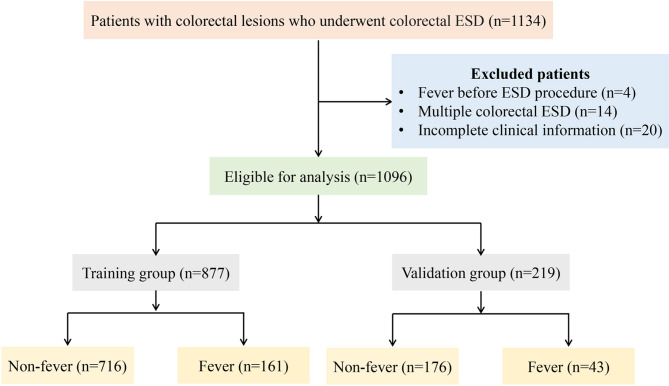
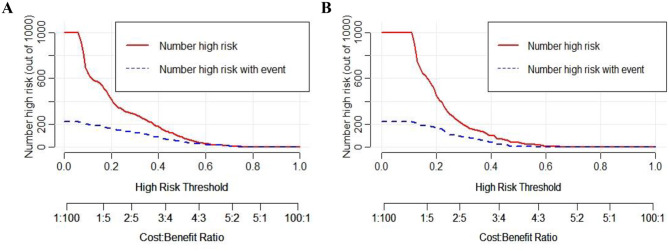
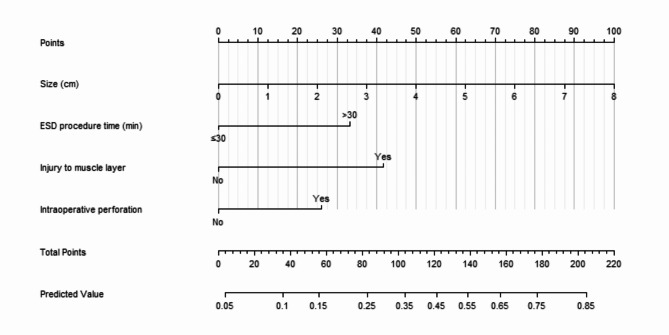
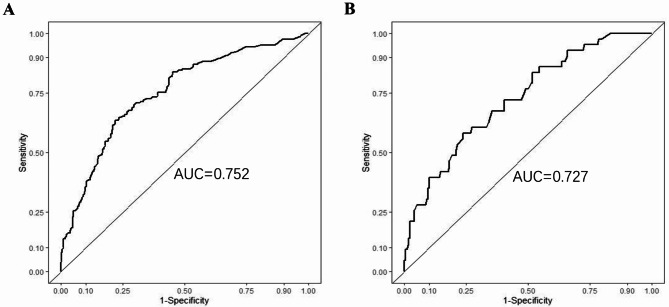
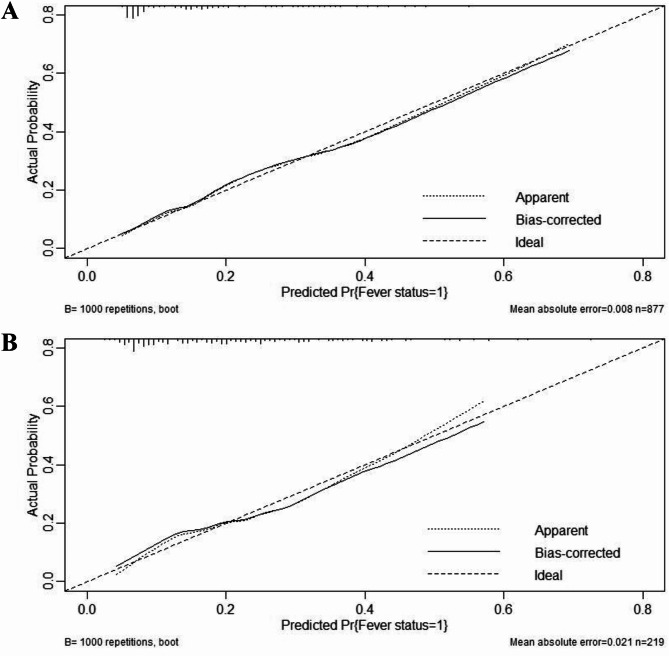
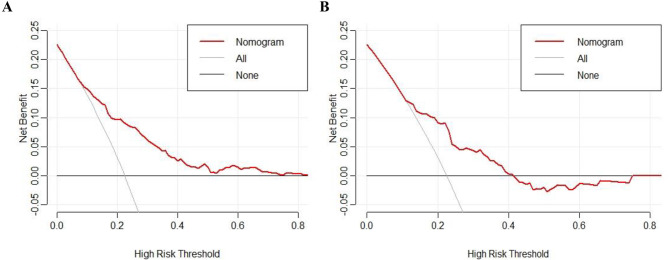
Fever is a complication after colorectal endoscopic submucosal dissection (ESD). The objective of this study was to explore the incidence and risk factors of fever after colorectal ESD and establish a predictive nomogram model. This retrospective analysis encompassed patients with colorectal lesions who underwent ESD between June 2008 and December 2021 in our center. Multivariate analyses were performed to identify the independent risk factors of fever after colorectal ESD based on univariate analysis, and derived predictive nomogram model was constructed. The performance of nomogram model was evaluated through the receiver operating characteristic curve, calibration curve, decision curve analysis (DCA) and clinical impact curve (CIC). Among the 1096 enrolled patients with colorectal lesions, fever after colorectal ESD occurred in 204 (18.6%) patients. Multivariate logistic regression revealed that tumor size (P < 0.001), ESD procedure time > 30 min (P < 0.001), injury to muscle layer (P < 0.001) and intraoperative perforation (P = 0.046) were estimated to be independent risk factors of fever after colorectal ESD. A predictive nomogram model, incorporating these four predictors, were established and performed well in both training and validation groups. Both DCA and CIC showed this nomogram model had a good potential for clinical practicability.
发热是结直肠内镜黏膜下剥离术(ESD)后的一种并发症。本研究的目的是探讨结直肠ESD后发热的发生率和危险因素,并建立一个预测列线图模型。这项回顾性分析纳入了2008年6月至2021年12月在本中心接受ESD的结直肠病变患者。基于单因素分析进行多因素分析,以确定结直肠ESD后发热的独立危险因素,并构建推导的预测列线图模型。通过受试者工作特征曲线、校准曲线、决策曲线分析(DCA)和临床影响曲线(CIC)对列线图模型的性能进行评估。在1096例纳入的结直肠病变患者中,204例(18.6%)患者发生了结直肠ESD后发热。多因素逻辑回归显示,肿瘤大小(P<0.001)、ESD手术时间>30分钟(P<0.001)、肌层损伤(P<0.001)和术中穿孔(P = 0.046)被估计为结直肠ESD后发热的独立危险因素。建立了一个包含这四个预测因素的预测列线图模型,该模型在训练组和验证组中均表现良好。DCA和CIC均显示该列线图模型具有良好的临床实用性潜力。