Kumari Poonam, Kumar Amarjeet, Sinha Chandni, Kumar Ajeet
Department of Anaesthesia, AIIMS, Patna, Bihar, India.
J Anaesthesiol Clin Pharmacol. 2024 Oct-Dec;40(4):641-644. doi: 10.4103/joacp.joacp_140_23. Epub 2024 Jul 19.
Both operating table height and patient level in relation to the anesthesiologist influence supraglottic airway device (SAD) insertion and task performance in terms of physical and mental workload. The aim of the study was to find out the appropriate table height during SAD insertion in terms of time taken for insertion, success rate, ease of insertion, and anesthesiologist comfort.
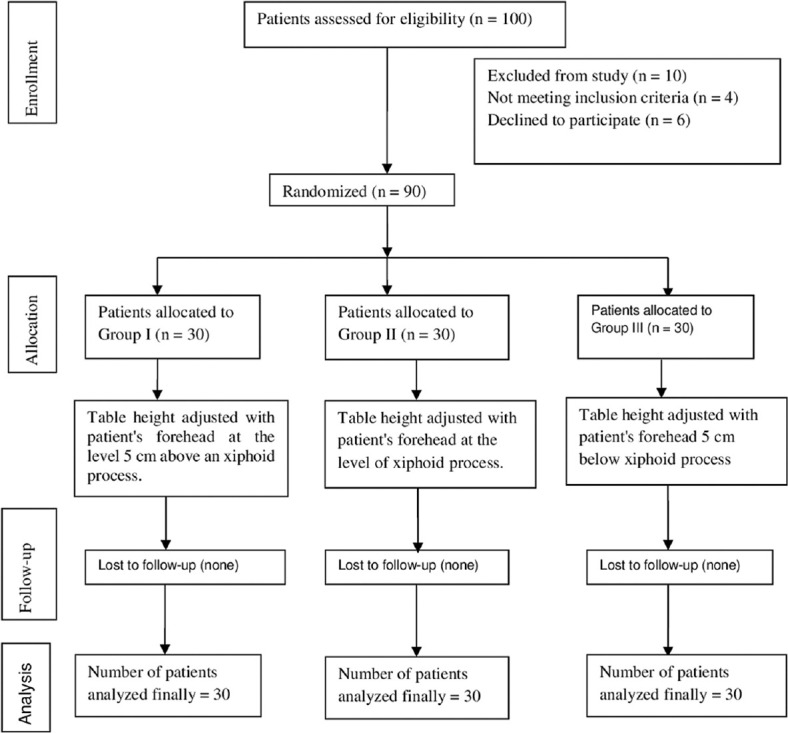
In this randomized controlled trial, 90 American Society of Anesthesiologists physical status I and II patients, aged between 18 and 60 years, scheduled for elective surgery were recruited. Patients were divided into three groups of 30 each. During SAD insertion, the table height was adjusted so that the patient's forehead was at the level of 5 cm above the xiphoid process in group I, at the level of the xiphoid process in group II, and at the level of 5 cm below the xiphoid process in group III of the anesthesiologist. We measured SAD insertion time, first attempt success rate, ease of insertion, and anesthesiologist comfort during the procedure.
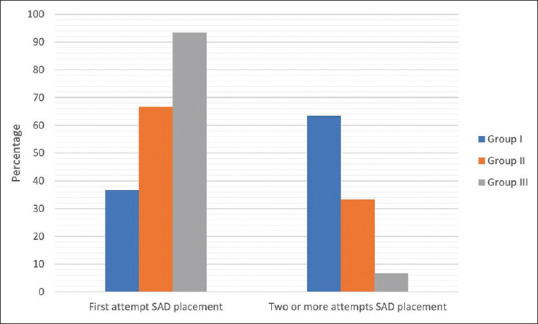
The SAD insertion time (in seconds) was lower in group III than in groups I and II, and a significant difference was found between the groups ( < 0.05). The mean ease of insertion score, anesthesiologist comfort, and the first-attempt success rate of SAD insertion were higher in group III than in groups I and II, and the difference among the groups was statistically significant ( < 0.05).
We conclude that the lower table height with the patient's forehead at the level of 5 cm below the xiphoid process of the anesthesiologist is ergonomically more efficient during SAD (I-gel) insertion. This table height is also more comfortable for the anesthesiologist during SAD placement.
手术台高度以及患者相对于麻醉医生的位置,都会影响声门上气道装置(SAD)的插入操作以及在体力和脑力负荷方面的任务表现。本研究的目的是,从插入所需时间、成功率、插入难易程度以及麻醉医生的舒适度方面,找出在插入SAD时合适的手术台高度。
在这项随机对照试验中,招募了90例年龄在18至60岁之间、计划进行择期手术的美国麻醉医师协会身体状况I级和II级患者。患者被分为三组,每组30人。在插入SAD期间,调整手术台高度,使得在第一组中患者的额头位于麻醉医生剑突水平上方5厘米处,在第二组中位于剑突水平,在第三组中位于剑突水平下方5厘米处。我们在操作过程中测量了SAD插入时间、首次尝试成功率、插入难易程度以及麻醉医生的舒适度。
第三组的SAD插入时间(以秒计)低于第一组和第二组,且组间差异有统计学意义(<0.05)。第三组SAD插入的平均插入难易程度评分、麻醉医生舒适度以及首次尝试成功率均高于第一组和第二组,组间差异具有统计学意义(<0.05)。
我们得出结论,在插入SAD(I-gel)时,将手术台高度降低,使患者额头位于麻醉医生剑突水平下方5厘米处,在人体工程学上效率更高。在放置SAD期间,这个手术台高度对麻醉医生来说也更舒适。