Nishigori Tatsuto, Kumamaru Hiraku, Obama Kazutaka, Suda Koichi, Tsunoda Shigeru, Yoda Yukie, Hikage Makoto, Shibasaki Susumu, Tanaka Tsuyoshi, Terashima Masanori, Kakeji Yoshihiro, Inomata Masafumi, Kitagawa Yuko, Miyata Hiroaki, Sakai Yoshiharu, Noshiro Hirokazu, Uyama Ichiro
The Japan Society for Endoscopic Surgery Tokyo Japan.
Department of Surgery, Graduate School of Medicine Kyoto University Kyoto Japan.
Ann Gastroenterol Surg. 2024 Aug 29;9(1):109-118. doi: 10.1002/ags3.12854. eCollection 2025 Jan.
The advantages of robot-assisted minimally invasive esophagectomy (RA-MIE) over conventional minimally invasive esophagectomy (C-MIE) are unknown. This nationwide large-scale study aimed to compare surgical outcomes between RA-MIE and C-MIE using rigorous propensity score methods, including detailed covariates and relevant outcomes.
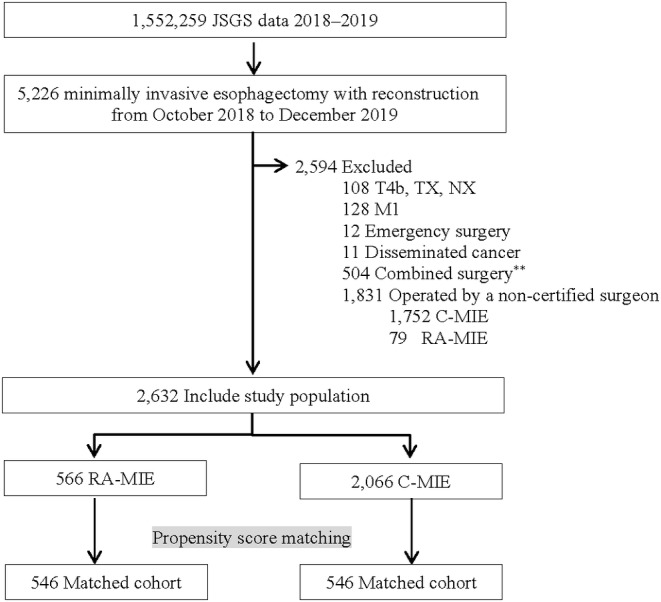
This Japanese nationwide retrospective cohort study included RA-MIE or C-MIE for esophageal malignant tumors performed between October 2018 and December 2019 and registered in the Japanese National Clinical Database. The primary outcome measure was postoperative complications classified as Clavien-Dindo Grade IIIa or higher. Propensity score matching was performed to create a balanced covariate distribution between the two groups.
After propensity score matching, 1092 patients were selected. The RA-MIE group had a significantly longer operation time and greater blood loss than the C-MIE group (565 vs. 477 min and 120 vs. 90 mL). Furthermore, the R0 resection rate was lower in the RA-MIE group than in the C-MIE group (95.1% vs. 97.8%). The RA-MIE and C-MIE groups had no differences regarding overall complications ≥ Grade IIIa (22.0% vs. 20.3%, = 0.52), 30-day mortality rates (0.4% vs. 0.5%), and operative mortality rates (0.7% vs. 0.7%). Deep SSI was less frequent (2.7% vs. 6.0%) and pulmonary embolism was more frequent (2.4% vs. 0.5%) in the RA-MIE group than in the C-MIE group.
In the initial phase of implementation, RA-MIE and C-MIE demonstrated comparable morbidity rates when performed by skilled board-certified endoscopic surgeons.
机器人辅助微创食管切除术(RA-MIE)相较于传统微创食管切除术(C-MIE)的优势尚不清楚。这项全国性大规模研究旨在使用严格的倾向评分方法,包括详细的协变量和相关结局,比较RA-MIE和C-MIE的手术结果。
这项日本全国性回顾性队列研究纳入了2018年10月至2019年12月期间在日本国家临床数据库中登记的因食管恶性肿瘤接受RA-MIE或C-MIE手术的患者。主要结局指标为分类为Clavien-Dindo IIIa级或更高等级的术后并发症。进行倾向评分匹配以在两组之间创建平衡的协变量分布。
倾向评分匹配后,选择了1092例患者。RA-MIE组的手术时间明显长于C-MIE组,失血量也更多(565分钟对477分钟,120毫升对90毫升)。此外,RA-MIE组的R0切除率低于C-MIE组(95.1%对97.8%)。RA-MIE组和C-MIE组在总体≥IIIa级并发症(22.0%对20.3%,P = 0.52)、30天死亡率(0.4%对0.5%)和手术死亡率(0.7%对0.7%)方面没有差异。RA-MIE组的深部手术部位感染发生率低于C-MIE组(2.7%对6.0%),而肺栓塞发生率高于C-MIE组(2.4%对0.5%)。
在实施的初始阶段,由经验丰富的获得委员会认证的内镜外科医生进行RA-MIE和C-MIE时,二者的发病率具有可比性。