Mwaheb Mai Ali, El-Aziz Basant Mohamed Abd, Abd-Elhalim Basma T, El-Kassim Nabil Abo, Radwan Tharwat E E
Department of Botany, Faculty of Science, Fayoum University, Fayoum, 63511, Egypt.
Department of Agricultural Microbiology, Faculty of Agriculture, Ain Shams University, Hadayek Shoubra, P.O. Box 68, Cairo, 11241, Egypt.
Microb Ecol. 2025 Jan 6;87(1):165. doi: 10.1007/s00248-024-02474-0.
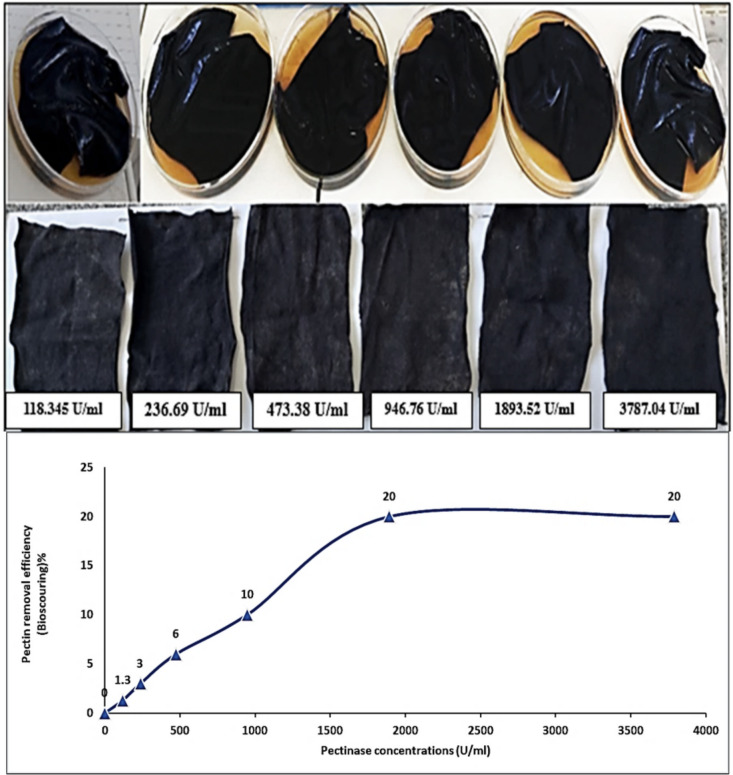
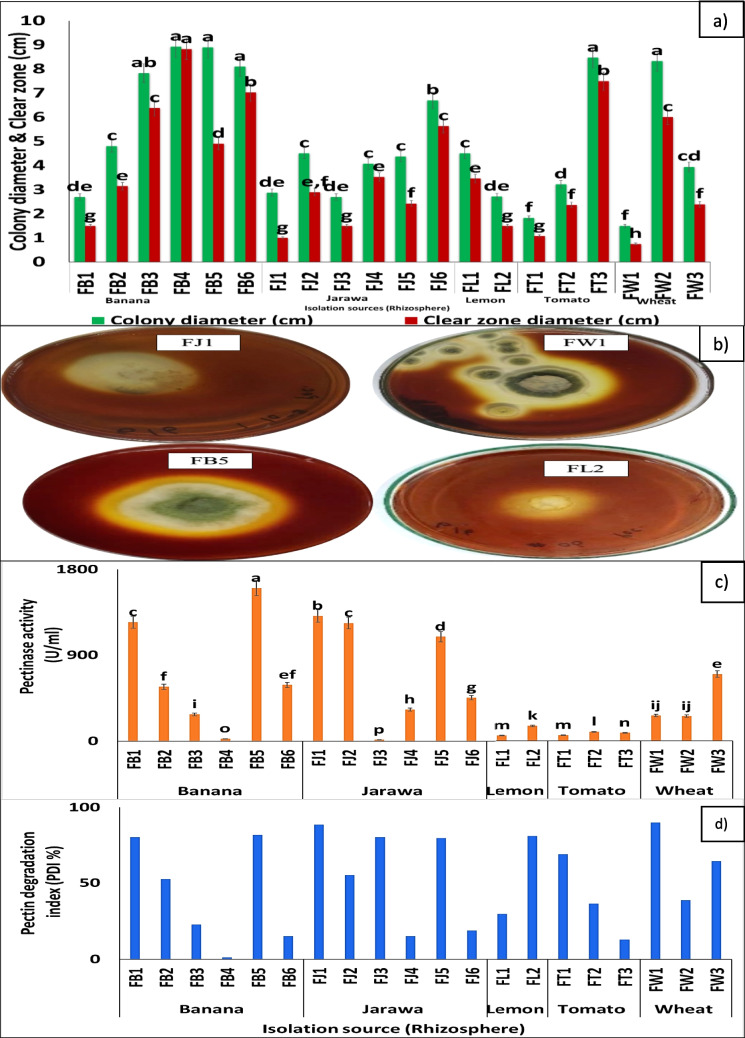
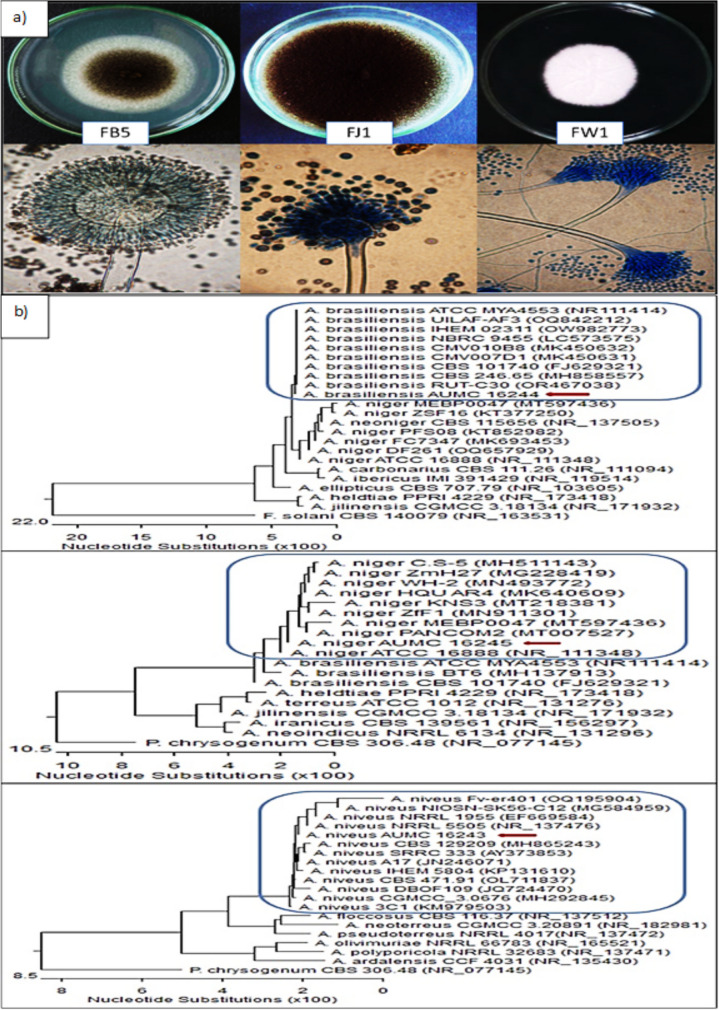
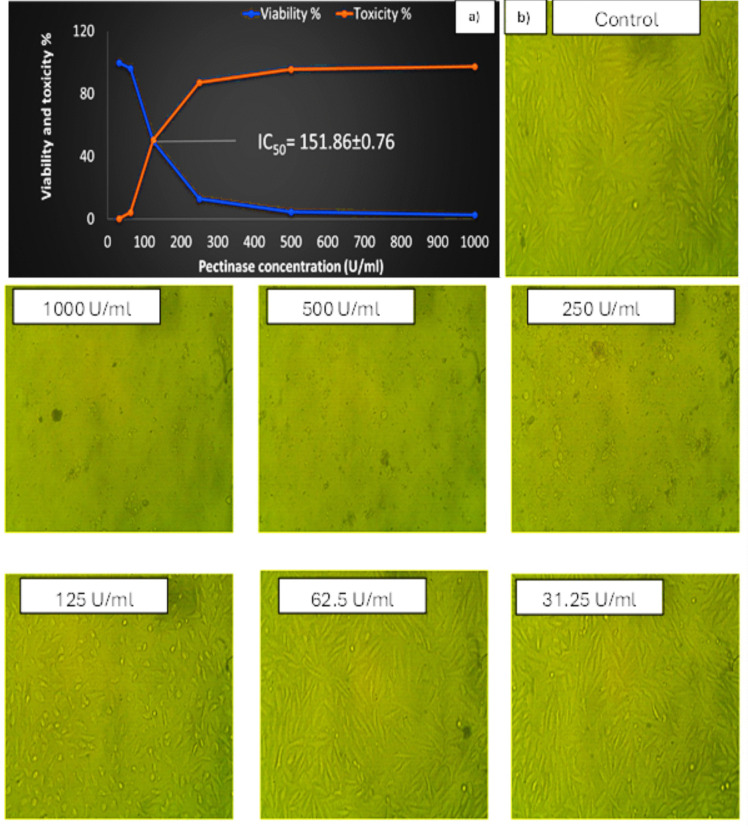
Microorganisms are preferred as an enzyme source due to their short lifespan, high production rate, affordability, and absence of harmful chemicals in enzymes generated from plant and animal sources. Fungi communities are biological factories for many bioactive compounds such as the important industrial enzyme pectinase. The current study dealt with production, optimization, purification, biocompatibility, and application of fungal pectinase obtained from five plant rhizospheres (banana, jarawa, lemon, tomato, and wheat) at Fayoum Governorate, Egypt. The highest pectinase degrading index (PDI) was scored for FB5, FJ2, and FW1 isolates. Pectinase production was also examined quantitively and the highest output of 1603.67, 1311.22, and 1264.83 U/ml was gained by FB5, FJ1, and FW1 fungal isolates, respectively. The most active pectinase-producing fungi were identified as Aspergillus niveus strain AUMC1624, A. niger strain AUMC16245, and A. brasiliensis strain AUMC16244, respectively. For pectinase production optimization, one factor at a time (OFAT) protocol was applied and revealed that A. niger, A. niveus, and A. brasiliensis reached maximum pectinase levels at 1% pectin after 5, 7, and 7 days, at 40, 45, and 45 °C, respectively. Obtained pectinases were partially purified using ammonium sulfate precipitation (ASP) and organic solvent precipitation (OSP) methods. The highest activity using the ASP method scored at 40-60% saturation with A. niger. The thermostability characterization of A. niger pectinase was reached with relative activities of 61.7, 69.0, 99.9, 91.3, and 90.6% at temperatures ranging between 30 and 70 °C. pH optimized at pH 5-7. The enzyme's molecular weight was approximately 30 kDa. The GC-mass analysis of pectinase end products included acetic acid ethyl ester, hexadecane carbonsaure methylase, and hexadecenoic acid. The biocompatibility was examined using a human skin cell line (HFb-4) for the first time, with a minimal half concentration (IC) of 151.86 ± 0.76 U/ml. The biocompatible pectinase was applied as a clothes bioscouring agent with different concentrations of 1893.52 U/ml achieving the highest bioscouring with 20.0%.
由于微生物寿命短、生产速度快、成本低,且其产生的酶中不含植物和动物来源酶中的有害化学物质,因此微生物是首选的酶源。真菌群落是许多生物活性化合物的生物工厂,比如重要的工业酶果胶酶。本研究涉及从埃及法尤姆省的五个植物根际(香蕉、贾拉瓦、柠檬、番茄和小麦)获得的真菌果胶酶的生产、优化、纯化、生物相容性及应用。FB5、FJ2和FW1分离株的果胶酶降解指数(PDI)得分最高。还对果胶酶产量进行了定量检测,FB5、FJ1和FW1真菌分离株分别获得了最高产量1603.67、1311.22和1264.83 U/ml。最活跃的产果胶酶真菌分别被鉴定为构巢曲霉AUMC1624菌株、黑曲霉AUMC16245菌株和巴西曲霉AUMC16244菌株。为了优化果胶酶生产,采用了一次一个因素(OFAT)方案,结果表明黑曲霉、构巢曲霉和巴西曲霉分别在5、7和7天后,于40、45和45℃下,在1%果胶时达到最高果胶酶水平。使用硫酸铵沉淀(ASP)和有机溶剂沉淀(OSP)方法对获得的果胶酶进行了部分纯化。使用ASP方法时,黑曲霉在40 - 60%饱和度下活性最高。黑曲霉果胶酶的热稳定性特征在30至70℃温度范围内,相对活性分别为61.7%、69.0%、99.9%、91.3%和90.6%。pH在pH 5 - 7时优化。该酶的分子量约为30 kDa。果胶酶终产物的气相色谱 - 质谱分析包括乙酸乙酯、十六烷碳酸甲酯和十六碳烯酸。首次使用人皮肤细胞系(HFb - 4)检测了生物相容性,最低半数浓度(IC)为151.86 ± 0.76 U/ml。将具有生物相容性的果胶酶作为衣物生物精练剂应用,不同浓度中1893.52 U/ml实现了20.0%的最高生物精练效果。