Molecular Allergology, Federal Institute for Vaccines and Biomedicines, Paul-Ehrlich-Institut, Langen, Germany.
Laboratory of Food and Biomolecular Science, Graduate School of Agricultural Science, Tohoku University, Sendai, Japan.
Curr Allergy Asthma Rep. 2021 Sep 10;21(10):43. doi: 10.1007/s11882-021-01020-z.
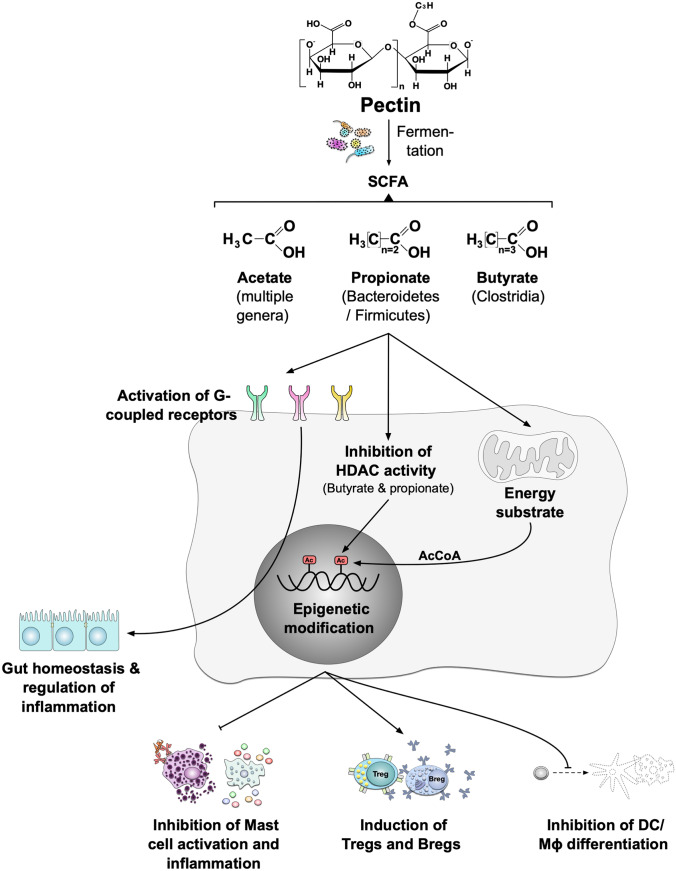
The incidence of allergies is increasing and has been associated with several environmental factors including westernized diets. Changes in environment and nutrition can result in dysbiosis of the skin, gut, and lung microbiota altering the production of microbial metabolites, which may in turn generate epigenetic modifications. The present review addresses studies on pectin-mediated effects on allergies, including the immune modulating mechanisms by bacterial metabolites.
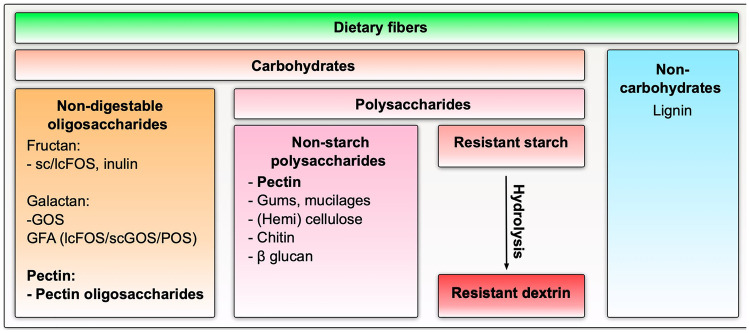
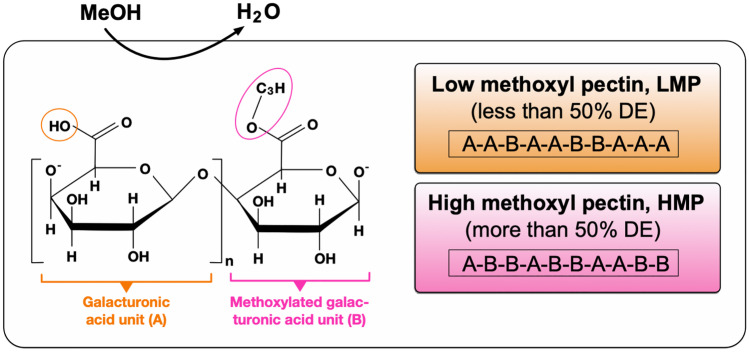
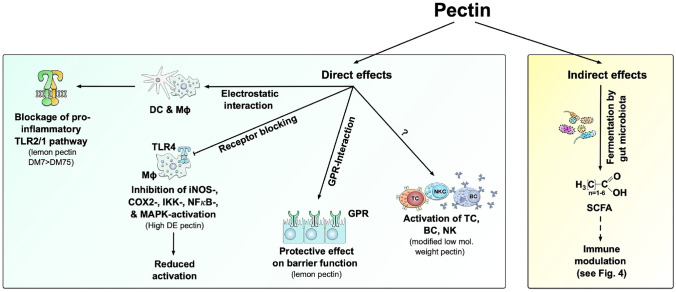
Recently, microbiota have gained attention as target for allergy intervention, especially with prebiotics, that are able to stimulate the growth and activity of certain microorganisms. Dietary fibers, which cannot be digested in the gastrointestinal tract, can alter the gut microbiota and lead to increased local and systemic concentrations of gut microbiota-derived short chain fatty acids (SCFAs). These can promote the generation of peripheral regulatory T cells (T) by epigenetic modulation and suppress the inflammatory function of dendritic cells (DCs) by transcriptional modulation. The dietary fiber pectin (a plant-derived polysaccharide commonly used as gelling agent and dietary supplement) can alter the ratio of Firmicutes to Bacteroidetes in gut and lung microbiota, increasing the concentrations of SCFAs in feces and sera, and reducing the development of airway inflammation by suppressing DC function. Pectin has shown immunomodulatory effects on allergies, although the underlying mechanisms still need to be elucidated. It has been suggested that the different types of pectin may exert direct and/or indirect immunomodulatory effects through different mechanisms. However, little is known about the relation of certain pectin structures to allergies.
过敏的发病率正在上升,并与包括西式饮食在内的多种环境因素有关。环境和营养的变化会导致皮肤、肠道和肺部微生物群落的失调,改变微生物代谢产物的产生,这可能反过来又会产生表观遗传修饰。本综述探讨了果胶介导的过敏作用的研究,包括细菌代谢物的免疫调节机制。
最近,微生物群作为过敏干预的靶点受到了关注,特别是使用益生元,它能够刺激某些微生物的生长和活性。膳食纤维不能在胃肠道中消化,它可以改变肠道微生物群,并导致肠道微生物群衍生的短链脂肪酸(SCFA)的局部和全身浓度增加。这些可以通过表观遗传调节促进外周调节性 T 细胞(T 细胞)的产生,并通过转录调节抑制树突状细胞(DC)的炎症功能。膳食纤维果胶(一种常用作胶凝剂和膳食补充剂的植物来源多糖)可以改变肠道和肺部微生物群中厚壁菌门和拟杆菌门的比例,增加粪便和血清中 SCFA 的浓度,并通过抑制 DC 功能来减少气道炎症的发展。果胶对过敏具有免疫调节作用,但潜在机制仍需阐明。有人提出,不同类型的果胶可能通过不同的机制发挥直接和/或间接的免疫调节作用。然而,对于某些果胶结构与过敏的关系知之甚少。