Taylor Kyla W, Eftim Sorina E, Sibrizzi Christopher A, Blain Robyn B, Magnuson Kristen, Hartman Pamela A, Rooney Andrew A, Bucher John R
Division of Translational Toxicology, National Institute of Environmental Health Sciences, National Institutes of Health, Research Triangle Park, North Carolina.
ICF, Reston, Virginia.
JAMA Pediatr. 2025 Mar 1;179(3):282-292. doi: 10.1001/jamapediatrics.2024.5542.
Previous meta-analyses suggest that fluoride exposure is adversely associated with children's IQ scores. An individual's total fluoride exposure comes primarily from fluoride in drinking water, food, and beverages.
To perform a systematic review and meta-analysis of epidemiological studies investigating children's IQ scores and prenatal or postnatal fluoride exposure.
BIOSIS, Embase, PsycInfo, PubMed, Scopus, Web of Science, CNKI, and Wanfang, searched through October 2023.
Studies reporting children's IQ scores, fluoride exposure, and effect sizes.
Data were extracted into the Health Assessment Workplace Collaborative system. Study quality was evaluated using the OHAT risk-of-bias tool. Pooled standardized mean differences (SMDs) and regression coefficients were estimated with random-effects models.
Children's IQ scores.
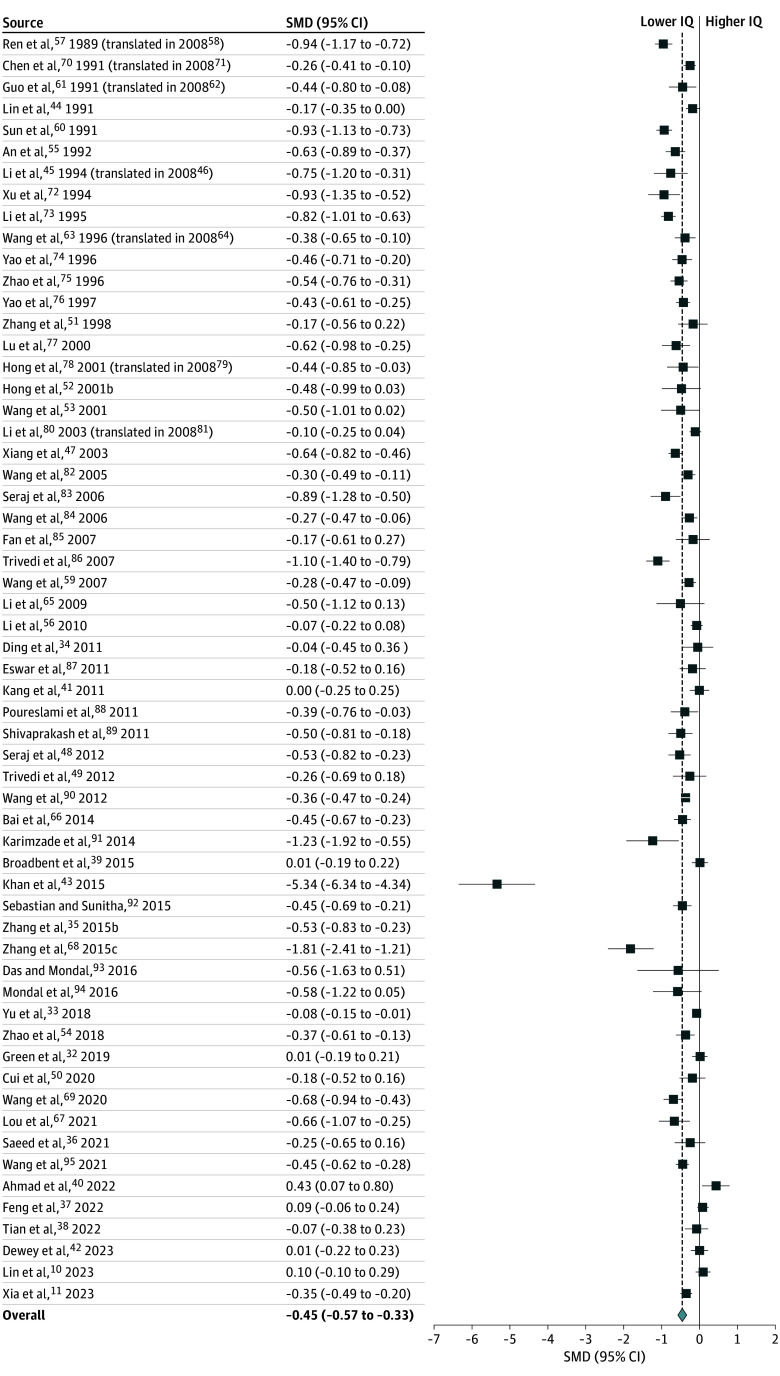
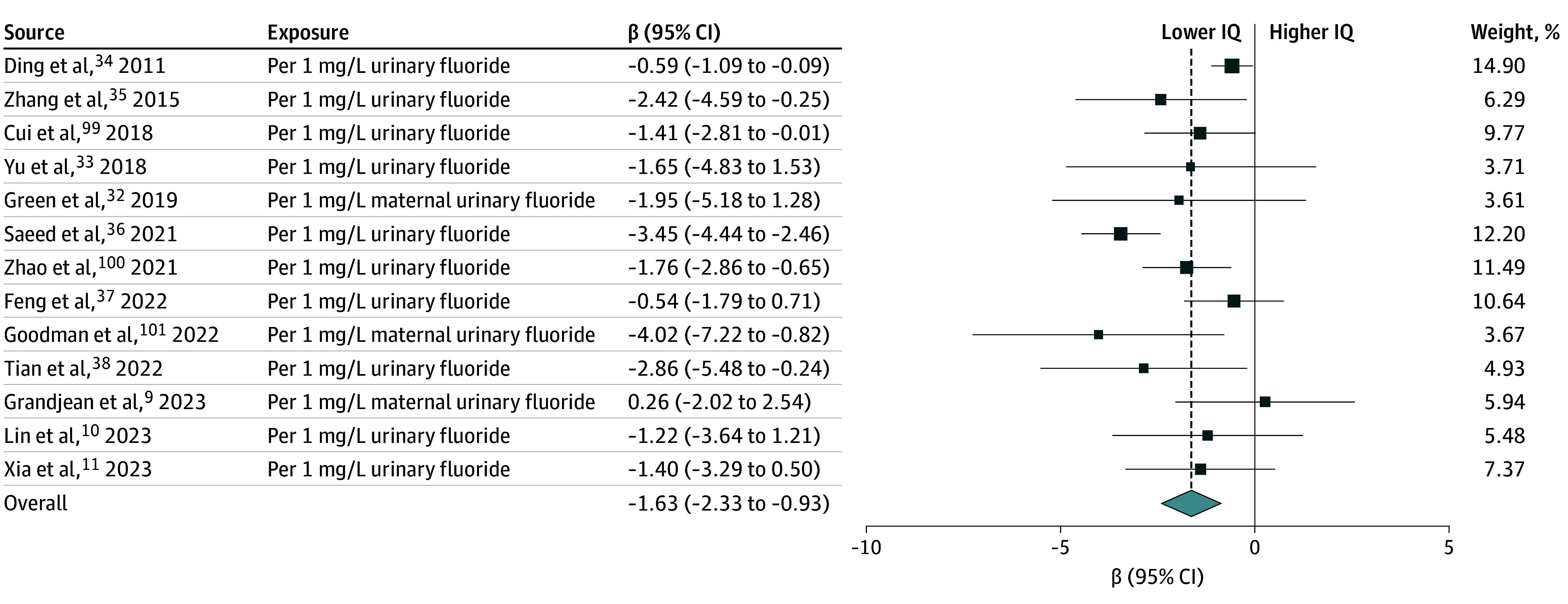
Of 74 studies included (64 cross-sectional and 10 cohort studies), most were conducted in China (n = 45); other locations included Canada (n = 3), Denmark (n = 1), India (n = 12), Iran (n = 4), Mexico (n = 4), New Zealand (n = 1), Pakistan (n = 2), Spain (n = 1), and Taiwan (n = 1). Fifty-two studies were rated high risk of bias and 22 were rated low risk of bias. Sixty-four studies reported inverse associations between fluoride exposure measures and children's IQ. Analysis of 59 studies with group-level measures of fluoride in drinking water, dental fluorosis, or other measures of fluoride exposure (47 high risk of bias, 12 low risk of bias; n = 20 932 children) showed an inverse association between fluoride exposure and IQ (pooled SMD, -0.45; 95% CI, -0.57 to -0.33; P < .001). In 31 studies reporting fluoride measured in drinking water, a dose-response association was found between exposed and reference groups (SMD, -0.15; 95% CI, -0.20 to -0.11; P < .001), and associations remained inverse when exposed groups were restricted to less than 4 mg/L and less than 2 mg/L; however, the association was null at less than 1.5 mg/L. In analyses restricted to low risk-of-bias studies, the association remained inverse when exposure was restricted to less than 4 mg/L, less than 2 mg/L, and less than 1.5 mg/L fluoride in drinking water. In 20 studies reporting fluoride measured in urine, there was an inverse dose-response association (SMD, -0.15; 95% CI, -0.23 to -0.07; P < .001). Associations remained inverse when exposed groups were restricted to less than 4 mg/L, less than 2 mg/L, and less than 1.5 mg/L fluoride in urine; the associations held in analyses restricted to the low risk-of-bias studies. Analysis of 13 studies with individual-level measures found an IQ score decrease of 1.63 points (95% CI, -2.33 to -0.93; P < .001) per 1-mg/L increase in urinary fluoride. Among low risk-of-bias studies, there was an IQ score decrease of 1.14 points (95% CI, -1.68 to -0.61; P < .001). Associations remained inverse when stratified by risk of bias, sex, age, outcome assessment type, country, exposure timing, and exposure matrix.
This systematic review and meta-analysis found inverse associations and a dose-response association between fluoride measurements in urine and drinking water and children's IQ across the large multicountry epidemiological literature. There were limited data and uncertainty in the dose-response association between fluoride exposure and children's IQ when fluoride exposure was estimated by drinking water alone at concentrations less than 1.5 mg/L. These findings may inform future comprehensive public health risk-benefit assessments of fluoride exposures.
以往的荟萃分析表明,氟暴露与儿童智商得分呈负相关。个体的总氟暴露主要来自饮用水、食物和饮料中的氟。
对调查儿童智商得分与产前或产后氟暴露的流行病学研究进行系统评价和荟萃分析。
截至2023年10月检索了BIOSIS、Embase、PsycInfo、PubMed、Scopus、Web of Science、中国知网和万方数据库。
报告儿童智商得分、氟暴露及效应量的研究。
将数据提取到健康评估工作场所协作系统中。使用OHAT偏倚风险工具评估研究质量。采用随机效应模型估计合并标准化均数差(SMD)和回归系数。
儿童智商得分。
纳入的74项研究中(64项横断面研究和10项队列研究),大多数在中国进行(n = 45);其他地点包括加拿大(n = 3)、丹麦(n = 1)、印度(n = 12)、伊朗(n = 4)、墨西哥(n = 4)、新西兰(n = 1)、巴基斯坦(n = 2)、西班牙(n = 1)和台湾(n = 1)。52项研究被评为高偏倚风险,22项被评为低偏倚风险。64项研究报告了氟暴露测量与儿童智商之间的负相关。对59项采用饮用水中氟的群体水平测量、氟斑牙或其他氟暴露测量的研究进行分析(47项高偏倚风险,12项低偏倚风险;n = 20932名儿童),结果显示氟暴露与智商呈负相关(合并SMD,-0.45;95%CI,-0.57至-0.33;P <.001)。在31项报告饮用水中氟测量值的研究中,暴露组与参照组之间发现了剂量反应关系(SMD,-0.15;95%CI,-0.20至-0.11;P <.001),当暴露组限制在低于4mg/L和低于2mg/L时,这种关系仍然为负相关;然而,在低于1.5mg/L时这种关系不成立。在仅限于低偏倚风险研究的分析中,当饮用水中氟暴露限制在低于4mg/L、低于2mg/L和低于1.5mg/L时,这种关系仍然为负相关。在20项报告尿氟测量值的研究中,存在负剂量反应关系(SMD,-0.15;95%CI,-0.23至-0.07;P <.001)。当尿氟暴露组限制在低于4mg/L、低于2mg/L和低于1.5mg/L时,这种关系仍然为负相关;在仅限于低偏倚风险研究的分析中这种关系成立。对13项采用个体水平测量的研究进行分析发现,尿氟每升高1mg/L,智商得分降低1.63分(95%CI,-2.33至-0.93;P <.001)。在低偏倚风险研究中,智商得分降低1.14分(95%CI,-1.68至-0.61;P <.001)。按偏倚风险、性别、年龄、结局评估类型、国家、暴露时间和暴露矩阵分层时,这种关系仍然为负相关。
这项系统评价和荟萃分析发现,在大量多国流行病学文献中,尿氟和饮用水氟测量值与儿童智商之间存在负相关和剂量反应关系。当仅通过饮用水估计氟暴露且浓度低于1.5mg/L时,氟暴露与儿童智商之间的剂量反应关系数据有限且存在不确定性。这些发现可能为未来氟暴露的综合公共卫生风险效益评估提供参考。