Wang Yu, Fan Jian, Meng Xianbin, Shu Qingyao, Wu Yincui, Chu Guo-Chao, Ji Rong, Ye Yinshan, Wu Xiangwei, Shi Jing, Deng Haiteng, Liu Lei, Li Yi-Ming
School of Food and Biological Engineering, Engineering Research Center of Bio-process, Ministry of Education, Key Laboratory of Animal Source of Anhui Province, Hefei University of Technology, Hefei, 230009, China.
Department of Chemistry, Hefei National Laboratory of Physical Science at Microscale, University of Science and Technology of China, Hefei, 230026, China.
Nat Commun. 2025 Jan 6;16(1):415. doi: 10.1038/s41467-024-55046-8.
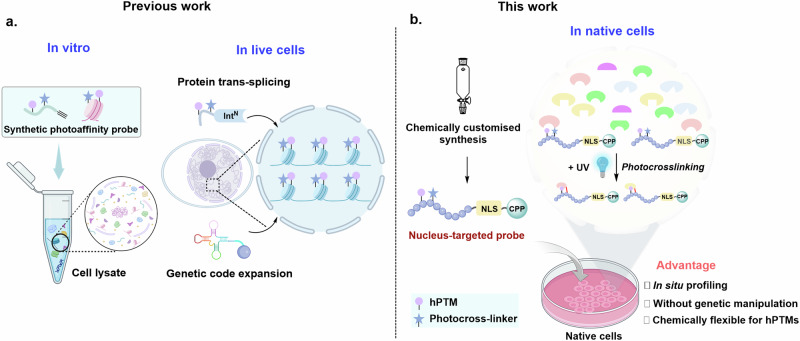
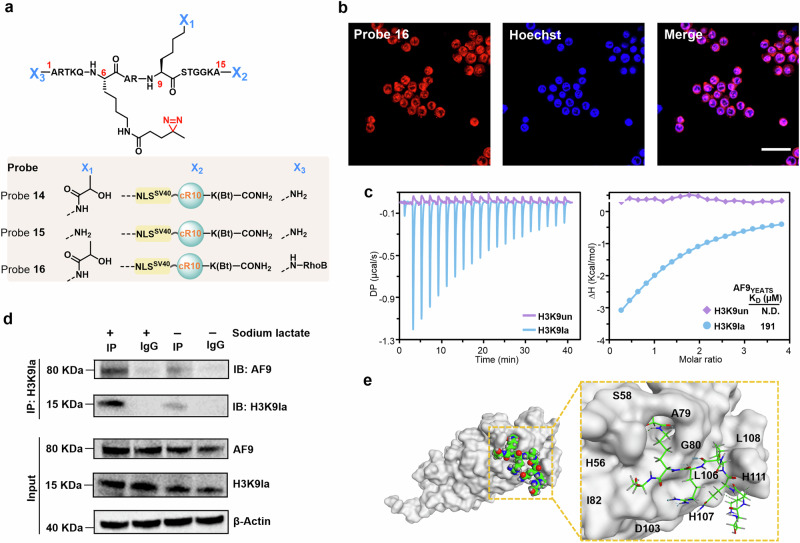
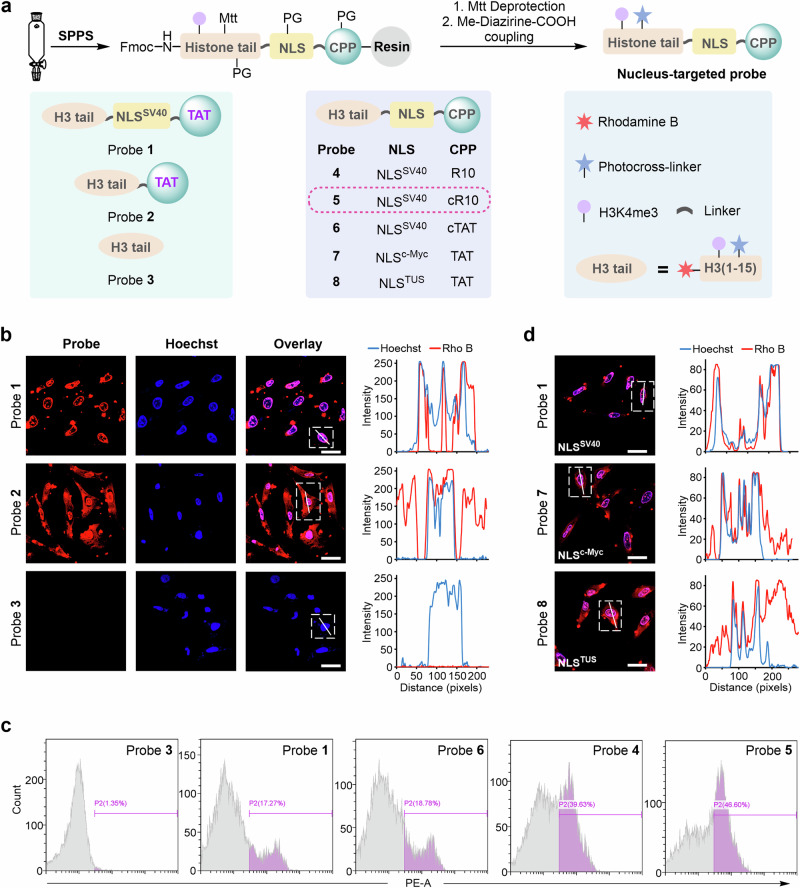
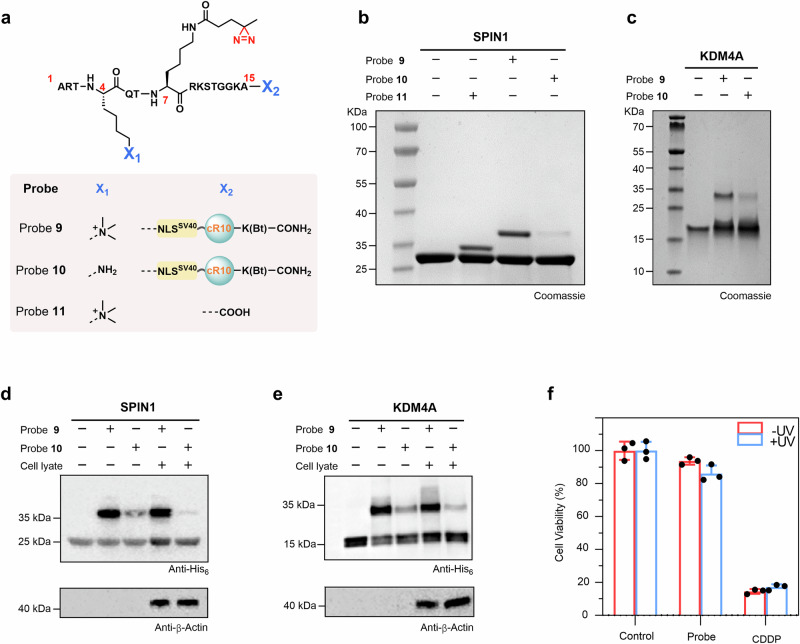
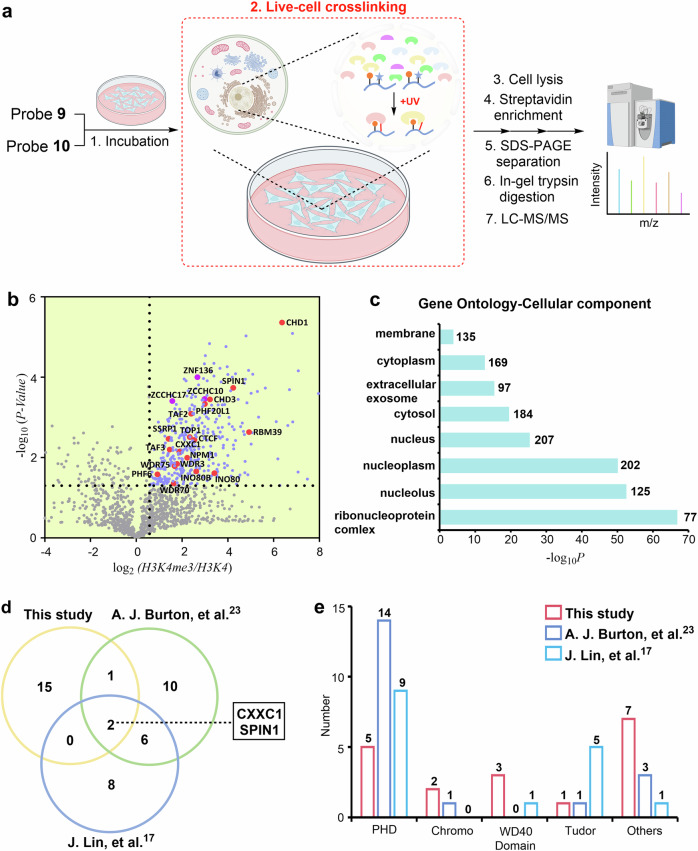
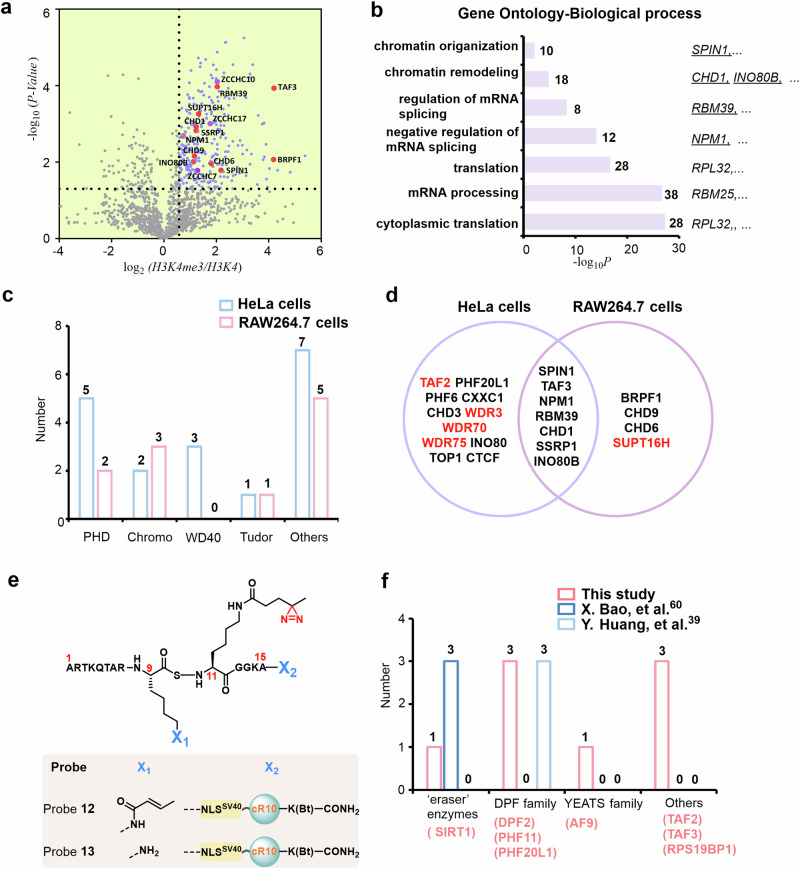
Dissection of the physiological interactomes of histone post-translational modifications (hPTMs) is crucial for understanding epigenetic regulatory pathways. Peptide- or protein-based histone photoaffinity tools expanded the ability to probe the epigenetic interactome, but in situ profiling in native cells remains challenging. Here, we develop a nucleus-targeting histone-tail-based photoaffinity probe capable of profiling the hPTM-mediated interactomes in native cells, by integrating cell-permeable and nuclear localization peptide modules into an hPTM peptide equipped with a photoreactive moiety. These types of probes, such as histone H3 lysine 4 trimethylation and histone H3 Lysine 9 crotonylation probes, enable the probing of epigenetic interactomes both in HeLa cell and hard-to-transfect RAW264.7 cells, resulting in the discovery of distinct interactors in different cell lines. The utility of this probe is further exemplified by characterizing interactome of emerging hPTM, such as AF9 was detected as a binder of histone H3 Lysine 9 lactylation, thus expanding the toolbox for profiling of hPTM-mediated PPIs in live cells.
剖析组蛋白翻译后修饰(hPTM)的生理相互作用组对于理解表观遗传调控途径至关重要。基于肽或蛋白质的组蛋白光亲和工具扩展了探测表观遗传相互作用组的能力,但在天然细胞中进行原位分析仍然具有挑战性。在这里,我们通过将细胞可渗透和核定位肽模块整合到配备光反应性部分的hPTM肽中,开发了一种能够在天然细胞中分析hPTM介导的相互作用组的核靶向组蛋白尾基光亲和探针。这些类型的探针,如组蛋白H3赖氨酸4三甲基化和组蛋白H3赖氨酸9巴豆酰化探针,能够在HeLa细胞和难以转染的RAW264.7细胞中探测表观遗传相互作用组,从而在不同细胞系中发现不同的相互作用因子。通过表征新兴hPTM的相互作用组,进一步证明了该探针的实用性,例如检测到AF9是组蛋白H3赖氨酸9乳酰化的结合蛋白,从而扩展了用于在活细胞中分析hPTM介导的蛋白质-蛋白质相互作用的工具箱。