Espinosa Oscar, Bejarano Valeria, Franky Isabella, Pagali Sandeep, Drummond Michael, Franco Oscar H
Economic Models and Quantitative Methods Research Group, Centro de Investigaciones para el Desarrollo, Universidad Nacional de Colombia, Bogotá, D.C., Colombia.
Division of Hospital Medicine & Section of Geriatrics, Department of Medicine, Mayo Clinic, Rochester, USA.
Sci Rep. 2025 Jan 6;15(1):918. doi: 10.1038/s41598-024-84150-4.
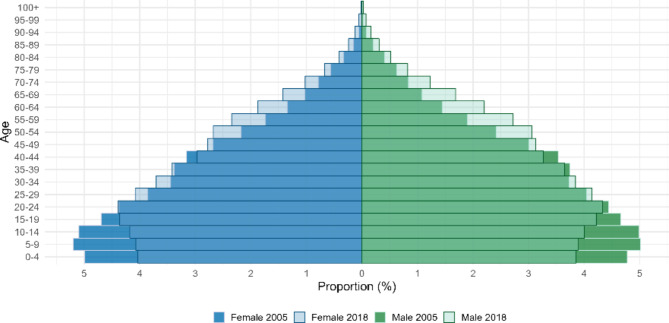
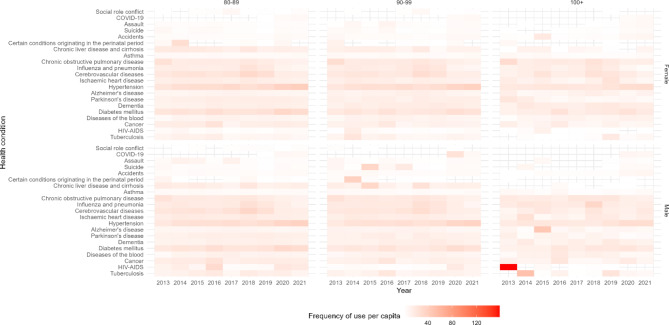
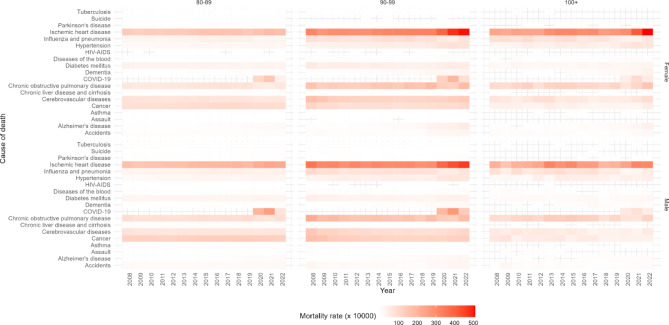
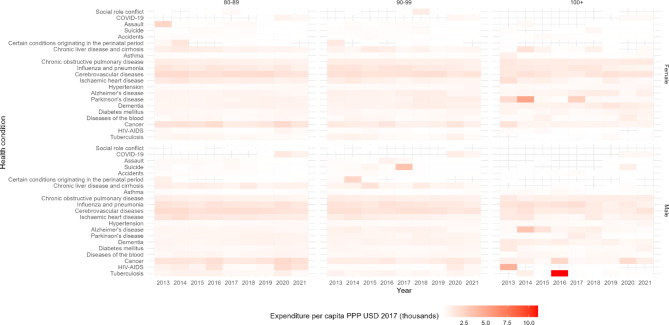
This document determines the causes of mortality (2008-2022) and calculate per capita health expenditure (2013-2021) in octogenarians, nonagenarians and centenarians in the Colombian population, considering year, gender and age group. For this nationwide retrospective descriptive observational study, epidemiological regions, urban/rural areas and morbidities were also studied. A mean of 75,552 deaths was observed from 2008 to 2022. Deaths were higher due to ischemic heart disease, COVID-19, chronic obstructive pulmonary disease, cancer, and cerebrovascular diseases in the oldest old Colombian population with urban areas having higher mortality rates than rural areas (an average of 948 (min: 847, max: 1207) against 630 (min: 558, max: 789) per 10,000 people, respectively). Conditions of cerebrovascular diseases, cancer, influenza pneumonia and chronic obstructive pulmonary disease were the most expensive in health care, summing above 5000 purchasing power parity USD on average (min: 2234, max: 7539). These conditions, along with hypertension and diabetes mellitus, were the most frequently recorded. COVID-19 incurred higher health expenditure in rural areas compared to urban areas (1090 vs. 519 purchasing power parity USD respectively). High prevalence (14·3%) and medical attention (16·8 health care utilisations per capita) were shown for organic mental disorders. Our analysis found that centenarians survived COVID-19 more than octogenarians and nonagenarians, with several hypotheses attributing this to their immune profiles. We found high expenditure on HIV/AIDS among older males suggesting the need for further study on sexually transmitted diseases prevention in this population. Lastly, Alzheimer's disease, particularly in rural areas, had substantial expenditure. Therefore, neurodegenerative diseases and the impact of stressful events on mental health must be priorities for the health system to ensure adequate resource management.
本文件确定了哥伦比亚人口中八旬老人、九旬老人和百岁老人的死亡原因(2008 - 2022年),并计算了人均医疗支出(2013 - 2021年),同时考虑了年份、性别和年龄组。对于这项全国性回顾性描述性观察研究,还研究了流行病学区域、城乡地区和发病率。2008年至2022年期间平均观察到75,552例死亡。在哥伦比亚最年长的人群中,缺血性心脏病、COVID - 19、慢性阻塞性肺疾病、癌症和脑血管疾病导致的死亡人数较多,城市地区的死亡率高于农村地区(每10,000人分别平均为948例(最小值:847,最大值:1207)和630例(最小值:558,最大值:789))。脑血管疾病、癌症、流感肺炎和慢性阻塞性肺疾病的医疗保健费用最高,平均总计超过5000购买力平价美元(最小值:2234,最大值:7539)。这些疾病以及高血压和糖尿病是记录最频繁的疾病。与城市地区相比,COVID - 19在农村地区产生的医疗支出更高(分别为1090和519购买力平价美元)。器质性精神障碍的患病率较高(14.3%),人均医疗关注度为(16.8次医疗保健利用)。我们的分析发现,百岁老人比八旬老人和九旬老人更能在COVID - 19中存活下来,有几种假设将此归因于他们的免疫特征。我们发现老年男性中艾滋病毒/艾滋病的支出较高,这表明需要对该人群的性传播疾病预防进行进一步研究。最后,阿尔茨海默病,特别是在农村地区,支出巨大。因此,神经退行性疾病以及压力事件对心理健康的影响必须成为卫生系统的优先事项,以确保进行充分的资源管理。