Kaczorowska Antonina, Kozieł Sławomir, Ignasiak Zofia
Institute of Health Sciences, University of Opole, ul. Katowicka 68, Opole, 45-060, Poland.
Department of Anthropology, Hirszfeld Institute of Immunology and Experimental Therapy, Polish Academy of Sciences, Wrocław, Poland.
Sci Rep. 2025 Jan 6;15(1):882. doi: 10.1038/s41598-024-84923-x.
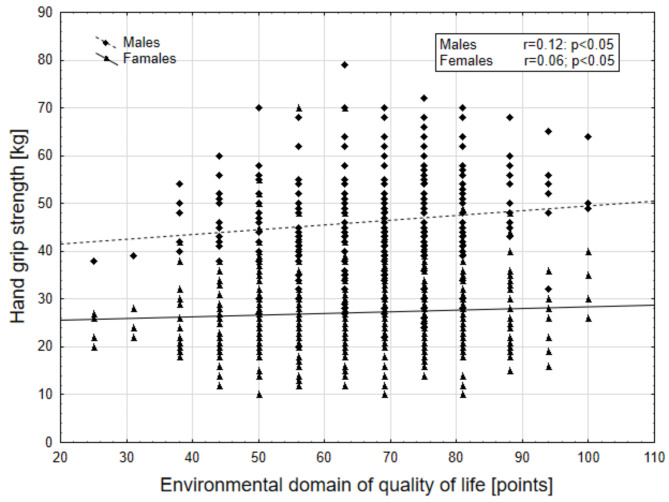
With advancing age, progressive loss of muscle strength, as assessed by hand grip strength, may result in a poorer health-related quality of life. The aim of this study is to determine the associations of hand grip strength with quality of life among people aged 50-90 years from South West Poland. The study group comprised 1 446 people, including 351 men and 1 095 women, aged between 50 and 90 years. The WHOQoL-BREF questionnaire was used to assess quality of life. Hand grip strength of the dominant hand was measured. The general assessment of quality of life shows a significant relationship with hand grip strength. Two domains of quality of life: social and environmental also significantly differentiate hand grip strength. As the number of points in given domains increases, the hand grip strength increases. Among men, the relationship between the environmental domain and hand grip strength is significantly stronger compared to women. Hand grip strength is related to the quality of life among older adults, especially in the social and environmental domains. The results of our study suggest that measures need to be taken to improve the strength of skeletal muscles in adults, which might improve their quality of life.
随着年龄的增长,通过握力评估的肌肉力量逐渐丧失,可能会导致与健康相关的生活质量下降。本研究的目的是确定波兰西南部50至90岁人群中握力与生活质量之间的关联。研究组包括1446人,其中351名男性和1095名女性,年龄在50至90岁之间。使用世界卫生组织生活质量简表(WHOQoL-BREF)问卷来评估生活质量。测量优势手的握力。生活质量的总体评估显示与握力有显著关系。生活质量的两个领域:社会和环境领域也显著区分握力。随着给定领域得分的增加,握力增强。在男性中,环境领域与握力之间的关系比女性显著更强。握力与老年人的生活质量相关,尤其是在社会和环境领域。我们的研究结果表明,需要采取措施提高成年人的骨骼肌力量,这可能会改善他们的生活质量。