Moore Kelvin, Tourneau Noelle Le, Alvarez Jasmin, Rodriguez Santos, Broussard Janessa, Crouch Pierre-Cédric, Roman Jorge, Defechereux Patricia, Bena Jason, Koester Kimberly A, Moran Lissa, Pilcher Christopher, Grant Robert, Christopoulos Katerina A
University of California, San Francisco, San Francisco, CA, USA.
San Francisco AIDS Foundation, San Francisco, CA, USA.
BMC Infect Dis. 2025 Jan 6;25(1):26. doi: 10.1186/s12879-024-10384-2.
Point-of-care HIV viral load testing may enhance patient care and improve HIV health services. We aimed to evaluate the feasibility and acceptability of implementing such testing in a high-volume community sexual health clinic in the United States.
We conducted a cross-sectional, mixed-methods study. Remnant venipuncture specimens from clients undergoing HIV and other sexual health screenings were analyzed using the Xpert HIV-1 Viral Load assay. Results were compared to COBAS AmpliPrep/COBAS TaqMan HIV-1 Test. Clinical staff observations, study meeting notes, and two semi-structured in-depth interviews with clinical staff were used to understand perspectives on incorporating this testing into clinical practice.
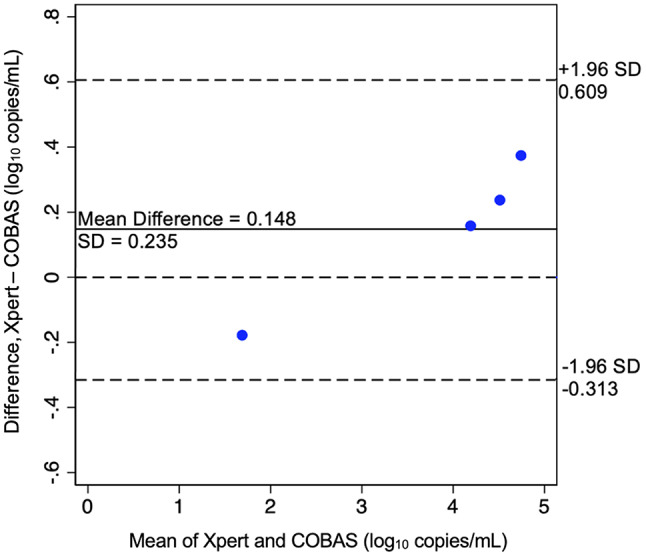
We analyzed 113 samples from 111 clients. The Xpert assay showed excellent agreement with COBAS, with no clinically significant difference in viral load measurements. Clinical staff found Xpert testing acceptable, based on its ability to provide rapid, accurate test results and potential for bridging patient care gaps. Respondents noted that this testing would be particularly beneficial for individuals in whom barriers to care engagement may complicate follow-up. Challenges in implementation included machine errors as well as concerns related to staff workload, testing logistics, and the need for comprehensive equipment training.
This study represents the first effort in the United States to describe the feasibility of HIV viral load point-of-care testing in routine care. While the Xpert demonstrated comparable results to standard-of-care testing and staff found it acceptable, further work is needed to develop the workflow and implementation strategies that would enable real-time use and improved patient care.
Not applicable.
即时检测艾滋病毒载量可能会改善患者护理并提升艾滋病毒健康服务水平。我们旨在评估在美国一家大规模社区性健康诊所开展此类检测的可行性和可接受性。
我们开展了一项横断面混合方法研究。使用Xpert HIV-1病毒载量检测法对接受艾滋病毒及其他性健康筛查的患者剩余静脉穿刺样本进行分析。将结果与COBAS AmpliPrep/COBAS TaqMan HIV-1检测法进行比较。通过临床工作人员观察、研究会议记录以及对临床工作人员进行的两次半结构化深度访谈,来了解将该检测纳入临床实践的相关观点。
我们分析了来自111名患者的113份样本。Xpert检测法与COBAS检测法结果高度一致,病毒载量测量结果无临床显著差异。临床工作人员认为Xpert检测法可接受,因为它能够提供快速、准确的检测结果,并且有潜力弥补患者护理方面的差距。受访者指出,这种检测对于那些护理参与存在障碍可能使后续跟进变得复杂的个体尤为有益。实施过程中的挑战包括机器故障以及与工作人员工作量、检测后勤保障和全面设备培训需求相关的问题。
本研究是美国首次描述在常规护理中进行艾滋病毒载量即时检测可行性的努力。虽然Xpert检测法的结果与标准护理检测相当,且工作人员认为其可接受,但仍需进一步开展工作,以制定能够实现实时使用并改善患者护理的工作流程和实施策略。
不适用。