Touron Edelweiss, de Flores Robin, Coulbault Laurent, Palix Cassandre, Chocat Anne, Kuhn Elizabeth, Landeau Brigitte, Mézenge Florence, Roquet Daniel, Chauveau Léa, Haudry Sacha, Vivien Denis, de La Sayette Vincent, Marchant Natalie L, Chételat Gaël, Poisnel Géraldine
Normandie Univ, UNICAEN, INSERM, U1237, PhIND "Physiopathology and Imaging of Neurological Disorders", NeuroPresage Team, Institut Blood and Brain @ Caen-Normandie, GIP Cyceron, Bd Henri Becquerel, BP 5229, Caen, 14074, France.
Service de Biochimie, CHU de Caen-Normandie, Avenue de la Côte de Nacre CS 30001, Caen, 14033, France.
Alzheimers Res Ther. 2025 Jan 6;17(1):9. doi: 10.1186/s13195-024-01643-0.
Subclinical depressive symptoms increase the risk of developing Alzheimer's disease (AD). The neurobiological mechanisms underlying this link may involve stress system dysfunction, notably related to the hippocampus which is particularly sensitive to AD. We aimed to investigate the links between blood stress markers and changes in brain regions involved in the stress response in older adults with or without subclinical depressive symptoms.
This cross-sectional study was conducted using baseline data from the Age-Well trial. Cognitively unimpaired (CU) older adults with (DepS; n = 73) or without (NoDepS; n = 58) subclinical depressive symptoms (defined using the 15-item Geriatric Depression Scale) were included in the analyses. Blood cortisol, epinephrine and norepinephrine were measured; as well as the resting-state functional connectivity (rs-FC) between, and gray matter (GM) volume of, the hypothalamus, hippocampus and hippocampal subfields. Blood stress markers levels and neuroimaging measures were compared between groups; then regression analyses were conducted between these measures.
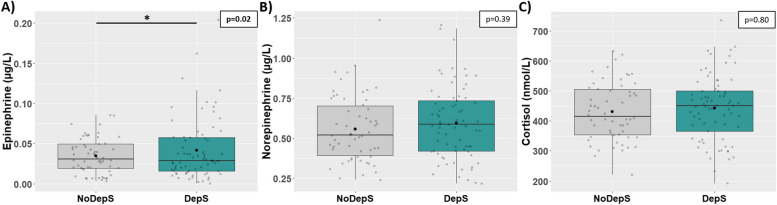
DepS participants showed higher plasma epinephrine levels, which was associated with greater rs-FC between the CA1 and Subiculum hippocampal subfields and the hypothalamus. Lower GM volume in the CA1 and DG/CA2-3-4 subfields was also found in DepS. No between-group differences were observed for blood cortisol and norepinephrine.
Our findings show that subclinical depressive symptoms are associated with increased sympatho-adrenomedullary axis activity, together with lower GM volume in a hippocampal subfield (i.e., CA1) particularly sensitive to AD. While causation cannot be inferred, these results suggest that screening and treating subclinical depressive symptoms in CU older adults could reduce AD risk.
ClinicalTrials.gov Identifier: NCT02977819, Registration Date: 2016-11-25.
亚临床抑郁症状会增加患阿尔茨海默病(AD)的风险。这种关联背后的神经生物学机制可能涉及应激系统功能障碍,特别是与对AD特别敏感的海马体有关。我们旨在研究有或无亚临床抑郁症状的老年人血液应激标志物与参与应激反应的脑区变化之间的联系。
本横断面研究使用了来自“健康老龄化”试验的基线数据。分析纳入了认知未受损(CU)且有(DepS;n = 73)或无(NoDepS;n = 58)亚临床抑郁症状(使用15项老年抑郁量表定义)的老年人。测量了血液中的皮质醇、肾上腺素和去甲肾上腺素;以及下丘脑、海马体和海马亚区之间的静息态功能连接(rs-FC)和灰质(GM)体积。比较了两组之间的血液应激标志物水平和神经影像学测量结果;然后对这些测量结果进行回归分析。
DepS参与者的血浆肾上腺素水平较高,这与海马亚区CA1和下托与下丘脑之间更强的rs-FC相关。在DepS中还发现CA1以及DG/CA2 - 3 - 4亚区的GM体积较低。两组之间在血液皮质醇和去甲肾上腺素方面未观察到差异。
我们的研究结果表明,亚临床抑郁症状与交感 - 肾上腺髓质轴活动增加以及对AD特别敏感的海马亚区(即CA1)的GM体积降低有关。虽然无法推断因果关系,但这些结果表明,对CU老年人筛查和治疗亚临床抑郁症状可能会降低AD风险。
ClinicalTrials.gov标识符:NCT02977819,注册日期:2016年11月25日。