Chege Mary, Ferretti Pamela, Webb Shasta, Macharia Rosaline W, Obiero George, Kamau Joseph, Alberts Susan C, Tung Jenny, Akinyi Mercy Y, Archie Elizabeth A
One Health Centre, Kenya Institute of Primate Research, Nairobi, Kenya.
Department of Biochemistry, University of Nairobi, Nairobi, Kenya.
bioRxiv. 2024 Dec 17:2024.12.17.628920. doi: 10.1101/2024.12.17.628920.
Animals coexist with complex microbiota, including bacteria, viruses, and eukaryotes (e.g., fungi, protists, and helminths). While the composition of bacterial and viral components of animal microbiota are increasingly well understood, eukaryotic composition remains neglected. Here we characterized eukaryotic diversity in the microbiomes in wild baboons and tested the degree to which eukaryotic community composition was predicted by host social group membership, sex, age, and season of sample collection.
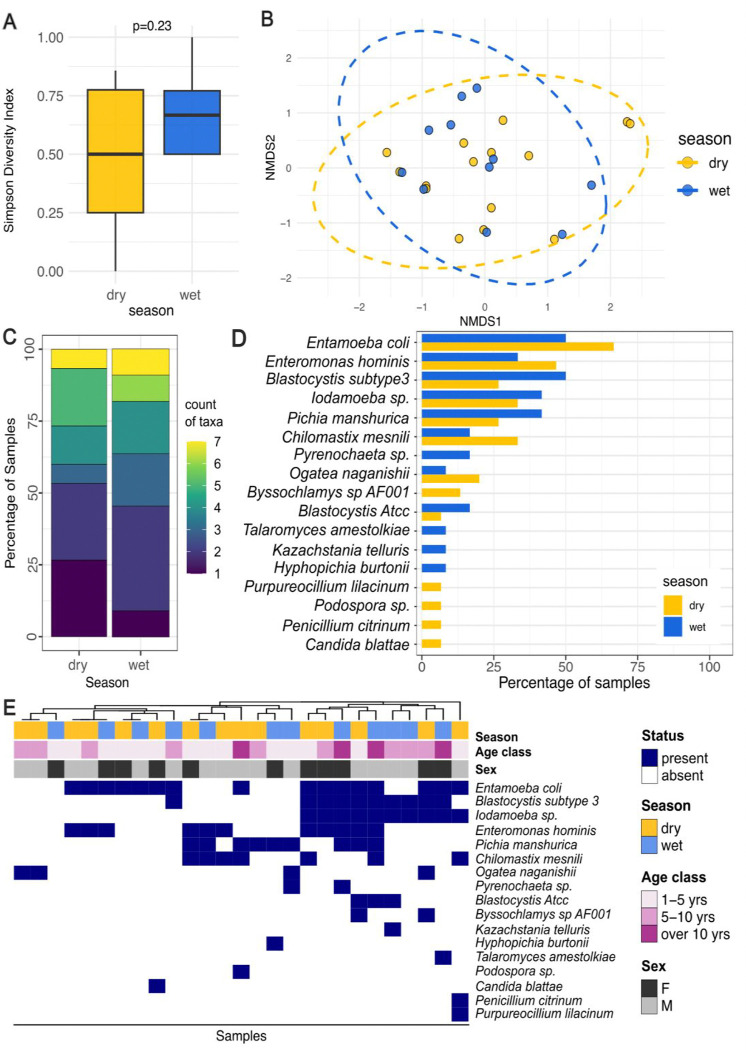
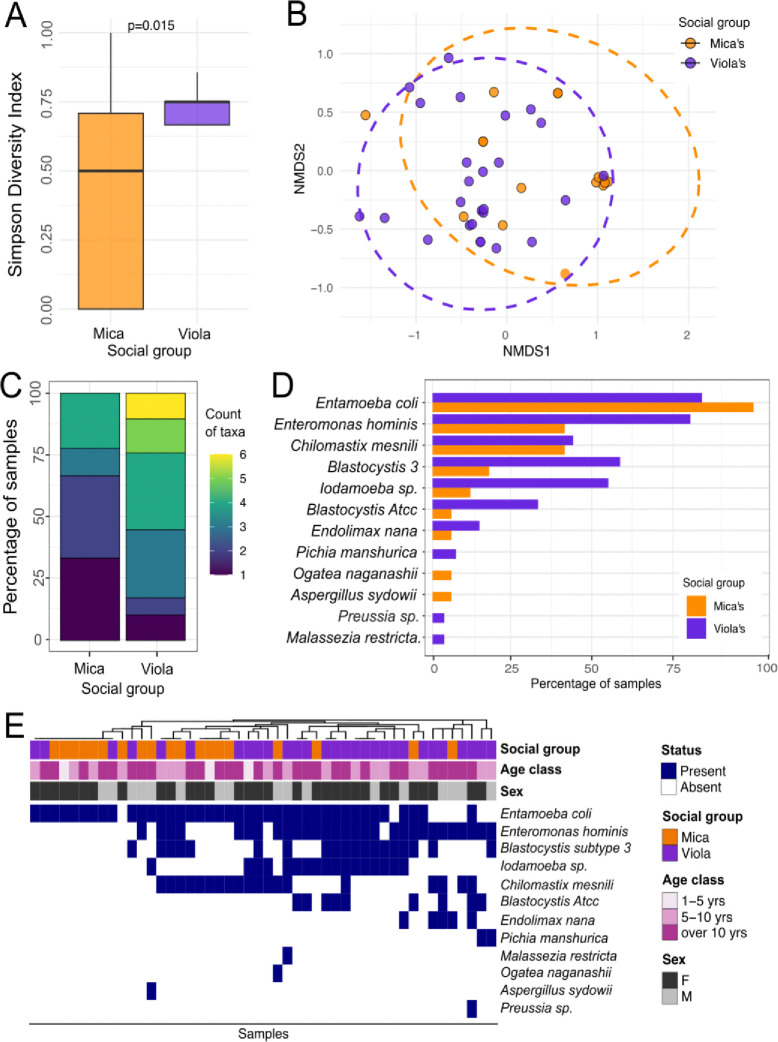
We analyzed a total of 75 fecal samples collected between 2012 and 2014 from 73 wild baboons in the Amboseli ecosystem in Kenya. DNA from these samples was subjected to shotgun metagenomic sequencing, revealing members of the kingdoms Protista, Chromista, and Fungi in 90.7%, 46.7%, and 20.3% of samples, respectively. Social group membership explained 11.2% of the global diversity in gut eukaryotic species composition, but we did not detect statistically significant effect of season, host age, and host sex. Across samples, the most prevalent protists were (74.66% of samples), (53.33% of samples), and 3 (38.66% of samples), while the most prevalent fungi included (14.66% of samples), and (6.66% of samples).
Protista, Chromista, and Fungi are common members of the gut microbiome of wild baboons. More work on eukaryotic members of primate gut microbiota is essential for primate health monitoring and management strategies.
动物与复杂的微生物群共存,包括细菌、病毒和真核生物(如真菌、原生生物和蠕虫)。虽然动物微生物群中细菌和病毒成分的组成越来越为人所知,但真核生物的组成仍然被忽视。在这里,我们对野生狒狒微生物群中的真核生物多样性进行了表征,并测试了宿主社会群体成员身份、性别、年龄和样本采集季节对真核生物群落组成的预测程度。
我们分析了2012年至2014年间从肯尼亚安博塞利生态系统的73只野生狒狒身上采集的总共75份粪便样本。对这些样本的DNA进行鸟枪法宏基因组测序,分别在90.7%、46.7%和20.3%的样本中发现了原生生物界、色藻界和真菌界的成员。社会群体成员身份解释了肠道真核生物物种组成中11.2%的全球多样性,但我们没有检测到季节、宿主年龄和宿主性别的统计学显著影响。在所有样本中,最普遍的原生生物是(74.66%的样本)、(53.33%的样本)和3(38.66%的样本),而最普遍的真菌包括(14.66%的样本)和(6.66%的样本)。
原生生物界、色藻界和真菌界是野生狒狒肠道微生物群的常见成员。对灵长类动物肠道微生物群的真核生物成员进行更多研究对于灵长类动物的健康监测和管理策略至关重要。