Nasasira Benson, Banturaki Grace, Kalema Nelson, Musaazi Joseph, Nanvuma Aidah, Okoboi Stephen, Kiarie Nancy, Moitui Joash Ntenga, Kadengye Damazo, Izudi Jonathan, Castelnuovo Barbara
Infectious Diseases Institute Makerere university of health sciences.
African Population and Health Research Center.
Res Sq. 2024 Dec 17:rs.3.rs-5443965. doi: 10.21203/rs.3.rs-5443965/v1.
Differentiated service delivery (DSD) models in resource-limited settings have reduced strain on health services and improved client experience, retention and viral suppression, but little is known about the impact of HIV DSD models on quality of life (QoL), which is essential for optimizing person-centered care. This study assessed the impact of DSD models on QoL, loss to follow-up (LTFU), and mortality among persons living with HIV (PLHIV) on ART over time at a large urban HIV clinic in Uganda.
We analyzed records of 1,000 PLHIV who had been on ART for 10 years and followed up for eight years, starting in 2014 or 2015 at the Infectious Diseases Institute clinic in Kampala, Uganda. The primary outcome, QoL, was assessed using an adapted Medical Outcomes Study (MOS-HIV) tool. Secondary outcomes included sustained viral suppression (< 200 copies/mL), all-cause mortality, and loss to follow-up or LTFU (missing clinic visits for ≥ 3 months). Outcomes were compared across three DSD models-fast-track drug refill (FTDR), facility-based groups (FBG), and a composite model combining FTDR and FBG against the facility-based individual management (FBIM), the standard of care (SOC). Inverse probability treatment weighting was used to achieve comparability in measured covariates across the DSD models followed by mixed effects modeling. Robustness of results was checked using G-computation analysis.
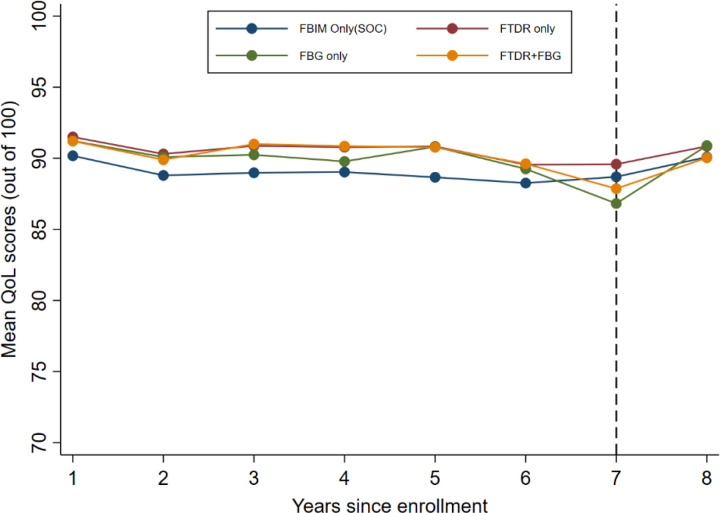
Of 1,000 records for PLHIV, 980 were analyzed. 62% were female and 95% virally suppressed at baseline. After eight years of follow-up, participants on DSD models had higher QoL (90.4% vs 89.1%; weighted mean ratio 3.66, 95% CI 2.10-6.37, p-value < 0.001), better sustained viral suppression, lower mortality, and reduced LTFU rates compared to SOC.
These findings support the broader adoption of DSD models in delivering ART across HIV programs to enhance the QoL and clinical outcomes among PLHIV.
资源有限环境下的差异化服务提供(DSD)模式减轻了卫生服务的压力,改善了客户体验、留存率和病毒抑制效果,但对于HIV DSD模式对生活质量(QoL)的影响知之甚少,而生活质量对于优化以患者为中心的护理至关重要。本研究评估了在乌干达一家大型城市HIV诊所中,DSD模式对接受抗逆转录病毒治疗(ART)的HIV感染者(PLHIV)的生活质量、失访(LTFU)和死亡率随时间的影响。
我们分析了1000名接受ART治疗10年且随访8年的PLHIV的记录,这些记录始于2014年或2015年,来自乌干达坎帕拉传染病研究所诊所。使用经过改编的医学结局研究(MOS-HIV)工具评估主要结局生活质量。次要结局包括持续病毒抑制(<200拷贝/毫升)、全因死亡率以及失访或LTFU(连续3个月及以上未到诊所就诊)。将三种DSD模式——快速药物 refill(FTDR)、基于机构的分组(FBG)以及结合FTDR和FBG的复合模式——与基于机构的个体管理(FBIM)即标准护理(SOC)进行结局比较。使用逆概率治疗加权法使DSD模式间测量的协变量具有可比性,随后进行混合效应建模。使用G计算分析检查结果的稳健性。
在1000份PLHIV记录中,分析了980份。62%为女性,95%在基线时病毒得到抑制。经过8年随访,与SOC相比,采用DSD模式的参与者生活质量更高(90.4%对89.1%;加权平均比3.66,95%CI 2.10 - 6.37,p值<0.001),持续病毒抑制效果更好,死亡率更低,失访率降低。
这些发现支持在HIV项目中更广泛地采用DSD模式来提供ART,以提高PLHIV的生活质量和临床结局。