Sun Jiayi, Cheng Kai, Xie Yanyun
Xiangya Hospital, Central South University, Changsha 410008, China.
Department of Urology, Xiangya Hospital, Central South University, Changsha 410008, China.
Biomolecules. 2024 Nov 30;14(12):1540. doi: 10.3390/biom14121540.
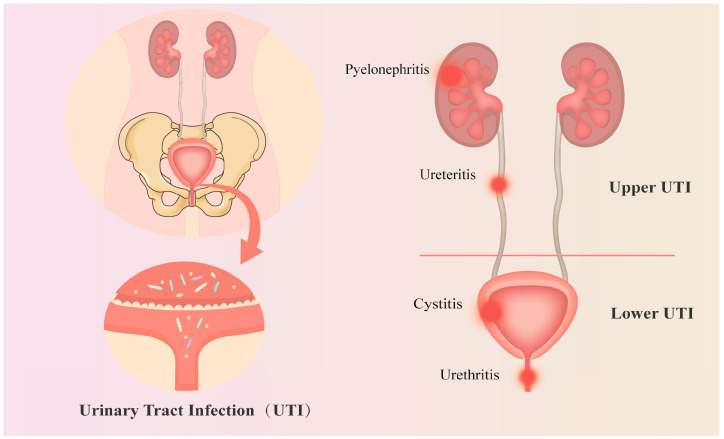
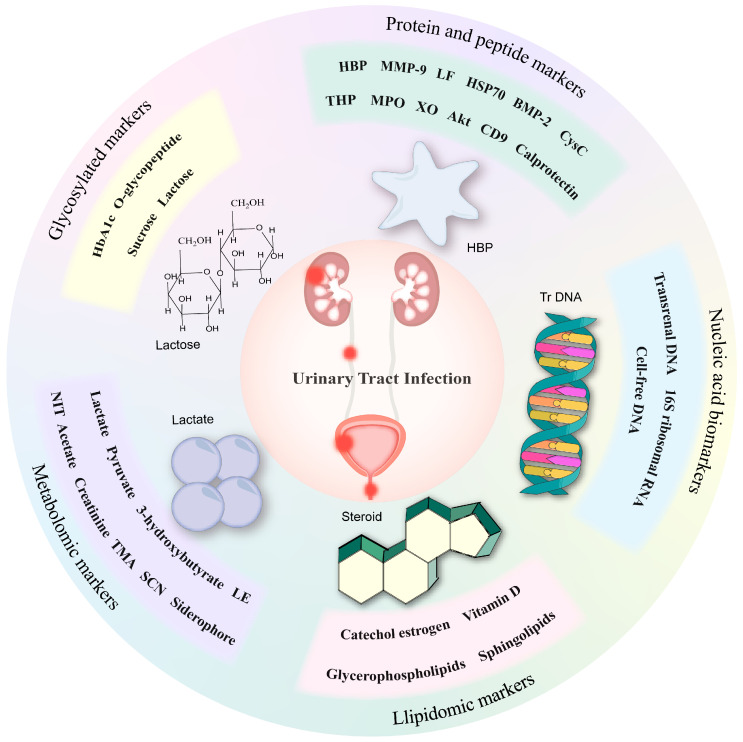
Urinary tract infection (UTI) is the most prevalent kind of pathogenic bacteria infection, and the midstream urine culture is regarded as the gold standard in UTI diagnosis. Recently, even with modern media and techniques such as polymerase chain reaction (PCR), urinary cultures still create a considerable workload for hospital laboratories. Other UTI-detecting methods, such as flow cytometry and lateral flow immunoassay, suffer from various drawbacks like long time consumption and low sensitivity. Therefore, looking for reliable biomarkers in UTI is urgently needed. In this review, the current definitions of UTI can be basically divided into two main categories: uncomplicated UTI and complicated UTI. In light of anatomical sites, it can be classified as either lower UTI or upper UTI. We take the classification of UTI as a clue and review the reported extensive literature to classify the existing studied markers into the following three categories: Biomarkers used clinically; Promising biomarkers; and Controversial biomarkers. Particularly, the nucleic acid-associated, metabolomic, and lipidomic biomarkers are highlighted. At the end, we discuss the challenges and prospects of biomarkers in UTI, hoping to further inspire the diagnosis of UTI.
尿路感染(UTI)是最常见的病原菌感染类型,中段尿培养被视为UTI诊断的金标准。近来,即便有诸如聚合酶链反应(PCR)等现代媒介和技术,尿培养仍给医院实验室带来相当大的工作量。其他UTI检测方法,如流式细胞术和侧向流动免疫测定法,存在诸如耗时久和灵敏度低等各种缺陷。因此,迫切需要寻找UTI的可靠生物标志物。在本综述中,UTI的当前定义基本可分为两大类:单纯性UTI和复杂性UTI。根据解剖部位,可将其分类为下尿路感染或上尿路感染。我们以UTI的分类为线索,回顾已报道的大量文献,将现有的研究标志物分为以下三类:临床使用的生物标志物;有前景的生物标志物;以及有争议的生物标志物。特别强调了与核酸、代谢组学和脂质组学相关的生物标志物。最后,我们讨论了UTI生物标志物面临的挑战和前景,希望能进一步推动UTI的诊断。