Zhang Shiyi, Gao Jiaqi, Lan Xiaozhong, Zhang Linfan, Lian Weipeng, Wang Chenglin, Shen Zhanyun, Li Xiang, Liu Juan
State Key Laboratory for Quality Ensurance and Sustainable Use of Dao-di Herbs, National Resource Center for Chinese Materia Medica, China Academy of Chinese Medical Sciences, Beijing 100700, China.
School of Pharmaceutical Sciences, Zhejiang Chinese Medical University, Hangzhou 310053, China.
Genes (Basel). 2024 Dec 21;15(12):1644. doi: 10.3390/genes15121644.
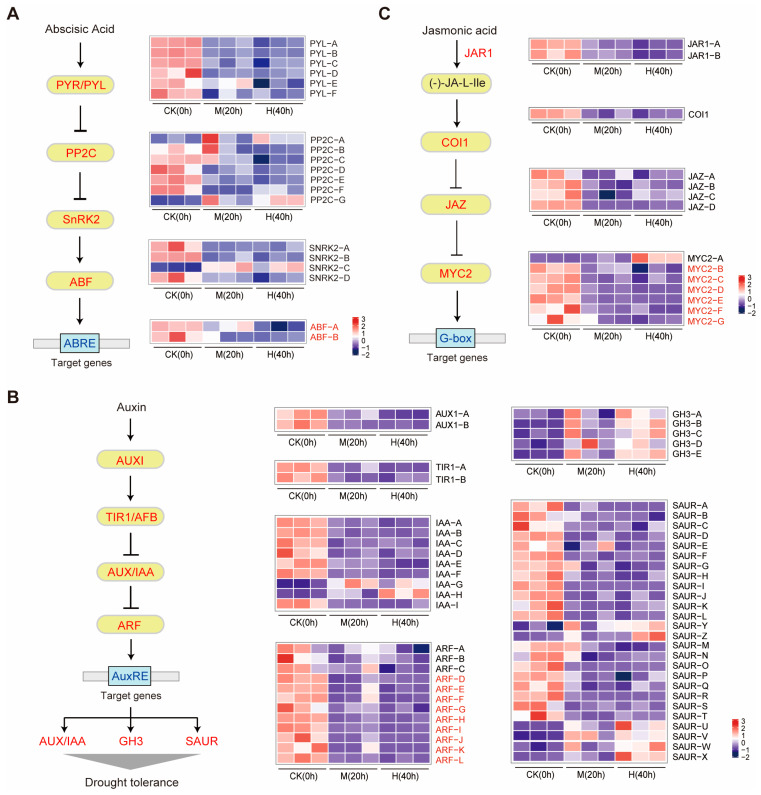
, distributed in the high-altitude, arid, and semi-arid regions of Xizang, exhibits great tolerance to drought, which is rich in rotenoids and other secondary metabolites. It is still unknown, though, how drought stress influences rotenoid synthesis in . : In this study, the calli of were subjected to 5% PEG6000 for 0, 20, and 40 h and divided into control group (CK), mild-drought-treated group (M), and high-drought-treated group (H), respectively. We then analyzed the relative content of three main rotenoids in using high-performance liquid chromatography-electrospray ionization-tandem mass spectrometry (HPLC-ESI-MS/MS). : Our findings demonstrated that the content of rotenoids was significantly reduced under drought stress. Transcriptome analysis subsequently revealed 14,525 differentially expressed genes (DEGs) between the different treatments. Furthermore, these DEGs exhibited enrichment in pathways associated with isoflavone biosynthesis and hormone signaling pathways. Key genes with decreased expression patterns during drought stress were also found to be involved in rotenoid accumulation and drought-responsive phytohormone signaling, including abscisic acid (ABA), auxin (IAA), and jasmonic acid (JA). : These findings elucidate the molecular processes of drought resistance in and shed light on the relationship between rotenoid production and drought stress in .
分布于西藏高海拔、干旱和半干旱地区,对干旱具有很强的耐受性,富含鱼藤酮类化合物和其他次生代谢产物。然而,干旱胁迫如何影响其鱼藤酮类化合物的合成仍不清楚。: 在本研究中,将其愈伤组织分别用5% PEG6000处理0、20和40小时,并分为对照组(CK)、轻度干旱处理组(M)和重度干旱处理组(H)。然后,我们使用高效液相色谱-电喷雾电离-串联质谱(HPLC-ESI-MS/MS)分析了其中三种主要鱼藤酮类化合物的相对含量。: 我们的研究结果表明,干旱胁迫下鱼藤酮类化合物的含量显著降低。随后的转录组分析揭示了不同处理之间有14525个差异表达基因(DEG)。此外,这些DEG在与异黄酮生物合成和激素信号通路相关的途径中表现出富集。还发现干旱胁迫期间表达模式下降的关键基因参与鱼藤酮类化合物的积累和干旱响应植物激素信号传导,包括脱落酸(ABA)、生长素(IAA)和茉莉酸(JA)。: 这些发现阐明了其抗旱的分子过程,并揭示了其鱼藤酮类化合物产生与干旱胁迫之间的关系。