Calvino Giulia, Peconi Cristina, Strafella Claudia, Trastulli Giulia, Megalizzi Domenica, Andreucci Sarah, Cascella Raffaella, Caltagirone Carlo, Zampatti Stefania, Giardina Emiliano
Genomic Medicine Laboratory UILDM, IRCCS Santa Lucia Foundation, 00179 Rome, Italy.
Department of Science, Roma Tre University, 00146 Rome, Italy.
Genes (Basel). 2024 Dec 22;15(12):1650. doi: 10.3390/genes15121650.
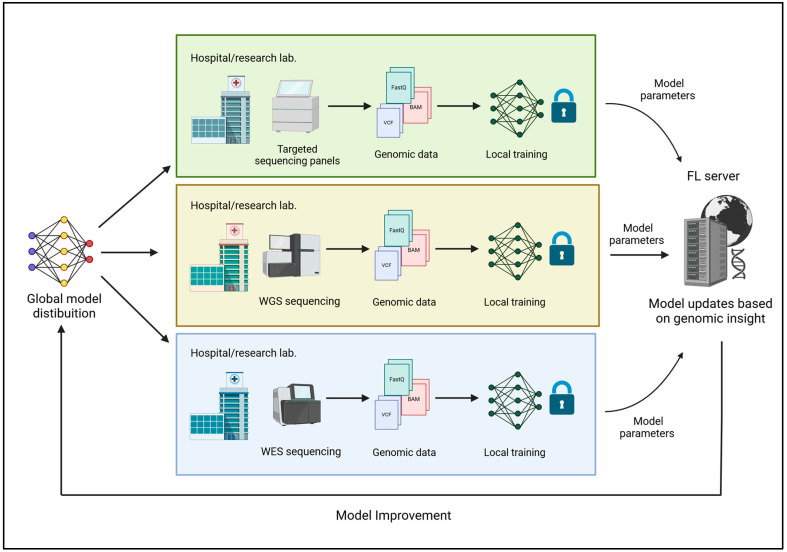
Recent advancements in Next-Generation Sequencing (NGS) technologies have revolutionized genomic research, presenting unprecedented opportunities for personalized medicine and population genetics. However, issues such as data silos, privacy concerns, and regulatory challenges hinder large-scale data integration and collaboration. Federated Learning (FL) has emerged as a transformative solution, enabling decentralized data analysis while preserving privacy and complying with regulations such as the General Data Protection Regulation (GDPR). This review explores the potential use of FL in genomics, detailing its methodology, including local model training, secure aggregation, and iterative improvement. Key challenges, such as heterogeneous data integration and cybersecurity risks, are examined alongside regulations like GDPR. In conclusion, successful implementations of FL in global and national initiatives demonstrate its scalability and role in supporting collaborative research. Finally, we discuss future directions, including AI integration and the necessity of education and training, to fully harness the potential of FL in advancing precision medicine and global health initiatives.
下一代测序(NGS)技术的最新进展彻底改变了基因组研究,为个性化医疗和群体遗传学带来了前所未有的机遇。然而,数据孤岛、隐私问题和监管挑战等问题阻碍了大规模数据整合与协作。联邦学习(FL)已成为一种变革性解决方案,能够在保护隐私并符合《通用数据保护条例》(GDPR)等法规的同时实现分散式数据分析。本综述探讨了联邦学习在基因组学中的潜在应用,详细介绍了其方法,包括局部模型训练、安全聚合和迭代改进。同时,还研究了诸如异构数据整合和网络安全风险等关键挑战以及GDPR等法规。总之,联邦学习在全球和国家计划中的成功实施证明了其可扩展性以及在支持协作研究中的作用。最后,我们讨论了未来的方向,包括人工智能整合以及教育和培训的必要性,以充分利用联邦学习在推进精准医疗和全球健康计划方面的潜力。