Cheng Yanfei, Fei Tao, Liu Yuyi, Chen Shuai, Wang Zexin, Han Yiran, Wang Lu, Li Congfa
School of Food Science and Engineering, Hainan University, Haikou 570228, China.
Key Laboratory of Food Nutrition and Functional Food of Hainan Province, Haikou 570228, China.
Foods. 2024 Dec 11;13(24):4010. doi: 10.3390/foods13244010.
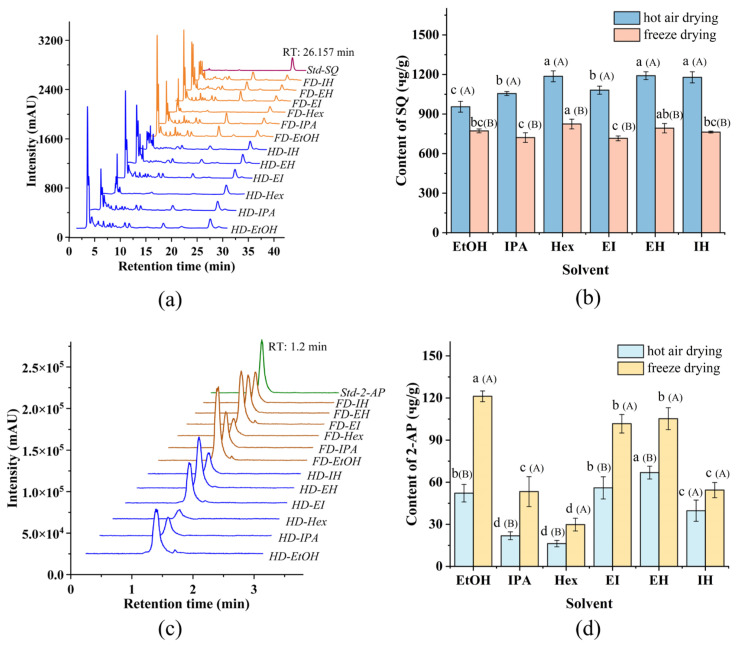
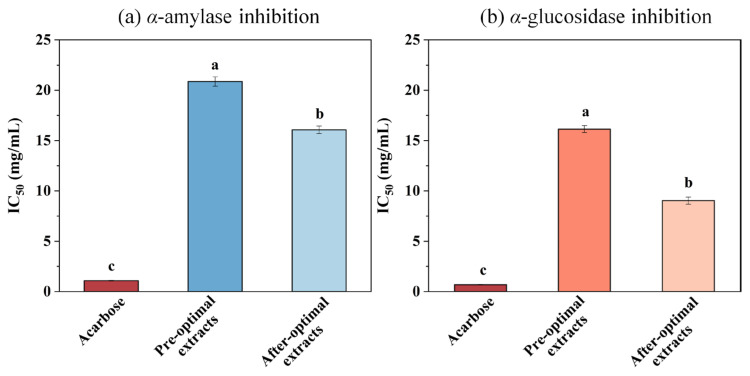
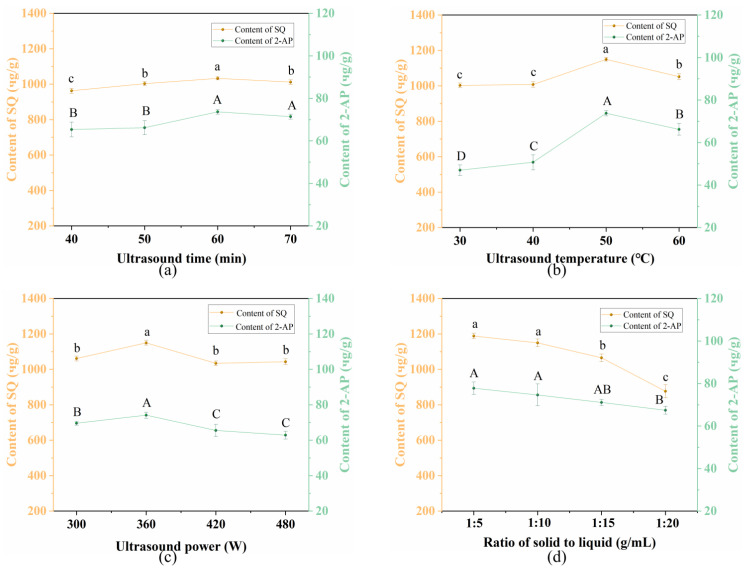
Pandan, a tropical crop, is rich in squalene (SQ), known for its antioxidant and hypoglycemic properties, and 2-acetyl-1-pyrroline (2-AP), which imparts a characteristic aroma. This study focuses on the extraction of the two bioactive compounds from Pandan leaves and investigates the effects of drying methods, extraction solvents, and conditions on the yield of SQ and 2-AP. Results show that hot air-dried Pandan leaves when extracted using the binary solvent system of ethanol and n-hexane (EH), yield higher SQ content while maintaining an adequate content of 2-AP. To further optimize the extraction process, a single-factor experiment was followed by optimization using Box-Behnken design (BBD) and response surface methodology (RSM). The optimal extraction conditions were determined as follows: ultrasound time of 60 min, a temperature of 50 °C, power of 300 W, and a solid-to-liquid ratio of 1:5 g/mL. Under these conditions, an SQ yield of 1229.98 ± 13.09 μg/DW 1 g Pandan leaves and a 2-AP yield of 80.72 ± 0.88 μg/DW 1 g Pandan leaves were achieved, representing increases of 3.30% and 9.82% compared to pre-optimization values. Additionally, the antioxidant activities of EH extracts were evaluated through various in vitro assays. The extracts demonstrated significant DPPH and ABTS free radical scavenging activity (12.46 μmol TE/g DW and 22.14 μmol TE/g DW, respectively), along with ferric and cupric ion reducing power (10.629 μmol TE/g DW and 14.275 μmol TE/g DW, respectively). The extracts also exhibited notable inhibitory effects on α-amylase and α-glucosidase. The findings suggest that these extracts are a promising natural source of antioxidants with potential applications in health and nutrition.
香兰是一种热带作物,富含具有抗氧化和降血糖特性的角鲨烯(SQ)以及赋予其特征香气的2-乙酰基-1-吡咯啉(2-AP)。本研究聚焦于从香兰叶中提取这两种生物活性化合物,并研究干燥方法、提取溶剂和条件对角鲨烯和2-AP产量的影响。结果表明,使用乙醇和正己烷二元溶剂体系(EH)提取热风干燥的香兰叶时,角鲨烯含量更高,同时能保持适当的2-AP含量。为进一步优化提取工艺,先进行单因素实验,然后采用Box-Behnken设计(BBD)和响应面法(RSM)进行优化。确定的最佳提取条件如下:超声时间60分钟、温度50℃、功率300瓦、固液比1:5克/毫升。在此条件下,每克香兰叶的角鲨烯产量为1229.98±13.09微克/干重,2-AP产量为80.72±0.88微克/干重,与优化前的值相比分别提高了3.30%和9.82%。此外,通过各种体外试验评估了EH提取物的抗氧化活性。提取物表现出显著的DPPH和ABTS自由基清除活性(分别为12.46微摩尔TE/克干重和22.14微摩尔TE/克干重),以及铁离子和铜离子还原能力(分别为10.629微摩尔TE/克干重和14.275微摩尔TE/克干重)。提取物还对α-淀粉酶和α-葡萄糖苷酶表现出显著的抑制作用。研究结果表明,这些提取物是一种有前景的天然抗氧化剂来源,在健康和营养领域具有潜在应用价值。