Salazar-Piña Azucena, Maldonado-Gama Minerva, Gonzalez-Jaimes Ana M, Cruz-Valdez Aurelio, Ortiz-Panozo Eduardo, Esquivel-Guadarrama Fernando, Gutierrez-Xicotencatl Lourdes
Facultad de Nutrición, Universidad Autónoma del Estado de Morelos, Cuernavaca 62350, Mexico.
Centro de Investigación Sobre Enfermedades Infecciosas, Instituto Nacional de Salud Pública, Cuernavaca 62100, Mexico.
Biomedicines. 2024 Nov 26;12(12):2699. doi: 10.3390/biomedicines12122699.
The humoral immune response against human papillomavirus (HPV) has been suggested as a source of biomarkers for the early detection of cervical cancer (CC). Therefore, we aimed to characterize the antibody response against HPV16 E5 in the natural history of cervical cancer and to determine its usefulness as a biomarker of HPV-associated cervical lesions.
This study was conducted at the Cuautla General Hospital, Morelos, Mexico, with women (18 to 64 years) who agreed to participate. Samples were obtained from 335 women with cervical lesions and 150 women with negative Papanicolaou tests. HPV genotyping was performed by PCR and pyrosequencing, and anti-E5 antibodies were detected by slot blot.
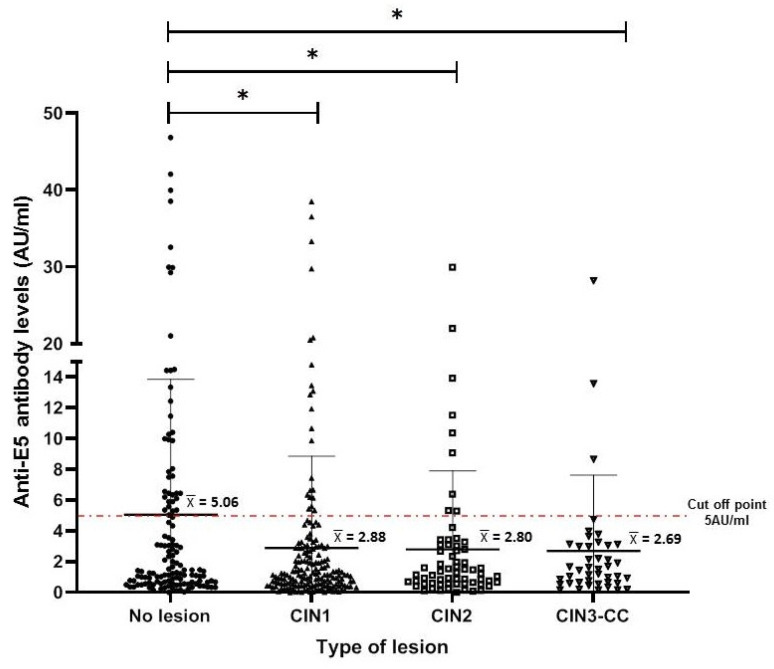
The overall anti-E5 antibodies prevalence in the study was 17.9%, with the higher prevalence observed in the no lesion (NL, 49.4%) group, and with a downward trend according to the degree of the cervical lesion, from cervical intraepithelial neoplasia-1 (CIN1, 32.2%) to CIN2 (11.5%) and CIN3/CC (6.9%). The logistic regression model showed negative associations of anti-E5 antibodies with CIN1 (OR = 0.38), CIN2 (OR = 0.42), and CIN3/CC (OR = 0.32) groups, being statistically significant. Contrast analysis showed an inverse relationship between anti-E5 antibodies with HPV DNA and the CIN1 (OR = 0.35), CIN2 (OR = 0.39), and CIN3/CC (OR = 0.31) groups.
These results suggest that anti-E5 antibodies could be associated with clearance of infection in women without lesions and with CIN1 lesions since an inverse relationship was observed between the presence of HPV DNA and anti-E5 antibodies. In contrast, with progression from CIN2/CIN3 to CC, the relationship was reversed, as the anti-E5 antibodies disappeared, and the frequency of the viral genome increased.
针对人乳头瘤病毒(HPV)的体液免疫反应已被认为是宫颈癌(CC)早期检测生物标志物的来源。因此,我们旨在描述宫颈癌自然史中针对HPV16 E5的抗体反应,并确定其作为HPV相关宫颈病变生物标志物的效用。
本研究在墨西哥莫雷洛斯州夸特拉综合医院对同意参与的18至64岁女性进行。从335名宫颈病变女性和150名巴氏试验阴性女性中获取样本。通过聚合酶链反应(PCR)和焦磷酸测序进行HPV基因分型,通过斑点杂交检测抗E5抗体。
研究中抗E5抗体的总体患病率为17.9%,在无病变(NL,49.4%)组中患病率较高,并且根据宫颈病变程度呈下降趋势,从宫颈上皮内瘤变1级(CIN1,32.2%)到CIN2(11.5%)和CIN3/CC(6.9%)。逻辑回归模型显示抗E5抗体与CIN1(比值比[OR]=0.38)、CIN2(OR = 0.42)和CIN3/CC(OR = 0.32)组呈负相关,具有统计学意义。对比分析显示抗E5抗体与HPV DNA以及CIN1(OR = 0.35)、CIN2(OR = 0.39)和CIN3/CC(OR = 0.31)组之间存在反比关系。
这些结果表明,抗E5抗体可能与无病变女性和CIN1病变中的感染清除有关,因为在HPV DNA和抗E5抗体之间观察到反比关系。相比之下,随着从CIN2/CIN3进展到CC,关系发生逆转,因为抗E5抗体消失,病毒基因组频率增加。