Bello-Corral Laura, Seco-Calvo Jesús, Molina Fresno Angela, González Ana Isabel, Llorente Ana, Fernández-Lázaro Diego, Sánchez-Valdeón Leticia
Health Research Nursing Group (GREIS), University of Leon, 24071 Leon, Spain.
Department of Nursing and Physiotherapy, University of Leon, 24071 Leon, Spain.
Medicina (Kaunas). 2024 Nov 25;60(12):1941. doi: 10.3390/medicina60121941.
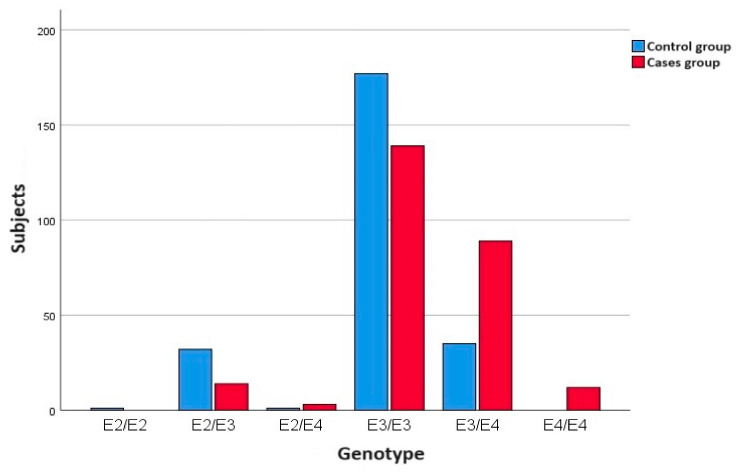
: Alzheimer's dementia is a progressive neurodegenerative disease that affects memory abilities due to genetic and environmental factors. A well-known gene that influences the risk of Alzheimer's disease is the apolipoprotein E (APOE) gene. The APOE gene is involved in the production of a protein that helps transport cholesterol and other types of fat in the bloodstream. Problems in this process are thought to contribute to the development of Alzheimer's disease. APOE comes in several forms, which are called alleles (ε2, ε3, ε4). : Therefore, our study aims to identify those subjects with a higher genetic risk through the polymorphism of the APOE gene, using a population screening in patients with a clinical diagnosis of AD in a region of Spain, Castilla y León, as potential biomarkers and to identify individuals at increased genetic risk by polymorphism of the APOE gene. An observational case-control study was conducted in Castilla y León (Spain). Saliva samples were collected and the ApoE gene was analyzed by PCR and agarose gel electrophoresis, respecting ethical criteria. : In the Alzheimer's population in Castilla y León, a high prevalence of ApoE3 (74%) was found, followed by ApoE4 (22%); in addition, a higher presence of the ε4 allele was found in the Alzheimer's disease (AD) group than in the control group. It was also observed that the ε2/ε2 genotype was not found in any individual with AD but was found in healthy subjects and that the opposite was observed for the ε4/ε4 genotype. The odds ratio (OR) indicated a risk four times greater of having AD if having the ε4 allele. : The demonstrated relation between the different isoforms and the likelihood of developing AD has led to its consideration as a biomarker and a potential pre-symptomatic therapy. The molecular mechanisms that confer a disruptive and protective role to ApoE4 and ApoE2, respectively, are still being studied.
阿尔茨海默病性痴呆是一种进行性神经退行性疾病,由于遗传和环境因素影响记忆能力。一种影响阿尔茨海默病风险的著名基因是载脂蛋白E(APOE)基因。APOE基因参与一种蛋白质的产生,该蛋白质有助于在血液中运输胆固醇和其他类型的脂肪。这个过程中的问题被认为会导致阿尔茨海默病的发展。APOE有几种形式,被称为等位基因(ε2、ε3、ε4)。
因此,我们的研究旨在通过APOE基因的多态性,在西班牙卡斯蒂利亚-莱昂地区对临床诊断为AD的患者进行人群筛查,以识别那些遗传风险较高的受试者作为潜在的生物标志物,并通过APOE基因的多态性识别遗传风险增加的个体。在西班牙的卡斯蒂利亚-莱昂进行了一项观察性病例对照研究。按照伦理标准收集唾液样本,并通过PCR和琼脂糖凝胶电泳分析ApoE基因。
在卡斯蒂利亚-莱昂的阿尔茨海默病患者群体中,发现ApoE3的患病率很高(74%),其次是ApoE4(22%);此外,阿尔茨海默病(AD)组中ε4等位基因的存在比例高于对照组。还观察到,在任何AD个体中均未发现ε2/ε2基因型,但在健康受试者中发现了该基因型,而对于ε4/ε4基因型则观察到相反的情况。优势比(OR)表明,如果携带ε4等位基因,患AD的风险会高出四倍。
不同异构体与患AD可能性之间已证实的关系,使其被视为一种生物标志物和潜在的症状前治疗方法。分别赋予ApoE4和ApoE2破坏和保护作用的分子机制仍在研究中。