Gahramanov Valid, Vizeacoumar Frederick S, Morales Alain Morejon, Bonham Keith, Sakharkar Meena K, Kumar Santosh, Vizeacoumar Franco J, Freywald Andrew, Sherman Michael Y
Molecular, Cellular, and Developmental Biology, Yale University, New Haven, CT 06511, USA.
Department of Molecular Biology, Ariel University, Ariel 40700, Israel.
Int J Mol Sci. 2024 Dec 17;25(24):13495. doi: 10.3390/ijms252413495.
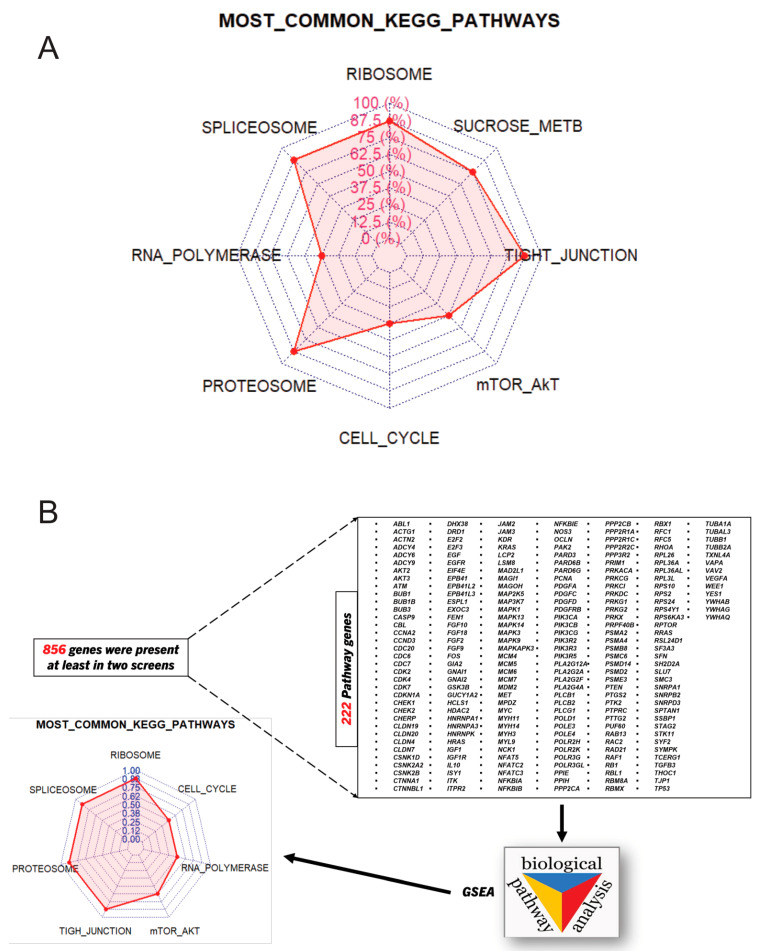
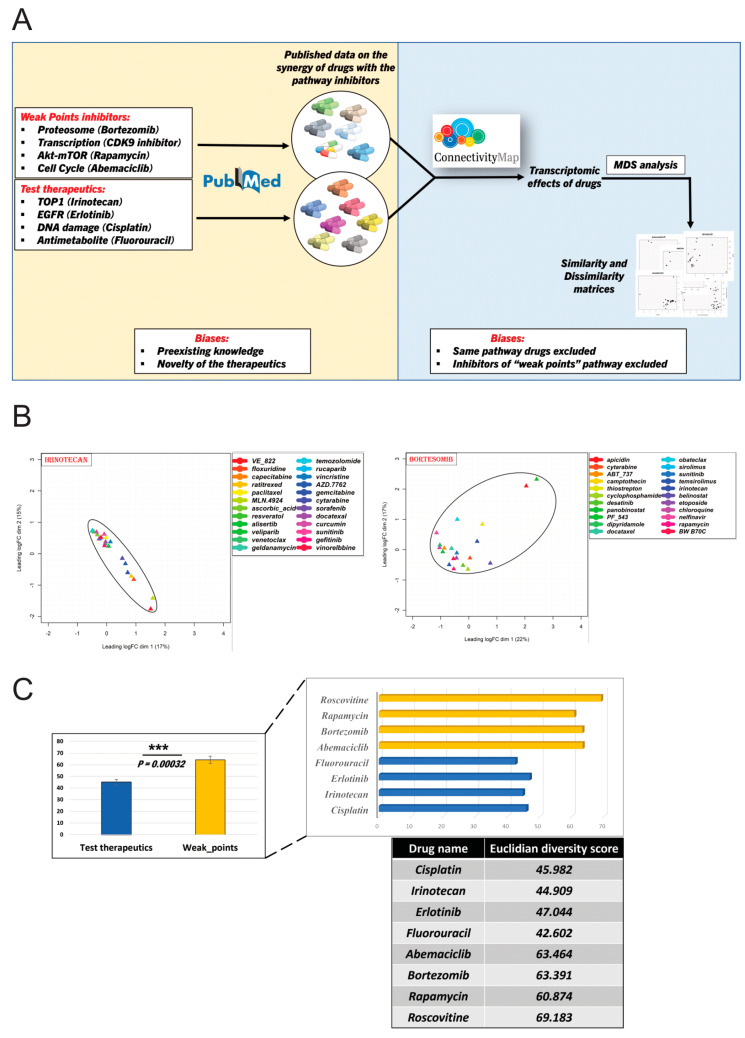
Loss of function screens using shRNA (short hairpin RNA) and CRISPR (clustered regularly interspaced short palindromic repeats) are routinely used to identify genes that modulate responses of tumor cells to anti-cancer drugs. Here, by integrating GSEA (Gene Set Enrichment Analysis) and CMAP (Connectivity Map) analyses of multiple published shRNA screens, we identified a core set of pathways that affect responses to multiple drugs with diverse mechanisms of action. This suggests that these pathways represent "weak points" or "Achilles heels", whose mild disturbance should make cancer cells vulnerable to a variety of treatments. These "weak points" include proteasome, protein synthesis, RNA splicing, RNA synthesis, cell cycle, Akt-mTOR, and tight junction-related pathways. Therefore, inhibitors of these pathways are expected to sensitize cancer cells to a variety of drugs. This hypothesis was tested by analyzing the diversity of drugs that synergize with FDA-approved inhibitors of the proteasome, RNA synthesis, and Akt-mTOR pathways. Indeed, the quantitative evaluation indicates that inhibitors of any of these signaling pathways can synergize with a more diverse set of pharmaceuticals, compared to compounds inhibiting targets distinct from the "weak points" pathways. Our findings described here imply that inhibitors of the "weak points" pathways should be considered as primary candidates in a search for synergistic drug combinations.
使用短发夹RNA(shRNA)和规律成簇间隔短回文重复序列(CRISPR)进行的功能丧失筛选,常用于识别调节肿瘤细胞对抗癌药物反应的基因。在此,通过整合多个已发表的shRNA筛选的基因集富集分析(GSEA)和连通性图谱(CMAP)分析,我们确定了一组核心通路,这些通路影响对多种具有不同作用机制的药物的反应。这表明这些通路代表了“弱点”或“阿喀琉斯之踵”,对其进行轻微干扰应会使癌细胞易受多种治疗方法的影响。这些“弱点”包括蛋白酶体、蛋白质合成、RNA剪接、RNA合成、细胞周期、Akt - mTOR和紧密连接相关通路。因此,预计这些通路的抑制剂会使癌细胞对多种药物敏感。通过分析与美国食品药品监督管理局(FDA)批准的蛋白酶体、RNA合成和Akt - mTOR通路抑制剂协同作用的药物多样性,对这一假设进行了验证。事实上,定量评估表明,与抑制不同于“弱点”通路靶点的化合物相比,这些信号通路中任何一个的抑制剂都能与更多种类的药物协同作用。我们在此描述的研究结果表明,在寻找协同药物组合时,“弱点”通路的抑制剂应被视为主要候选药物。