Sakalauskaite Sandra, Pilkyte Ligita, Gasiuniene Edita, Gradauskiene Brigita
Laboratory of Immunology, Department of Immunology and Allergology, Lithuanian University of Health Sciences, 50161 Kaunas, Lithuania.
Department of Immunology and Allergology, Lithuanian University of Health Sciences, 50161 Kaunas, Lithuania.
Int J Mol Sci. 2024 Dec 18;25(24):13535. doi: 10.3390/ijms252413535.
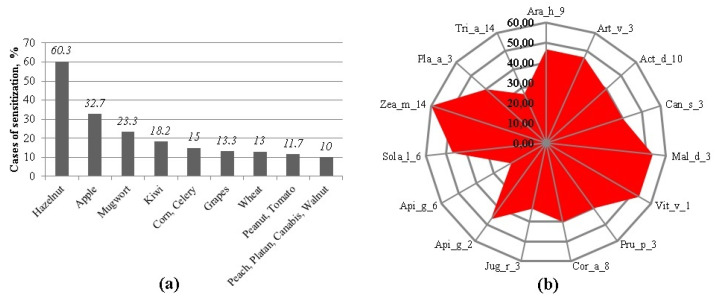
Non-specific Lipid Transfer proteins (nsLTPs) are relevant allergens of several pollens and plant foods. Sensitization to nsLTPs is not typical in our region. Still, it has become an increasingly common cause of IgE-mediated food allergies and food-induced anaphylaxis in Northern Europe in recent decades. No in-depth studies describe the prevalence of sensitization of molecular components to nsLTPs in Lithuania. This study aimed to determine the sensitization profile of atopic patients at the Immunology and Allergy Department of Kauno Klinikos to the components of nsLTPs, using molecular allergen component analysis. Sixty Lithuanian adults with symptoms of allergic rhinitis and/or allergic asthma and/or food allergies were included into the study. Specific immunoglobulin E (IgE) levels were measured using two in vitro techniques: allergen extract and molecular component analysis. Results showed that 25% of subjects were sensitized to nsLTP-containing allergen sources, mostly to Zea m 14, Mal d 3, Vit v 1, and Art v 3. The median amount of total IgE was higher in nsLTP-sensitized patients than in nsLTP-nonsensitized patients. Based on Cohen's Kappa and McNemar tests, the results of allergen extract and component analysis tests do not always agree, especially when we determine the sensitization to allergen sources containing nsLTPs. Molecular allergen component analysis could be the first choice in determining detailed sensitization to nsLTPs in patients who experienced anaphylaxis of unknown origin.
非特异性脂质转移蛋白(nsLTPs)是几种花粉和植物性食物的相关过敏原。在我们地区,对nsLTPs的致敏并不常见。然而,近几十年来,它在北欧已成为IgE介导的食物过敏和食物诱发过敏反应日益常见的原因。立陶宛尚无深入研究描述分子成分对nsLTPs的致敏率。本研究旨在通过分子过敏原成分分析,确定考纳斯临床医院免疫学和过敏科特应性患者对nsLTPs成分的致敏情况。60名有过敏性鼻炎和/或过敏性哮喘和/或食物过敏症状的立陶宛成年人纳入本研究。使用两种体外技术测量特异性免疫球蛋白E(IgE)水平:过敏原提取物和分子成分分析。结果显示,25%的受试者对含nsLTPs的过敏原来源致敏,主要是对玉米Zea m 14、苹果Mal d 3、葡萄Vit v 1和芹菜Art v 3致敏。nsLTP致敏患者的总IgE中位数高于非致敏患者。基于科恩kappa检验和麦克尼马尔检验,过敏原提取物和成分分析测试的结果并不总是一致,尤其是在我们确定对含nsLTPs的过敏原来源的致敏情况时。对于不明原因过敏反应的患者,分子过敏原成分分析可能是确定对nsLTPs详细致敏情况的首选方法。