Dong Kang, Hou Zhishuai, Li Zhao, Xu Yuling, Gao Qinfeng
Key Laboratory of Mariculture, Ministry of Education, Ocean University of China, Qingdao 266003, China.
Function Laboratory for Marine Fisheries Science and Food Production Processes, Qingdao National Laboratory for Marine Science and Technology, Qingdao 266100, China.
Int J Mol Sci. 2024 Dec 19;25(24):13583. doi: 10.3390/ijms252413583.
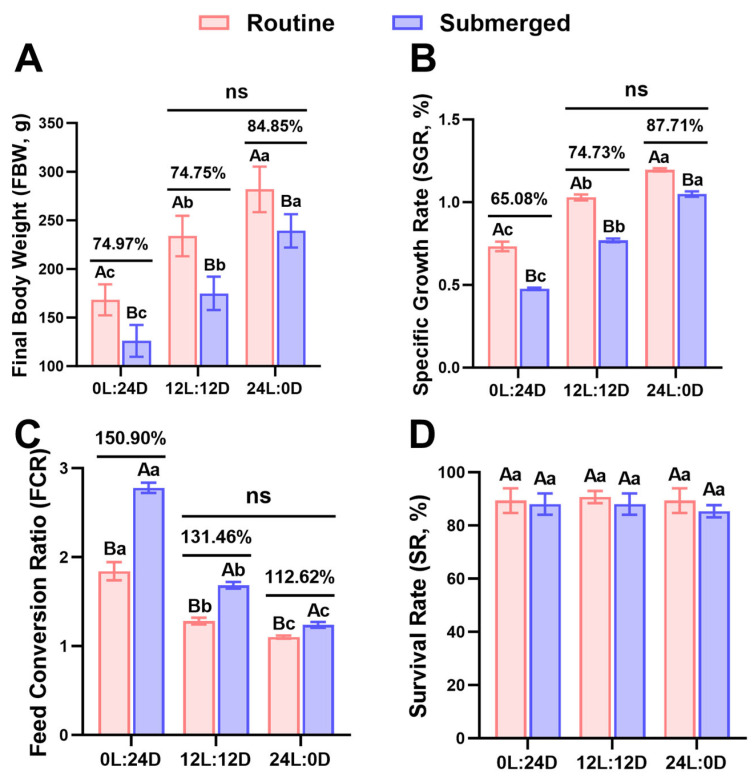
Salmonids, classified as physostomous fish, maintain buoyancy by ingesting air to inflate their swim bladders. Long-term submergence has been shown to cause body imbalance and reduced growth performance in these fish. Previous studies have demonstrated that extended photoperiod can promote growth in salmonids. This study aimed to investigate the regulatory effects of prolonged lighting on the growth of submerged rainbow trout () by examining the transcriptional expression of genes in the growth hormone (GH)-insulin-like growth factor (IGF) axis. Rainbow trout were individually reared in one of the six environments, defined by the combination of three photoperiods (0L:24D, 12L:12D, and 24L:0D) and two spatial rearing modes (routine and submerged), for 16 weeks. We compared the growth performance of rainbow trout in different environments and further analyzed the transcription profiles and correlations of GH-IGF axis genes in the brain, liver, and muscle. The findings of this study were as follows: growth performance of rainbow trout gradually increased with photoperiod duration. Specifically, final body weight (FBW) and specific growth rate (SGR) increased, while feed conversion ratio (FCR) decreased. Extended photoperiod partially mitigated the adverse effects of long-term submergence on rainbow trout growth. Under 24L:0D photoperiod conditions, growth performance (FBW, SGR, and FCR) in submerged and routine rainbow trout was more closely aligned compared to 0L:24D and 12L:12D photoperiod conditions. In response to variations in the photoperiod, GH-IGF axis genes of rainbow trout exhibited significant transcriptional differences, particularly between treatments with 0L:24D and 24L:0D light exposure. An extended photoperiod facilitated the restoration of the expression of GH-IGF axis genes in submerged rainbow trout towards routine levels, including the up-regulation of and genes in the brain. Correlation analysis implied differentiation of physiological functions of and paralogs. This study provided insights into the feasibility of enhancing the growth performance of submerged salmonids through photoperiod manipulation.
鲑科鱼类被归类为有鳔管鱼类,通过吸入空气使鱼鳔膨胀来维持浮力。长期潜水已被证明会导致这些鱼类身体失衡并降低生长性能。先前的研究表明,延长光照周期可促进鲑科鱼类的生长。本研究旨在通过检测生长激素(GH)-胰岛素样生长因子(IGF)轴上基因的转录表达,研究延长光照对潜水虹鳟()生长的调节作用。虹鳟分别饲养在六种环境之一中,这六种环境由三种光照周期(0L:24D、12L:12D和24L:0D)和两种空间饲养模式(常规和潜水)的组合定义,为期16周。我们比较了虹鳟在不同环境中的生长性能,并进一步分析了大脑、肝脏和肌肉中GH-IGF轴基因的转录谱及其相关性。本研究的结果如下:虹鳟的生长性能随着光照周期时长逐渐增加。具体而言,终末体重(FBW)和特定生长率(SGR)增加,而饲料转化率(FCR)降低。延长光照周期部分缓解了长期潜水对虹鳟生长的不利影响。在24L:0D光照周期条件下,与0L:24D和12L:12D光照周期条件相比,潜水虹鳟和常规虹鳟的生长性能(FBW、SGR和FCR)更为接近。响应光照周期的变化,虹鳟的GH-IGF轴基因表现出显著的转录差异,特别是在0L:24D和24L:0D光照处理之间。延长光照周期有助于使潜水虹鳟中GH-IGF轴基因的表达恢复到常规水平,包括大脑中 和 基因的上调。相关性分析暗示了 和 旁系同源基因生理功能的差异。本研究为通过光照周期调控提高潜水鲑科鱼类生长性能的可行性提供了见解。