
来自[具体来源未给出]的双环烯醚萜苷和三萜类化合物及其作为ACC1和ACL抑制剂的潜力。
Bis-Iridoid Glycosides and Triterpenoids from and Their Potential as Inhibitors of ACC1 and ACL.
作者信息
Wan Jiang, Zhao Ze-Yu, Wang Can, Jiang Chun-Xiao, Tong Ying-Peng, Zang Yi, Choo Yeun-Mun, Li Jia, Hu Jin-Feng
机构信息
Zhejiang Provincial Key Laboratory of Plant Evolutionary Ecology and Conservation, School of Pharmaceutical Sciences, Taizhou University, Taizhou 318000, China.
Department of Natural Medicine, School of Pharmacy, Fudan University, Shanghai 201203, China.
出版信息
Molecules. 2024 Dec 18;29(24):5980. doi: 10.3390/molecules29245980.
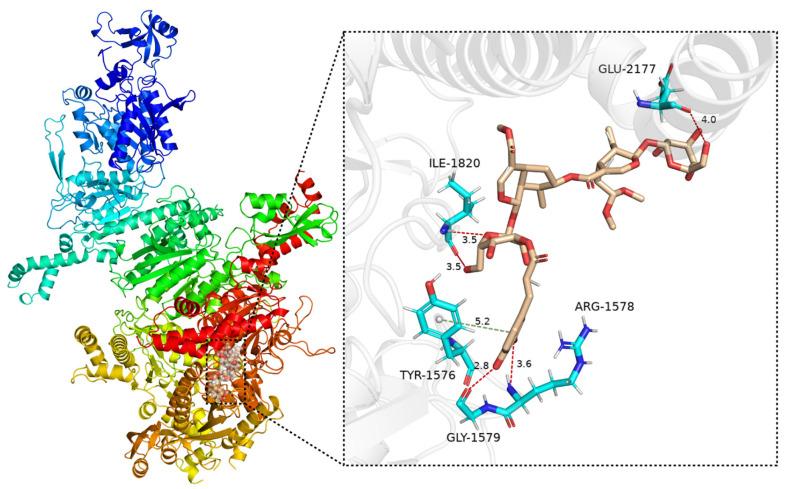
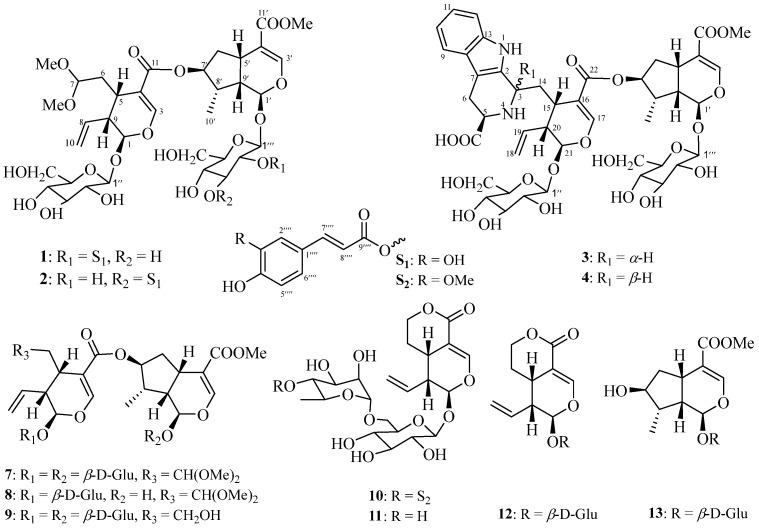
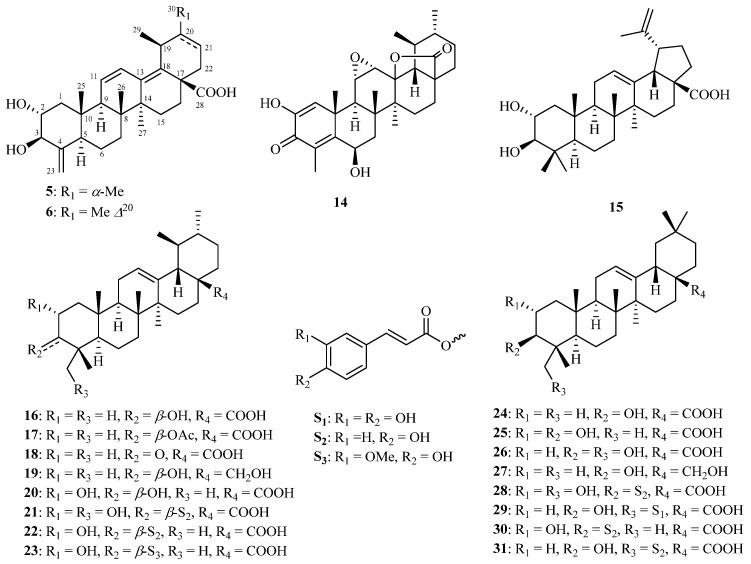
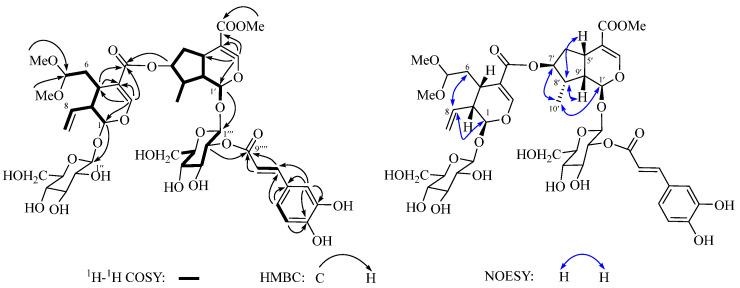
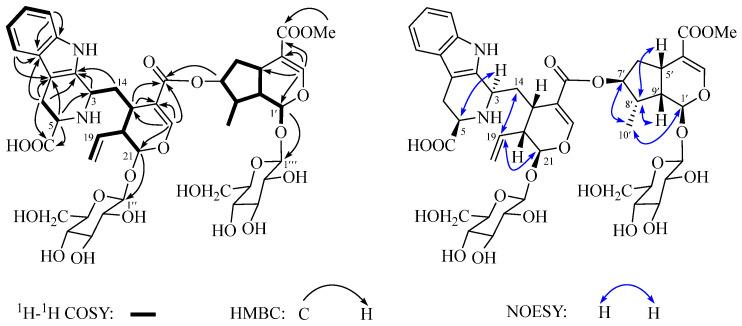
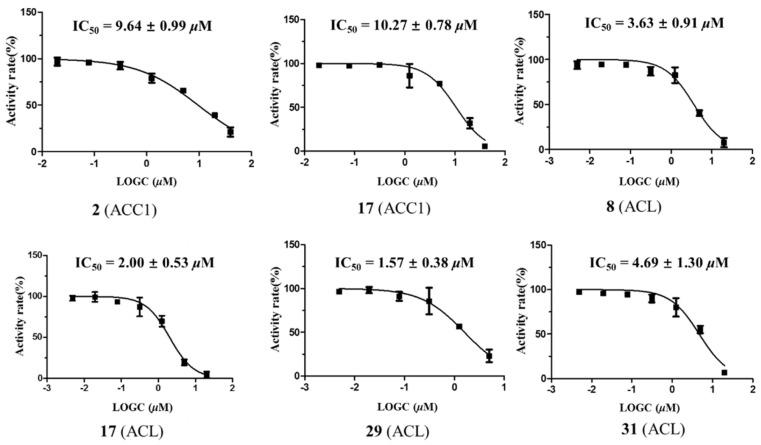
A comprehensive phytochemical investigation of the twigs/leaves and flower buds of , a rare deciduous shrub native to China, led to the isolation of 39 structurally diverse compounds. These compounds include 11 iridoid glycosides (- and -), 20 triterpenoids (, , and -), and 8 phenylpropanoids (-). Among these, amabiliosides A () and B () represent previously undescribed bis-iridoid glycosides, while amabiliosides C () and D () feature a unique bis-iridoid-monoterpenoid indole alkaloid scaffold with a tetrahydro--carboline-5-carboxylic acid moiety. Amabiliacids A () and B () are 24-nor-ursane-type triterpenoids characterized by an uncommon ∆ transannular double bond. Their chemical structures and absolute configurations were elucidated through spectroscopic data and electronic circular dichroism analyses. Compound exhibited a moderate inhibitory effect against acetyl CoA carboxylase 1 (ACC1), with an IC value of 9.6 μM. Lonicejaposide C (), 3---caffeoyl-olean-12-en-28-oic acid (), and (23)-coumaroylhederagenin () showed notable inhibitory effects on ATP-citrate lyase (ACL), with IC values of 3.6, 1.6, and 4.7 μM, respectively. Additionally, 3-acetyl-ursolic acid () demonstrated dual inhibitory activity against both ACC1 and ACL, with IC values of 10.3 and 2.0 μM, respectively. The interactions of the active compounds with ACC1 and ACL enzymes were examined through molecular docking studies. From a chemotaxonomic perspective, the isolation of bis-iridoid glycosides in this study may aid in clarifying the taxonomic relationship between the genera and within the Caprifoliaceae family. These findings highlight the importance of conserving plant species with unique and diverse secondary metabolites, which could serve as potential sources of new therapeutic agents for treating ACC1/ACL-associated diseases.
对一种原产于中国的珍稀落叶灌木的嫩枝/叶片和花芽进行了全面的植物化学研究,从中分离出39种结构各异的化合物。这些化合物包括11种环烯醚萜苷(-和-)、20种三萜类化合物(、、和-)以及8种苯丙素类化合物(-)。其中,美丽苷A()和美丽苷B()代表了此前未描述过的双环烯醚萜苷,而美丽苷C()和美丽苷D()具有独特的双环烯醚萜-单萜吲哚生物碱骨架,并带有一个四氢--咔啉-5-羧酸部分。美丽酸A()和美丽酸B()是24-降乌苏烷型三萜类化合物,其特征在于具有一个不常见的∆跨环双键。通过光谱数据和电子圆二色性分析阐明了它们的化学结构和绝对构型。化合物对乙酰辅酶A羧化酶1(ACC1)表现出中等抑制作用,IC值为9.6 μM。长白忍冬苷C()、3---咖啡酰齐墩果-12-烯-28-酸()和(23)-香豆酰地榆皂苷元()对ATP-柠檬酸裂解酶(ACL)表现出显著抑制作用,IC值分别为3.6、1.6和4.7 μM。此外,3-乙酰基熊果酸()对ACC1和ACL均表现出双重抑制活性,IC值分别为10.3和2.0 μM。通过分子对接研究考察了活性化合物与ACC1和ACL酶的相互作用。从化学分类学角度来看,本研究中双环烯醚萜苷的分离可能有助于阐明忍冬科中属和属之间的分类关系。这些发现凸显了保护具有独特和多样次生代谢产物的植物物种的重要性,这些次生代谢产物可能成为治疗与ACC1/ACL相关疾病的新型治疗药物的潜在来源。
 Zotero 插件