Guerrero-García José de Jesús, Flores-González Alejandra, Sánchez-Sánchez Alma Marina, Magaña-Duarte Rafael, Mireles-Ramírez Mario Alberto, Ortiz-Lazareno Pablo Cesar, Sierra Díaz Erick, Ortuño-Sahagún Daniel
Banco de Sangre Central, Unidad Médica de Alta Especialidad (UMAE), Hospital de Especialidades (HE), Centro Médico Nacional de Occidente (CMNO), Instituto Mexicano del Seguro Social (IMSS), Guadalajara 44340, Mexico.
Departamento de Farmacobiología, Centro Universitario de Ciencias Exactas e Ingenierías (CUCEI), Universidad de Guadalajara, Guadalajara 44340, Mexico.
Pathogens. 2024 Nov 21;13(12):1027. doi: 10.3390/pathogens13121027.
Non-viral bloodborne diseases are a group of infections that are a public health problem worldwide. The incidence of diseases such as brucellosis and syphilis is increasing in the Americas and Europe. Chagas disease is an endemic problem in Latin America, the United States and Europe. This study aims to determine the prevalence of non-viral bloodborne diseases in blood donors and to discuss some issues related to federal regulations for the control and prevention of these infectious diseases in Mexico.
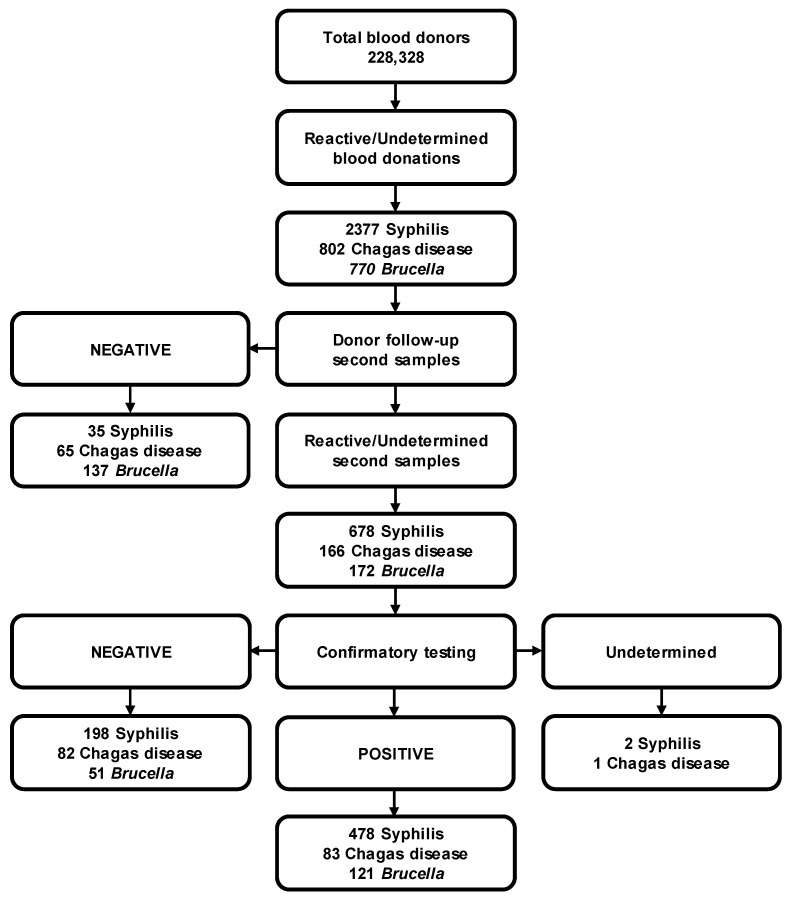
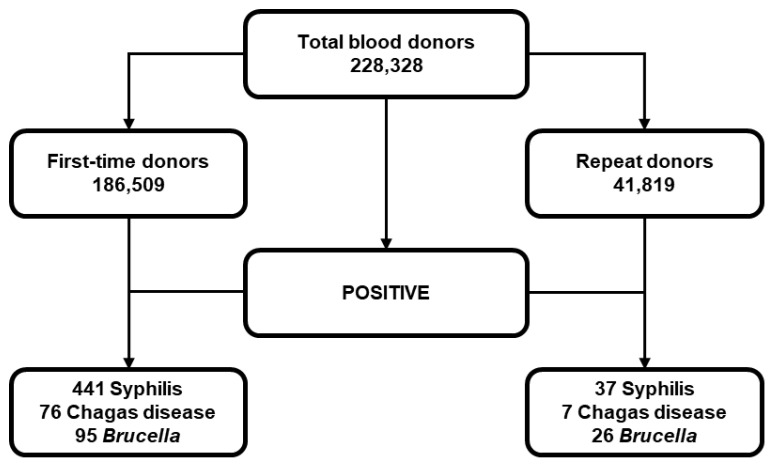
A cross-sectional study was conducted in the Western National Medical Center Blood Bank, including 228,328 blood donors (2018-2023). Frequencies, percentages, means, standard deviation and confidence intervals (CI) were calculated for demographic data. Prevalences were expressed as rates per 100,000 with 95% CI.
Of 3949 seroreactive or undetermined blood donors at the first screening, a total of 682 (0.299%) completed their follow-up test and were positive for (478), (83), or spp. (121). The overall prevalence for non-viral bloodborne diseases was 299 per 100,000 blood donors. The prevalence for syphilis, Chagas disease, and was 209, 36, and 53 per 100,000 respectively.
Federal regulations should be reviewed to formulate specific public health policies focused on controlling and preventing nonviral bloodborne diseases.
非病毒性血源疾病是一类感染性疾病,在全球范围内构成公共卫生问题。美洲和欧洲布鲁氏菌病及梅毒等疾病的发病率正在上升。恰加斯病在拉丁美洲、美国和欧洲是地方病问题。本研究旨在确定献血者中非病毒性血源疾病的患病率,并探讨墨西哥联邦政府关于控制和预防这些传染病的法规相关的一些问题。
在西部国立医学中心血库开展了一项横断面研究,纳入228,328名献血者(2018年至2023年)。计算人口统计学数据的频率、百分比、均值、标准差和置信区间(CI)。患病率以每10万例的比率表示,并带有95%CI。
在首次筛查时3949名血清反应阳性或结果未确定的献血者中,共有682名(0.299%)完成了后续检测,其中478名对[具体病原体1]呈阳性,83名对[具体病原体2]呈阳性,121名对[具体病原体3]呈阳性。非病毒性血源疾病的总体患病率为每10万献血者299例。梅毒、恰加斯病和[具体病原体3]的患病率分别为每10万例209例、36例和5例。
应审查联邦法规,以制定侧重于控制和预防非病毒性血源疾病的具体公共卫生政策。