Boldbaatar Bazartseren, Cleary Nora G, Paoli Julia E, Lee Dong-Wook, Altantogtokh Doniddemberel, Matulis Graham A, Cote Noel, Fiorenzano Jodi, Etobayeva Irina V, Kwon Jung-Hoon, Mavian Carla, Letizia Andrew G, von Fricken Michael E
School of Veterinary Medicine, Mongolian University of Life Sciences, Ulaanbaatar 17029, Mongolia.
Department of Environmental and Global Health, University of Florida, Gainesville, FL 32610, USA.
Pathogens. 2024 Dec 10;13(12):1086. doi: 10.3390/pathogens13121086.
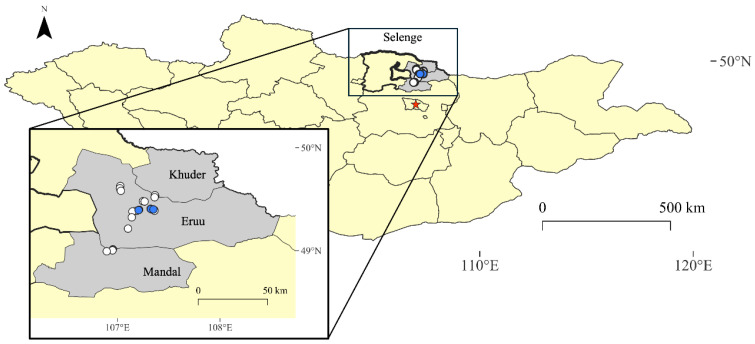
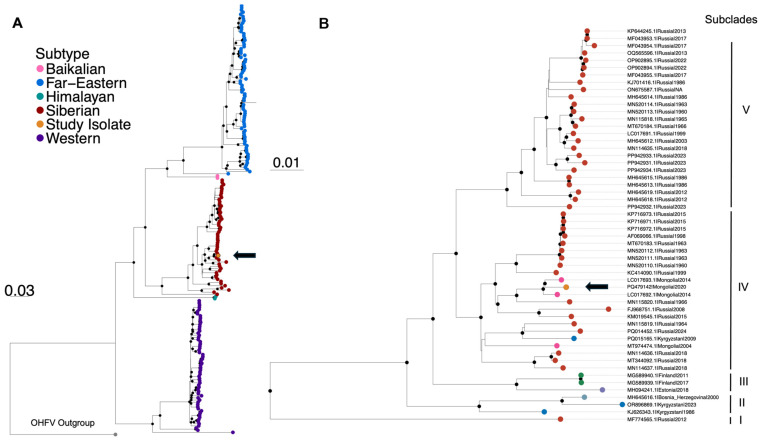
Tick-borne encephalitis virus (TBEV) causes neurological disease in humans, with varied clinical severity influenced by the viral subtype. TBEV is endemic to Mongolia, where both Siberian and Far-Eastern subtypes are present. is considered the main vector of TBEV in Mongolia; although, the virus has also been detected in species. To further characterize the disease ecology of TBEV within the endemic Selenge province of Mongolia, 1300 ticks were collected in May 2020 from regions outside Ulaanbaatar. Pooled tick samples (n = 20-50) were homogenized and the supernatant was inoculated into Vero cells. Two RT-PCR assays were conducted on the cell supernatant following an observed cytopathic effect: one for TBEV detection and the second for viral subtyping. Lysed cell cultures were processed for next-generation sequencing (NGS) using Illumina technology. TBEV was detected in 10.7% of tick pools (3/28), and isolates were identified as the Siberian subtype. Phylogenetic analysis showed PQ479142 clustering within the Siberian subtype and sharing high similarity with published isolates collected in Selenge in 2012 from . Subtype analysis of circulating TBEV isolates and sequencing analytics to track viral evolution in ticks are vital to continued understanding of the risk to local populations.
蜱传脑炎病毒(TBEV)可导致人类神经系统疾病,其临床严重程度各异,受病毒亚型影响。TBEV在蒙古是地方病,那里同时存在西伯利亚亚型和远东亚型。在蒙古,[某种蜱虫名称]被认为是TBEV的主要传播媒介;不过,在[另一种蜱虫名称]中也检测到了该病毒。为了进一步描述蒙古地方病流行的色楞格省内TBEV的疾病生态学特征,2020年5月从乌兰巴托以外地区采集了1300只[某种蜱虫名称]蜱。将混合的蜱样本(n = 20 - 50)匀浆,然后将上清液接种到Vero细胞中。在观察到细胞病变效应后,对细胞上清液进行了两种RT-PCR检测:一种用于检测TBEV,另一种用于病毒亚型分型。使用Illumina技术对裂解的细胞培养物进行下一代测序(NGS)。在10.7%的蜱样本池(3/28)中检测到了TBEV,分离株被鉴定为西伯利亚亚型。系统发育分析表明,PQ479142在西伯利亚亚型内聚类,与2012年在色楞格从[某种蜱虫名称]采集的已发表分离株具有高度相似性。对循环TBEV分离株进行亚型分析以及进行测序分析以追踪蜱中病毒的进化,对于持续了解当地人群面临的风险至关重要。