• 文献检索
  • 文档翻译
  • 深度研究
  • 学术资讯
  • Suppr Zotero 插件Zotero 插件
  • 邀请有礼
  • 套餐&价格
  • 历史记录
应用&插件
Suppr Zotero 插件Zotero 插件浏览器插件Mac 客户端Windows 客户端微信小程序
定价
高级版会员购买积分包购买API积分包
服务
文献检索文档翻译深度研究API 文档MCP 服务
关于我们
关于 Suppr公司介绍联系我们用户协议隐私条款
关注我们

Suppr 超能文献

核心技术专利:CN118964589B侵权必究
粤ICP备2023148730 号-1Suppr @ 2026

文献检索

告别复杂PubMed语法,用中文像聊天一样搜索,搜遍4000万医学文献。AI智能推荐,让科研检索更轻松。

立即免费搜索

文件翻译

保留排版,准确专业,支持PDF/Word/PPT等文件格式,支持 12+语言互译。

免费翻译文档

深度研究

AI帮你快速写综述,25分钟生成高质量综述,智能提取关键信息,辅助科研写作。

立即免费体验

一株铬还原菌的特性及分子解析

Characterization and Molecular Insights of a Chromium-Reducing Bacterium .

作者信息

Tuli Shanjana Rahman, Ali Md Firoz, Jamal Tabassum Binte, Khan Md Abu Sayem, Fatima Nigar, Ahmed Irfan, Khatun Masuma, Sharmin Shamima Akhtar

机构信息

Environmental Biotechnology Division, National Institute of Biotechnology, Ganakbari, Ashulia, Savar, Dhaka 1349, Bangladesh.

Department of Biotechnology and Genetic Engineering, Mawlana Bhashani Science and Technology University, Santosh, Tangail 1902, Bangladesh.

出版信息

Microorganisms. 2024 Dec 19;12(12):2633. doi: 10.3390/microorganisms12122633.

DOI:10.3390/microorganisms12122633
PMID:39770835
原文链接:https://pmc.ncbi.nlm.nih.gov/articles/PMC11676387/
Abstract

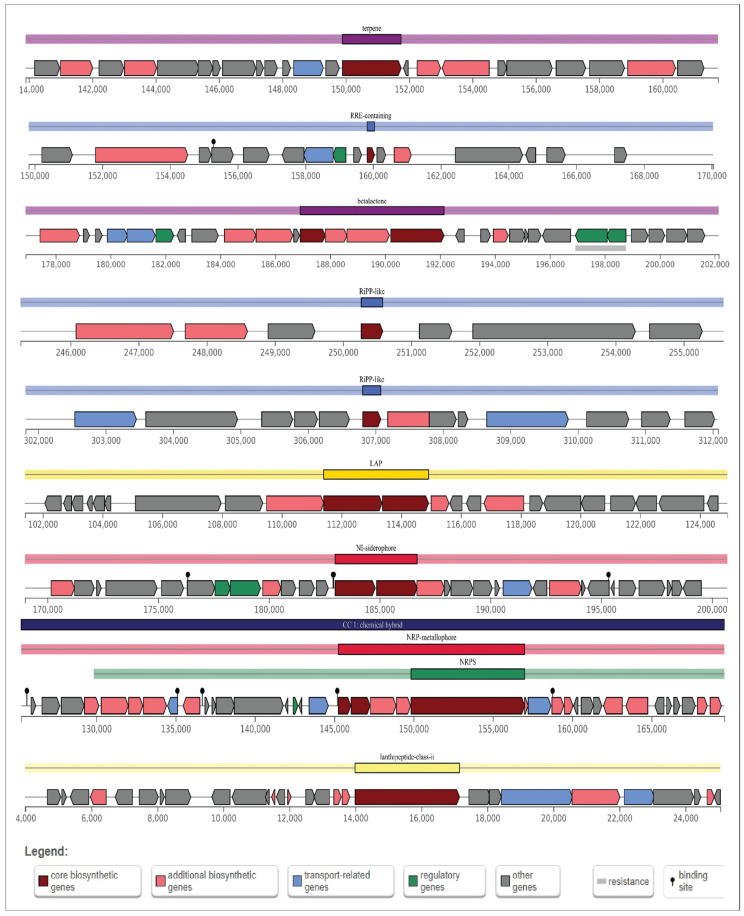
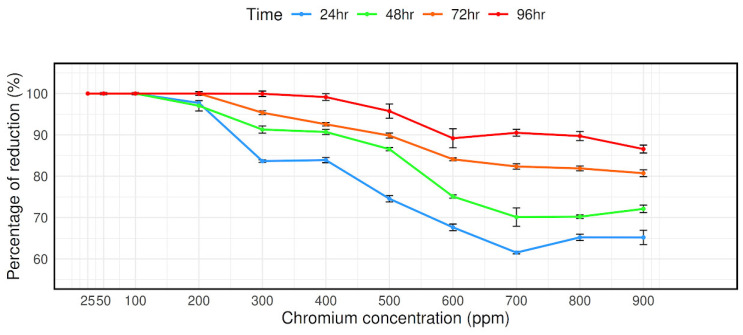
Environmental pollution from metal toxicity is a widespread concern. Certain bacteria hold promise for bioremediation via the conversion of toxic chromium compounds into less harmful forms, promoting environmental cleanup. In this study, we report the isolation and detailed characterization of a highly chromium-tolerant bacterium, CRB14. The isolate is capable of growing on 5000 mg/L Cr (VI) in an LB (Luria Bertani) agar plate while on 900 mg/L Cr (VI) in LB broth. It shows an 86.57% reduction ability in 96 h of culture. It can also tolerate high levels of As, Cd, Co, Fe, Zn, and Pb. The isolate also shows plant growth-promoting potential as demonstrated by a significant activity of nitrogen fixation, phosphate solubilization, IAA (indole acetic acid), and siderophore production. Whole-genome sequencing revealed that the isolate lacks Cr resistance genes in their plasmids and are located on its chromosome. The presence of the gene points towards Cr(VI) transport, while the absence of suggests alternative reduction pathways. The genome harbors features like genomic islands and CRISPR-Cas systems, potentially aiding adaptation and defense. Analysis suggests robust metabolic pathways, potentially involved in Cr detoxification. Notably, genes for siderophore and NRP-metallophore production were identified. Whole-genome sequencing data also provides the basis for molecular validation of various genes. Findings from this study highlight the potential application of CRB14 for bioremediation while plant growth promotion can be utilized as an added benefit.

摘要

金属毒性造成的环境污染是一个广泛关注的问题。某些细菌有望通过将有毒的铬化合物转化为危害较小的形式来进行生物修复,从而促进环境清理。在本研究中,我们报告了一种高度耐铬细菌CRB14的分离和详细表征。该分离株能够在LB(Luria Bertani)琼脂平板上的5000 mg/L Cr(VI)以及LB肉汤中的900 mg/L Cr(VI)上生长。在培养96小时后,它显示出86.57%的还原能力。它还能耐受高水平的砷、镉、钴、铁、锌和铅。该分离株还表现出促进植物生长的潜力,如固氮、解磷、产生吲哚乙酸(IAA)和铁载体的显著活性所示。全基因组测序表明,该分离株在其质粒中缺乏抗铬基因,这些基因位于其染色体上。该基因的存在指向Cr(VI)的转运,而该基因的缺失表明存在其他还原途径。该基因组具有基因组岛和CRISPR-Cas系统等特征,可能有助于适应和防御。分析表明存在强大的代谢途径,可能参与铬的解毒。值得注意的是,已鉴定出铁载体和NRP-金属载体产生的基因。全基因组测序数据也为各种基因的分子验证提供了基础。本研究的结果突出了CRB14在生物修复方面的潜在应用,同时促进植物生长可作为一项附加益处加以利用。

https://cdn.ncbi.nlm.nih.gov/pmc/blobs/3aaf/11676387/364bded27ac8/microorganisms-12-02633-g010.jpg
https://cdn.ncbi.nlm.nih.gov/pmc/blobs/3aaf/11676387/451db3147fd7/microorganisms-12-02633-g001.jpg
https://cdn.ncbi.nlm.nih.gov/pmc/blobs/3aaf/11676387/b4cad718aed4/microorganisms-12-02633-g002.jpg
https://cdn.ncbi.nlm.nih.gov/pmc/blobs/3aaf/11676387/d79b47919ddb/microorganisms-12-02633-g003.jpg
https://cdn.ncbi.nlm.nih.gov/pmc/blobs/3aaf/11676387/4f1fecff3abf/microorganisms-12-02633-g004.jpg
https://cdn.ncbi.nlm.nih.gov/pmc/blobs/3aaf/11676387/7d5e1a1ba9f4/microorganisms-12-02633-g005.jpg
https://cdn.ncbi.nlm.nih.gov/pmc/blobs/3aaf/11676387/1b8ad0b0872f/microorganisms-12-02633-g006.jpg
https://cdn.ncbi.nlm.nih.gov/pmc/blobs/3aaf/11676387/43fcf8ed66ad/microorganisms-12-02633-g007.jpg
https://cdn.ncbi.nlm.nih.gov/pmc/blobs/3aaf/11676387/5b0f963e7a76/microorganisms-12-02633-g008.jpg
https://cdn.ncbi.nlm.nih.gov/pmc/blobs/3aaf/11676387/b3e6c0b03fbe/microorganisms-12-02633-g009.jpg
https://cdn.ncbi.nlm.nih.gov/pmc/blobs/3aaf/11676387/364bded27ac8/microorganisms-12-02633-g010.jpg
https://cdn.ncbi.nlm.nih.gov/pmc/blobs/3aaf/11676387/451db3147fd7/microorganisms-12-02633-g001.jpg
https://cdn.ncbi.nlm.nih.gov/pmc/blobs/3aaf/11676387/b4cad718aed4/microorganisms-12-02633-g002.jpg
https://cdn.ncbi.nlm.nih.gov/pmc/blobs/3aaf/11676387/d79b47919ddb/microorganisms-12-02633-g003.jpg
https://cdn.ncbi.nlm.nih.gov/pmc/blobs/3aaf/11676387/4f1fecff3abf/microorganisms-12-02633-g004.jpg
https://cdn.ncbi.nlm.nih.gov/pmc/blobs/3aaf/11676387/7d5e1a1ba9f4/microorganisms-12-02633-g005.jpg
https://cdn.ncbi.nlm.nih.gov/pmc/blobs/3aaf/11676387/1b8ad0b0872f/microorganisms-12-02633-g006.jpg
https://cdn.ncbi.nlm.nih.gov/pmc/blobs/3aaf/11676387/43fcf8ed66ad/microorganisms-12-02633-g007.jpg
https://cdn.ncbi.nlm.nih.gov/pmc/blobs/3aaf/11676387/5b0f963e7a76/microorganisms-12-02633-g008.jpg
https://cdn.ncbi.nlm.nih.gov/pmc/blobs/3aaf/11676387/b3e6c0b03fbe/microorganisms-12-02633-g009.jpg
https://cdn.ncbi.nlm.nih.gov/pmc/blobs/3aaf/11676387/364bded27ac8/microorganisms-12-02633-g010.jpg

相似文献

1
Characterization and Molecular Insights of a Chromium-Reducing Bacterium .一株铬还原菌的特性及分子解析
Microorganisms. 2024 Dec 19;12(12):2633. doi: 10.3390/microorganisms12122633.
2
Tolerance and Reduction of Chromium(VI) by sp. MNU16 Isolated from Contaminated Coal Mining Soil.从受污染煤矿土壤中分离出的菌株MNU16对六价铬的耐受性及还原作用
Front Plant Sci. 2017 May 22;8:778. doi: 10.3389/fpls.2017.00778. eCollection 2017.
3
Chromium reduction, plant growth-promoting potentials, and metal solubilizatrion by Bacillus sp. isolated from alluvial soil.从冲积土中分离出的芽孢杆菌属对铬的还原、促进植物生长的潜力及金属溶解作用
Curr Microbiol. 2007 Mar;54(3):237-43. doi: 10.1007/s00284-006-0451-5.
4
Reclamation of chromium-contaminated soil by native Cr(VI)-reducing and PHA-accumulating Bacillus aryabhattai CTSI-07.土著 Cr(VI)-还原和 PHA 积累芽孢杆菌 CTSI-07 对铬污染土壤的修复。
Int Microbiol. 2024 Jun;27(3):731-742. doi: 10.1007/s10123-023-00421-6. Epub 2023 Sep 7.
5
Reduction of Hexavalent Chromium [Cr(VI)] by Heavy Metal Tolerant Bacterium Alkalihalobacillus clausii CRA1 and Its Toxicity Assessment Through Flow Cytometry.耐重金属细菌克劳氏碱嗜盐芽孢杆菌CRA1对六价铬[Cr(VI)]的还原及其通过流式细胞术进行的毒性评估
Curr Microbiol. 2021 Dec 24;79(1):33. doi: 10.1007/s00284-021-02734-z.
6
Intrinsic characteristics of Cr⁶⁺-resistant bacteria isolated from an electroplating industry polluted soils for plant growth-promoting activities.从电镀工业污染土壤中分离的耐六价铬细菌的固有特性及其对植物生长的促进作用。
Appl Biochem Biotechnol. 2012 Jul;167(6):1653-67. doi: 10.1007/s12010-012-9606-y. Epub 2012 Feb 28.
7
Characterization and genomic analysis of chromate resistant and reducing Bacillus cereus strain SJ1.铬酸盐抗性和还原芽孢杆菌 SJ1 的特性及基因组分析。
BMC Microbiol. 2010 Aug 19;10:221. doi: 10.1186/1471-2180-10-221.
8
New Plant Growth-Promoting, Chromium-Detoxifying Species Isolated From a Tannery Wastewater: Performance and Genomic Insights.从制革废水中分离出的促进植物生长、解毒铬的新物种:性能与基因组学见解
Front Bioeng Biotechnol. 2020 Jul 3;8:521. doi: 10.3389/fbioe.2020.00521. eCollection 2020.
9
Hexavalent chromium stress response, reduction capability and bioremediation potential of Trichoderma sp. isolated from electroplating wastewater.六价铬胁迫响应、还原能力及一株从电镀废水中分离的木霉的生物修复潜力。
Ecotoxicol Environ Saf. 2019 Dec 15;185:109734. doi: 10.1016/j.ecoenv.2019.109734. Epub 2019 Sep 28.
10
Hexavalent chromium reduction by Bacillus sp. strain FM1 isolated from heavy-metal contaminated soil.从重金属污染土壤中分离得到的芽孢杆菌 FM1 对六价铬的还原作用。
Bull Environ Contam Toxicol. 2011 Jan;86(1):114-9. doi: 10.1007/s00128-010-0181-z. Epub 2010 Dec 23.

本文引用的文献

1
Role of Plant-Growth-Promoting Rhizobacteria in Plant Machinery for Soil Heavy Metal Detoxification.植物促生根际细菌在植物土壤重金属解毒机制中的作用
Microorganisms. 2024 Mar 29;12(4):700. doi: 10.3390/microorganisms12040700.
2
Interactive Tree of Life (iTOL) v6: recent updates to the phylogenetic tree display and annotation tool.交互式生命树 (iTOL) v6:系统发育树显示和注释工具的最新更新。
Nucleic Acids Res. 2024 Jul 5;52(W1):W78-W82. doi: 10.1093/nar/gkae268.
3
Isolation of chromium resistant bacteria from tannery waste and assessment of their chromium reducing capabilities - A Bioremediation Approach.
从制革厂废料中分离耐铬细菌及其铬还原能力评估——一种生物修复方法
Heliyon. 2024 Mar 13;10(6):e27821. doi: 10.1016/j.heliyon.2024.e27821. eCollection 2024 Mar 30.
4
Genome analysis of Shewanella putrefaciens 4H revealing the potential mechanisms for the chromium remediation.希瓦氏菌 4H 的基因组分析揭示了其铬修复的潜在机制。
BMC Genomics. 2024 Feb 2;25(1):136. doi: 10.1186/s12864-024-10031-9.
5
Biotechnological Key Genes of the MGMM8 Genome: Genes for Bioremediation, Antibiotics, Plant Protection, and Growth Stimulation.MGMM8基因组的生物技术关键基因:用于生物修复、抗生素、植物保护和生长刺激的基因。
Microorganisms. 2023 Dec 31;12(1):88. doi: 10.3390/microorganisms12010088.
6
Chromium and arsenic bioaccumulation and biomass potential of pink morning glory (Ipomoea carnea Jacq.).铬和砷在粉色牵牛(Ipomoea carnea Jacq.)中的生物积累和生物量潜力。
Environ Sci Pollut Res Int. 2024 Jan;31(2):2187-2197. doi: 10.1007/s11356-023-31159-3. Epub 2023 Dec 6.
7
Microbial Biosurfactant: as a Potential Remediator of Environments Contaminated by Heavy Metals.微生物生物表面活性剂:作为重金属污染环境的潜在修复剂。
Microorganisms. 2023 Nov 15;11(11):2772. doi: 10.3390/microorganisms11112772.
8
Proksee: in-depth characterization and visualization of bacterial genomes.Proksee:细菌基因组的深入特征描述和可视化。
Nucleic Acids Res. 2023 Jul 5;51(W1):W484-W492. doi: 10.1093/nar/gkad326.
9
antiSMASH 7.0: new and improved predictions for detection, regulation, chemical structures and visualisation.antiSMASH 7.0:用于检测、调控、化学结构和可视化的全新且改进的预测功能。
Nucleic Acids Res. 2023 Jul 5;51(W1):W46-W50. doi: 10.1093/nar/gkad344.
10
Metabolic pathway of Cr(VI) reduction by bacteria: A review.细菌还原六价铬的代谢途径:综述
Microbiol Res. 2023 Mar;268:127288. doi: 10.1016/j.micres.2022.127288. Epub 2022 Dec 18.