Li Fangfang, He Yu, Yang Ali, Xia Mingrong, Zang Weizhou, Zhang Jiewen
Department of Neurology, Henan Provincial People's Hospital, Zhengzhou University People's Hospital, No. 7 Weiwu Road, Zhengzhou, Henan, China.
Lipids Health Dis. 2025 Jan 8;24(1):7. doi: 10.1186/s12944-025-02430-y.
The Cardiometabolic Index (CMI) represents a novel anthropometric measurement, which combines characteristics of adiposity and lipids. Since obesity, lipid metabolism, and inflammation may collectively facilitate the occurrence of stroke, we hypothesize that a combination of elevated levels of the CMI and high-sensitivity C-reactive protein (hs-CRP) increases the risk of future stroke among middle-aged and older Chinese adults.
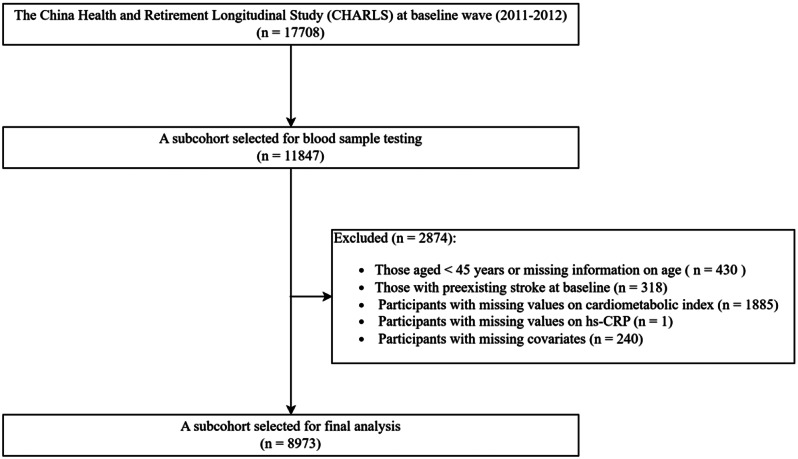
This study included 8,973 participants aged 45 years or older from the China Longitudinal Study on Health and Retirement (CHARLS), who were stroke-free and underwent baseline evaluations between 2011 and 2012, with followed-up at 2013, 2015 and 2018. The exposures were CMI and hs-CRP, with CMI calculated using the formula [waist circumference (cm)/height (cm)] × [triglycerides (mmol/L)/HDL-C (mmol/L)]. The primary outcome was the occurrence of new-onset stroke events. Cox proportional hazards models and restricted cubic spline (RCS) analyses were conducted to examine the associations between CMI, hs-CRP, and their combined effects on stroke risk. Sensitivity analysis was further implemented to verify the robustness of the results.
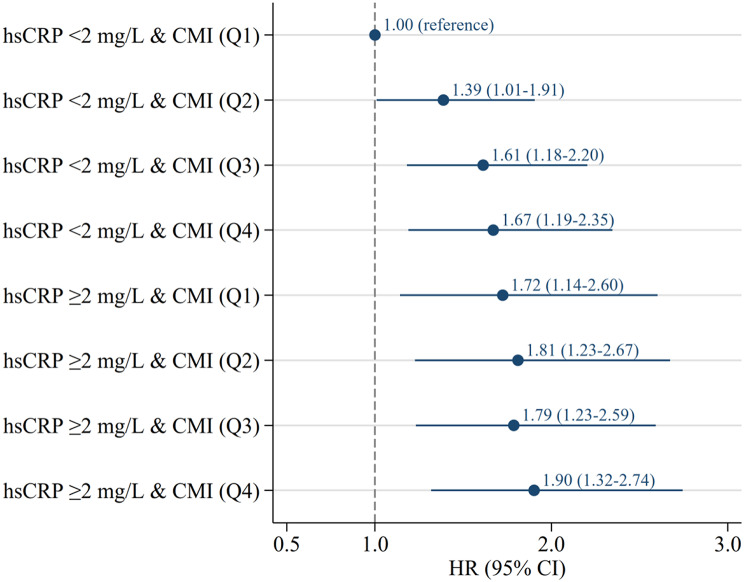
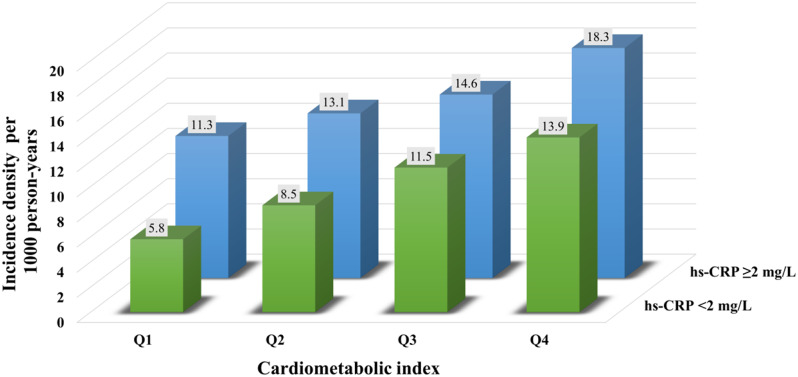
A total of 629 participants (7.01%) suffered new-onset stroke during follow-up. The risk for stroke increased with each elevating quartile of baseline CMI levels, with adjusted HRs and 95% CIs being 1.27 (0.98-1.66), 1.41 (1.08-1.83), and 1.46 (1.09-1.96) for Q2, Q3, and Q4, respectively. Moreover, participants with levels of hs-CRP ≥ 2 mg/L also had significantly higher stroke incidence compared to those with CRP levels < 2 mg/L (adjusted HR 1.24, 95% CI 1.05-1.47, p = 0.012). Specifically, those concurrently with the highest CMI quartile and levels of hs-CRP ≥ 2 mg/L had the highest risk of stroke (adjusted HR 1.90, 95% CI 1.32-2.74). The subsequent sensitivity analyses yielded consistent results, further corroborating the initial findings.
The combination of CMI and hs-CRP exhibited a significant association with stroke risk among middle-aged and older Chinese adults, highlighting the importance of joint assessments of these biomarkers for refining risk stratification and enhancing primary prevention strategies for stroke.
心脏代谢指数(CMI)是一种新的人体测量指标,它综合了肥胖和血脂的特征。由于肥胖、脂质代谢和炎症可能共同促进中风的发生,我们推测CMI水平升高与高敏C反应蛋白(hs-CRP)相结合会增加中国中老年成年人未来中风的风险。
本研究纳入了来自中国健康与养老追踪调查(CHARLS)的8973名45岁及以上的参与者,他们在2011年至2012年期间无中风且接受了基线评估,并在2013年、2015年和2018年进行了随访。暴露因素为CMI和hs-CRP,CMI使用公式[腰围(cm)/身高(cm)]×[甘油三酯(mmol/L)/高密度脂蛋白胆固醇(HDL-C,mmol/L)]计算。主要结局是新发中风事件的发生。采用Cox比例风险模型和受限立方样条(RCS)分析来检验CMI、hs-CRP及其联合作用与中风风险之间的关联。进一步进行敏感性分析以验证结果的稳健性。
共有629名参与者(7.01%)在随访期间发生了新发中风。中风风险随着基线CMI水平的每升高一个四分位数而增加,Q2、Q3和Q4的调整后风险比(HR)及95%置信区间(CI)分别为1.27(0.98 - 1.66)、1.41(1.08 - 1.83)和1.46(1.09 - 1.96)。此外,hs-CRP≥2 mg/L的参与者与CRP水平<2 mg/L的参与者相比,中风发病率也显著更高(调整后HR 1.24,95% CI 1.05 - 1.47,p = 0.012)。具体而言,CMI处于最高四分位数且hs-CRP≥2 mg/L的参与者中风风险最高(调整后HR 1.90,95% CI 1.32 - 2.74)。随后的敏感性分析得出了一致的结果,进一步证实了最初的发现。
CMI和hs-CRP的联合与中国中老年成年人的中风风险显著相关,突出了联合评估这些生物标志物对于优化风险分层和加强中风一级预防策略的重要性。