Department of Intensive Care Unit, Longgang Central Hospital of Shenzhen, Shenzhen, Guangdong, China.
Department of Internal Medicine, Shenzhen Baoan Maternal and Child Health Hospital, Shenzhen, Guangdong, China.
Front Endocrinol (Lausanne). 2024 Oct 21;15:1446276. doi: 10.3389/fendo.2024.1446276. eCollection 2024.
The cardiometabolic index (CMI) has emerged as a novel marker for evaluating the distribution and dysfunction of visceral adipose tissue, yet its correlation with numerous diseases, particularly new-onset chronic conditions, remains underexplored. Therefore, we aim to explore the association of cardiometabolic index (CMI) and new-onset chronic diseases.
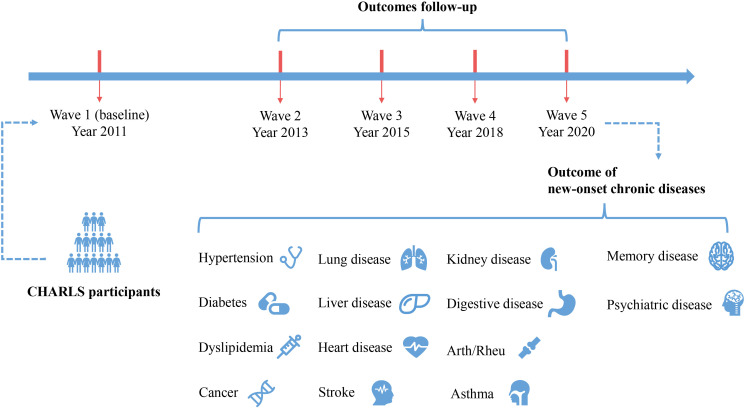
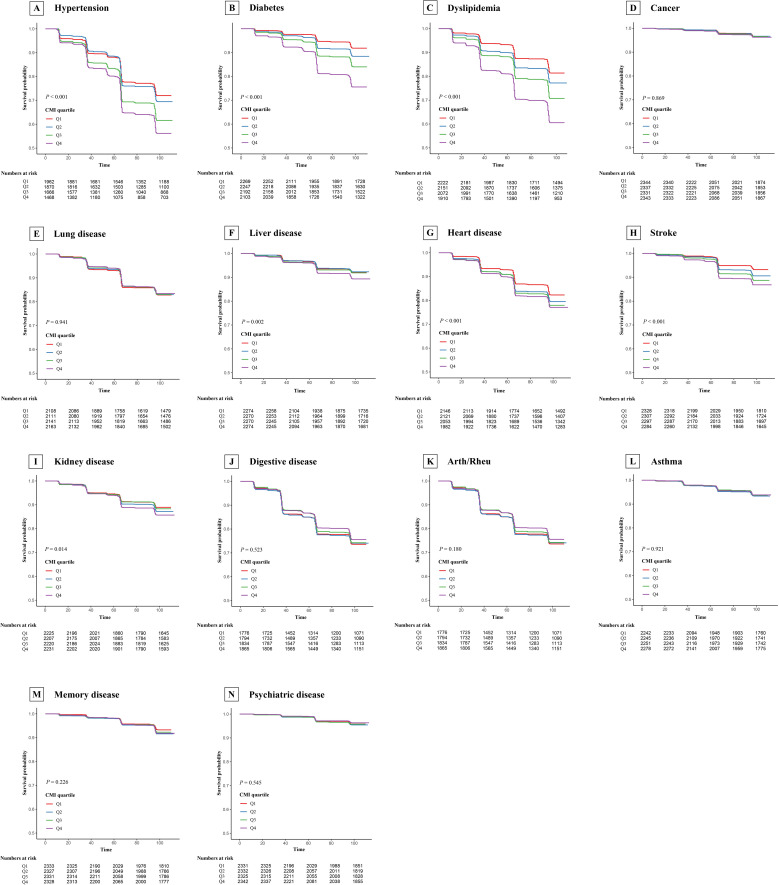
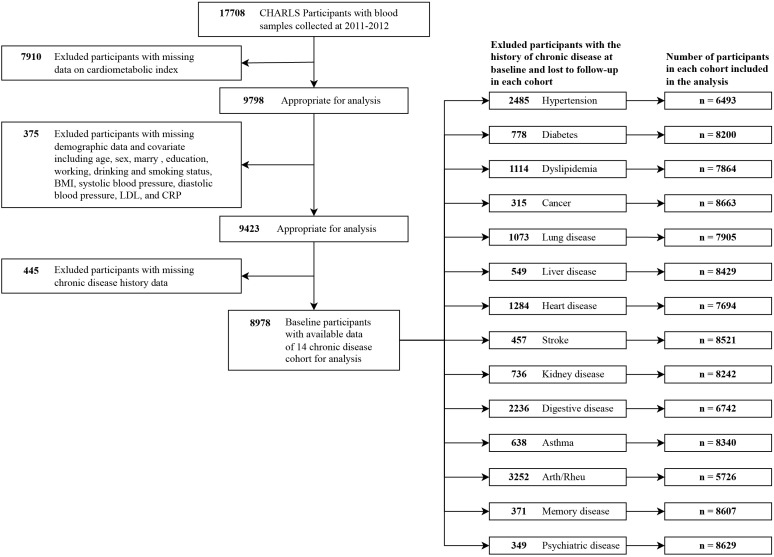
The analysis utilized data from the China Health and Retirement Longitudinal Study, with a baseline in 2011 and follow-ups biennially until 2020. Fourteen new-onset chronic diseases were diagnosed based on self-report, and separate cohorts were created for each disease. CMI was calculated as triglycerides/high-density lipoprotein cholesterol multiplied by the waist-to-height ratio. Cox proportional hazards models were used to assess the association between CMI and new-onset chronic diseases, while restricted cubic spline (RCS) models were employed to explore potential nonlinear effects. Additional and sensitivity analyses included Kaplan-Meier survival curves, subgroup analyses, multiple imputations, and exclude outcome events at the first follow-up.
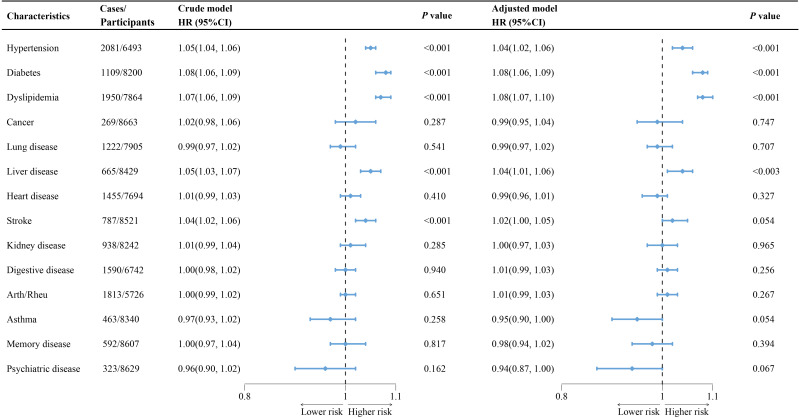
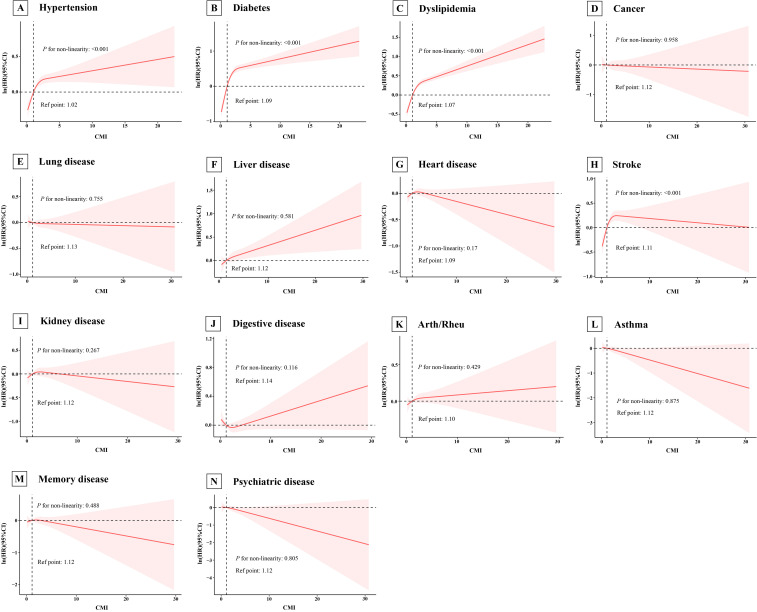
Higher levels of CMI were associated with an increased risk of new-onset hypertension (HR=1.05, 95% CI=1.04-1.06, <0.001), diabetes (HR=1.08, 95% CI=1.06-1.09, <0.001), dyslipidemia (HR=1.07, 95% CI=1.06-1.09, <0.001), liver disease (HR=1.05, 95% CI=1.03-1.07, <0.003), and stroke (HR=1.04, 95% CI=1.02-1.06, <0.001), although the association with stroke was not significant after adjusting for confounders (HR=1.02, 95% CI=1.00-1.05, =0.054). Participants in the highest quartile of CMI had a significantly higher risk of these diseases compared to those in the lowest quartile. RCS analyses showed a significant nonlinear relationship between CMI and the risk of these diseases above.
CMI showed a significant positive association with the risk of new-onset chronic diseases such as hypertension, diabetes, dyslipidemia, and liver disease. Future applications of CMI hold promise as an effective marker for early identification of chronic disease risk.
心脏代谢指数(CMI)已成为评估内脏脂肪组织分布和功能障碍的新型标志物,但它与许多疾病的相关性,尤其是新发慢性病的相关性仍未得到充分探索。因此,我们旨在探讨心脏代谢指数(CMI)与新发慢性病的关系。
本分析使用了中国健康与退休纵向研究的数据,基线为 2011 年,随后每两年进行一次随访,直至 2020 年。根据自我报告诊断出 14 种新发慢性病,并为每种疾病创建了单独的队列。CMI 计算方法为三酰甘油/高密度脂蛋白胆固醇乘以腰高比。使用 Cox 比例风险模型评估 CMI 与新发慢性病之间的关系,同时使用限制性立方样条(RCS)模型探讨潜在的非线性效应。进一步的分析包括 Kaplan-Meier 生存曲线、亚组分析、多重插补和排除首次随访时的结局事件。
较高的 CMI 水平与新发高血压(HR=1.05,95%CI=1.04-1.06,<0.001)、糖尿病(HR=1.08,95%CI=1.06-1.09,<0.001)、血脂异常(HR=1.07,95%CI=1.06-1.09,<0.001)、肝病(HR=1.05,95%CI=1.03-1.07,<0.003)和中风(HR=1.04,95%CI=1.02-1.06,<0.001)的风险增加相关,但在调整混杂因素后,与中风的相关性无统计学意义(HR=1.02,95%CI=1.00-1.05,=0.054)。与 CMI 最低四分位数相比,CMI 最高四分位数的参与者发生这些疾病的风险显著更高。RCS 分析表明,CMI 与这些疾病的风险之间存在显著的非线性关系。
CMI 与新发高血压、糖尿病、血脂异常和肝病等慢性病的发病风险呈显著正相关。CMI 有望成为一种有效的慢性病风险早期识别标志物。