Yu Zhongguang, Hu Ning, Zhao Qiuyi, Hu Xiang, Jia Cunbo, Zhang Chunyu, Liu Bing, Li Yanping
Economics and Management School, Wuhan University, Wuhan, China.
Respiratory Centre, China-Japan Friendship Hospital, Beijing, China.
J Med Internet Res. 2025 Jan 7;27:e62768. doi: 10.2196/62768.
Artificial intelligence-driven clinical decision support systems (AI-CDSSs) are pivotal tools for doctors to improve diagnostic and treatment processes, as well as improve the efficiency and quality of health care services. However, not all doctors trust artificial intelligence (AI) technology, and many remain skeptical and unwilling to adopt these systems.
This study aimed to explore in depth the factors influencing doctors' willingness to adopt AI-CDSSs and assess the causal relationships among these factors to gain a better understanding for promoting the clinical application and widespread implementation of these systems.
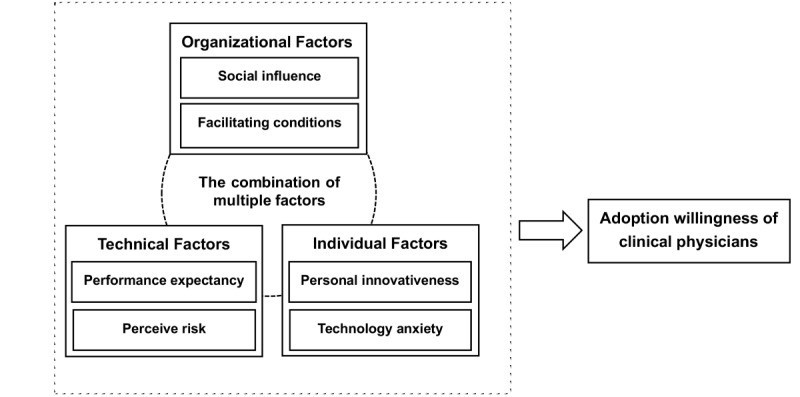
Based on the unified theory of acceptance and use of technology (UTAUT) and the technology-organization-environment (TOE) framework, we have proposed and designed a framework for doctors' willingness to adopt AI-CDSSs. We conducted a nationwide questionnaire survey in China and performed fuzzy set qualitative comparative analysis to explore the willingness of doctors to adopt AI-CDSSs in different types of medical institutions and assess the factors influencing their willingness.
The survey was administered to doctors working in tertiary hospitals and primary/secondary hospitals across China. We received 450 valid responses out of 578 questionnaires distributed, indicating a robust response rate of 77.9%. Our analysis of the influencing factors and adoption pathways revealed that doctors in tertiary hospitals exhibited 6 distinct pathways for AI-CDSS adoption, which were centered on technology-driven pathways, individual-driven pathways, and technology-individual dual-driven pathways. Doctors in primary/secondary hospitals demonstrated 3 adoption pathways, which were centered on technology-individual and organization-individual dual-driven pathways. There were commonalities in the factors influencing adoption across different medical institutions, such as the positive perception of AI technology's utility and individual readiness to try new technologies. There were also variations in the influence of facilitating conditions among doctors at different medical institutions, especially primary/secondary hospitals.
From the perspective of the 6 pathways for doctors at tertiary hospitals and the 3 pathways for doctors at primary/secondary hospitals, performance expectancy and personal innovativeness were 2 indispensable and core conditions in the pathways to achieving favorable willingness to adopt AI-CDSSs.
人工智能驱动的临床决策支持系统(AI-CDSSs)是医生改善诊断和治疗过程以及提高医疗服务效率和质量的关键工具。然而,并非所有医生都信任人工智能(AI)技术,许多人仍然持怀疑态度,不愿意采用这些系统。
本研究旨在深入探讨影响医生采用AI-CDSSs意愿的因素,并评估这些因素之间的因果关系,以便更好地理解如何促进这些系统的临床应用和广泛实施。
基于技术接受与使用统一理论(UTAUT)和技术-组织-环境(TOE)框架,我们提出并设计了一个医生采用AI-CDSSs意愿的框架。我们在中国进行了全国性问卷调查,并进行了模糊集定性比较分析,以探讨不同类型医疗机构中医生采用AI-CDSSs的意愿,并评估影响其意愿的因素。
该调查面向中国三级医院和基层医院的医生。在分发的578份问卷中,我们收到了450份有效回复,有效回复率为77.9%,相当可观。我们对影响因素和采用途径的分析表明,三级医院的医生表现出6种不同的AI-CDSS采用途径,这些途径以技术驱动途径、个人驱动途径和技术-个人双重驱动途径为中心。基层医院的医生展示了3种采用途径,这些途径以技术-个人和组织-个人双重驱动途径为中心。不同医疗机构中影响采用的因素存在共性,例如对AI技术效用的积极认知和个人尝试新技术的意愿。不同医疗机构的医生,尤其是基层医院的医生,在促进条件的影响方面也存在差异。
从三级医院医生的6种途径和基层医院医生的3种途径来看,绩效期望和个人创新性是实现采用AI-CDSSs良好意愿途径中两个不可或缺的核心条件。