Fujimori Ryo, Liu Keibun, Soeno Shoko, Naraba Hiromu, Ogura Kentaro, Hara Konan, Sonoo Tomohiro, Ogura Takayuki, Nakamura Kensuke, Goto Tadahiro
Faculty of Medicine, The University of Tokyo, Tokyo, Japan.
TXP Medical Co Ltd, Tokyo, Japan.
JMIR Form Res. 2022 Jun 13;6(6):e36501. doi: 10.2196/36501.
Despite the increasing availability of clinical decision support systems (CDSSs) and rising expectation for CDSSs based on artificial intelligence (AI), little is known about the acceptance of AI-based CDSS by physicians and its barriers and facilitators in emergency care settings.
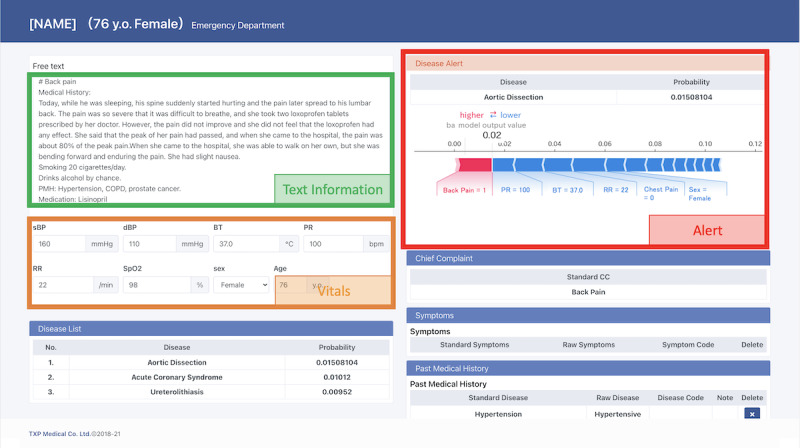
We aimed to evaluate the acceptance, barriers, and facilitators to implementing AI-based CDSSs in the emergency care setting through the opinions of physicians on our newly developed, real-time AI-based CDSS, which alerts ED physicians by predicting aortic dissection based on numeric and text information from medical charts, by using the Unified Theory of Acceptance and Use of Technology (UTAUT; for quantitative evaluation) and the Consolidated Framework for Implementation Research (CFIR; for qualitative evaluation) frameworks.
This mixed methods study was performed from March to April 2021. Transitional year residents (n=6), emergency medicine residents (n=5), and emergency physicians (n=3) from two community, tertiary care hospitals in Japan were included. We first developed a real-time CDSS for predicting aortic dissection based on numeric and text information from medical charts (eg, chief complaints, medical history, vital signs) with natural language processing. This system was deployed on the internet, and the participants used the system with clinical vignettes of model cases. Participants were then involved in a mixed methods evaluation consisting of a UTAUT-based questionnaire with a 5-point Likert scale (quantitative) and a CFIR-based semistructured interview (qualitative). Cronbach α was calculated as a reliability estimate for UTAUT subconstructs. Interviews were sampled, transcribed, and analyzed using the MaxQDA software. The framework analysis approach was used during the study to determine the relevance of the CFIR constructs.
All 14 participants completed the questionnaires and interviews. Quantitative analysis revealed generally positive responses for user acceptance with all scores above the neutral score of 3.0. In addition, the mixed methods analysis identified two significant barriers (System Performance, Compatibility) and two major facilitators (Evidence Strength, Design Quality) for implementation of AI-based CDSSs in emergency care settings.
Our mixed methods evaluation based on theoretically grounded frameworks revealed the acceptance, barriers, and facilitators of implementation of AI-based CDSS. Although the concern of system failure and overtrusting of the system could be barriers to implementation, the locality of the system and designing an intuitive user interface could likely facilitate the use of optimal AI-based CDSS. Alleviating and resolving these factors should be key to achieving good user acceptance of AI-based CDSS.
尽管临床决策支持系统(CDSS)的可用性不断提高,且人们对基于人工智能(AI)的CDSS的期望也在上升,但对于医生对基于AI的CDSS的接受程度及其在急诊环境中的障碍和促进因素知之甚少。
我们旨在通过医生对我们新开发的基于AI的实时CDSS的意见,评估在急诊环境中实施基于AI的CDSS的接受程度、障碍和促进因素。该CDSS通过利用病历中的数字和文本信息预测主动脉夹层,从而提醒急诊科医生,采用技术接受与使用统一理论(UTAUT;用于定量评估)和实施研究综合框架(CFIR;用于定性评估)框架。
这项混合方法研究于2021年3月至4月进行。纳入了日本两家社区三级护理医院的过渡年住院医师(n = 6)、急诊医学住院医师(n = 5)和急诊医生(n = 3)。我们首先基于病历中的数字和文本信息(如主诉、病史、生命体征),利用自然语言处理技术开发了一个用于预测主动脉夹层的实时CDSS。该系统部署在互联网上,参与者使用该系统处理模型病例的临床案例。然后,参与者参与了一项混合方法评估,包括基于UTAUT的5点李克特量表问卷(定量)和基于CFIR的半结构化访谈(定性)。计算Cronbach α作为UTAUT子结构的可靠性估计。访谈进行抽样、转录,并使用MaxQDA软件进行分析。研究期间采用框架分析方法来确定CFIR结构的相关性。
所有14名参与者都完成了问卷和访谈。定量分析显示,用户接受度总体呈积极反应,所有分数均高于中性分数3.0。此外,混合方法分析确定了在急诊环境中实施基于AI的CDSS的两个重大障碍(系统性能、兼容性)和两个主要促进因素(证据强度、设计质量)。
我们基于理论基础框架的混合方法评估揭示了基于AI的CDSS实施的接受程度、障碍和促进因素。尽管对系统故障的担忧和对系统的过度信任可能是实施的障碍,但系统的局部性和设计直观的用户界面可能会促进基于AI的最佳CDSS的使用。减轻和解决这些因素应该是实现用户对基于AI的CDSS良好接受度的关键。
