Oyarce Paula, Xiao Ting Ting, Henkel Corinna, Frederiksen Signe Frost, Gonzalez-Kise Jose Kenyi, Smet Wouter, Wang Jian You, Al-Babili Salim, Blilou Ikram
BESE Division, Plant Cell and Developmental Biology Laboratory, King Abdullah University of Science and Technology, Thuwal, Kingdom of Saudi Arabia.
Bruker Daltonics GmbH & Co. KG, Bremen, Germany.
Sci Rep. 2025 Jan 7;15(1):1076. doi: 10.1038/s41598-025-85416-1.
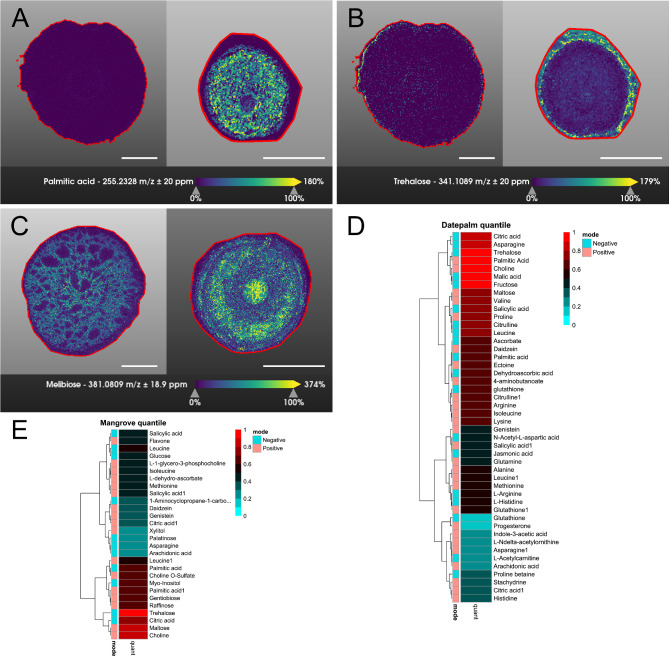
In arid and semi-arid climates, native plants have developed unique strategies to survive challenging conditions. These adaptations often rely on molecular pathways that shape plant architecture to enhance their resilience. Date palms (Phoenix dactylifera) and mangroves (Avicennia marina) endure extreme heat and high salinity, yet the metabolic pathways underlying this resilience remain underexplored. Here, we integrate tissue imaging with spatial metabolomics to uncover shared and distinct adaptive features in these species. We found that mangrove roots accumulate suberin and lignin in meristematic tissues, this is unlike other plant species, where only the differentiation zones contain these compounds. Our metabolomic analysis shows that date palm roots are enriched in metabolites involved in amino acid biosynthesis, whereas compounds involved in lignin and suberin production were more abundant in mangrove roots. Matrix-assisted laser desorption/ionization mass spectrometry imaging (MALDI-MSI) revealed tissue- and species-specific metabolite distributions in root tissues. We identified common osmoprotectants accumulating in the exodermis/epidermis of date palm and mangrove root meristems, along with a unique metabolite highly abundant in the inner cortex of date palm roots. These findings provide valuable insights into stress adaptation pathways and highlight key tissue types involved in root stress response.
在干旱和半干旱气候条件下,本地植物已形成独特策略以在具有挑战性的环境中生存。这些适应性变化通常依赖于塑造植物结构以增强其恢复力的分子途径。枣椰树(Phoenix dactylifera)和红树林(Avicennia marina)能耐受极端高温和高盐度,但这种恢复力背后的代谢途径仍未得到充分探索。在此,我们将组织成像与空间代谢组学相结合,以揭示这些物种中共同的和独特的适应性特征。我们发现,红树林根在分生组织中积累木栓质和木质素,这与其他植物物种不同,其他植物物种只有分化区含有这些化合物。我们的代谢组学分析表明,枣椰树根富含参与氨基酸生物合成的代谢物,而参与木质素和木栓质生成的化合物在红树林根中更为丰富。基质辅助激光解吸/电离质谱成像(MALDI-MSI)揭示了根组织中组织特异性和物种特异性的代谢物分布。我们鉴定出在枣椰树和红树林根分生组织的外皮层/表皮中积累的常见渗透保护剂,以及在枣椰树根内皮层中高度丰富的一种独特代谢物。这些发现为应激适应途径提供了有价值的见解,并突出了参与根应激反应的关键组织类型。