Thompson Lisa M, Ferguson Annalyse, Raheel Hina, Lovvorn Amy E, Hengstermann-Artiga Mayari, Lopez Maria Renee, Higgins Melinda, Saikawa Eri, Handley Margaret A
Nell Hodgson Woodruff School of Nursing, Emory University, Atlanta, GA, United States of America.
Gangarosa Department of Environmental Health, Emory University Rollins School of Public Health, Atlanta, GA, United States of America.
PLoS One. 2024 Dec 30;19(12):e0316161. doi: 10.1371/journal.pone.0316161. eCollection 2024.
Randomized controlled trials (RCTs) that evaluate the efficacy of an intervention remain underutilized in community-based environmental health research. RCTs that use a pragmatic design emphasize the effectiveness of interventions in complex, real world settings. Pragmatic trials may be especially relevant when community-based interventions address social and environmental determinants that threaten health equity. The revised Pragmatic Explanatory Continuum Indicator Summary (PRECIS-2) is a validated tool developed in 2015 by trialists to ensure that clinical trials are designed to fit their intended purpose, with an assessment of applicability of the trial results to specific contexts. The purpose of this cross-sectional study was to ask Ecolectivos study investigators and external implementation scientists to evaluate the Ecolectivos study protocol using the PRECIS-2 tool prior to the launch of the trial. Ecolectivos is an implementation science study, using a village-level cluster randomized controlled trial design, to assess a behavioral intervention to reduce household plastic waste burning in rural Guatemala.
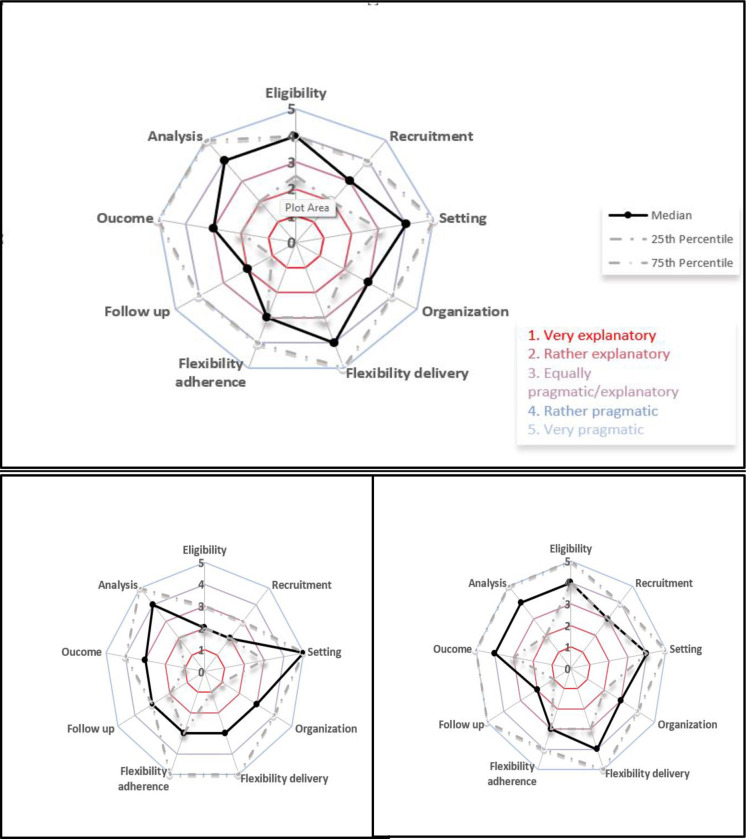
We invited 60 researchers to participate in an online survey between February 2022 and January 2023. Respondents were asked to review the Ecolectivos study protocol and provide scores for the nine PRECIS-2 domains (eligibility, recruitment, setting, organization, flexibility-delivery, flexibility-adherence, follow-up, primary outcome, and primary analysis), with short responses explaining their score. The PRECIS-2 tool is used to assess the degree of pragmatism, ranked on a five-point Likert scale from very explanatory (Checkley W, 2022) to very pragmatic (Ashcraft LE, 2024). Descriptive statistics were used to compare responses between Ecolectivos investigators and external evaluators.
Twenty-five respondents provided data. Among the nine domains, four were rated as pragmatic-eligibility, setting, flexibility-delivery, and primary analysis. Four were evaluated to be equally pragmatic as explanatory-recruitment, organization, flexibility-adherence, and primary outcome. One domain was primarily explanatory in nature-follow-up. Only one domain, eligibility, was statistically significantly different between Ecolectivos investigators and external evaluators, demonstrating that the two groups were broadly consistent in their opinions in eight of the nine study domains. Using the PRECIS-2 tool, we found that our study protocol was viewed as more pragmatic than explanatory, providing evidence to support the pragmatic approach of the Ecolectivos study goals, which is to reduce burning of plastic waste and plastic use in community settings using a behavioral intervention.
By evaluating the degree of pragmatism within the nine domains, PRECIS-2 guides investigators to think about the applicability of potential results. Investigator assessment and communication regarding intervention protocols for community-level environmental interventions, their degree of pragmatism, and external validity are important for identifying strategies to address complex community problems. Our findings contribute to the growing body of literature that addresses greater research utility through pragmatic trial design, tying community environmental health interventions to the rigor of implementation science strategies.
评估干预措施效果的随机对照试验(RCT)在基于社区的环境卫生研究中仍未得到充分利用。采用务实设计的RCT强调干预措施在复杂现实环境中的有效性。当基于社区的干预措施解决威胁健康公平的社会和环境决定因素时,务实试验可能尤为相关。修订后的务实解释性连续体指标摘要(PRECIS-2)是试验者于2015年开发的一种经过验证的工具,用于确保临床试验的设计符合其预期目的,并评估试验结果在特定背景下的适用性。这项横断面研究的目的是在试验启动前,让Ecolectivos研究的调查人员和外部实施科学家使用PRECIS-2工具评估Ecolectivos研究方案。Ecolectivos是一项实施科学研究,采用村级整群随机对照试验设计,以评估一项行为干预措施,以减少危地马拉农村家庭焚烧塑料垃圾的行为。
我们邀请了60名研究人员在2022年2月至2023年1月期间参与在线调查。要求受访者审查Ecolectivos研究方案,并为PRECIS-2的九个领域(入选标准、招募、环境、组织、灵活性-实施、灵活性-依从性、随访、主要结局和主要分析)打分,并简短说明打分理由。PRECIS-2工具用于评估务实程度,按从非常解释性(Checkley W,2022)到非常务实(Ashcraft LE,2024)的五点李克特量表进行排名。使用描述性统计来比较Ecolectivos研究人员和外部评估人员的回答。
25名受访者提供了数据。在九个领域中,四个被评为务实——入选标准、环境、灵活性-实施和主要分析。四个被评估为务实程度与解释性程度相当——招募、组织、灵活性-依从性和主要结局。一个领域本质上主要是解释性的——随访。只有入选标准这一领域在Ecolectivos研究人员和外部评估人员之间存在统计学显著差异,表明两组在九个研究领域中的八个领域的意见大致一致。使用PRECIS-2工具,我们发现我们的研究方案被视为比解释性更强的务实方案,这为支持Ecolectivos研究目标的务实方法提供了证据,该目标是通过行为干预减少社区环境中塑料垃圾的焚烧和塑料的使用。
通过评估九个领域内的务实程度,PRECIS-2指导研究人员思考潜在结果的适用性。研究人员对社区层面环境干预措施的干预方案、其务实程度和外部效度进行评估和交流,对于确定解决复杂社区问题的策略很重要。我们的研究结果为越来越多的文献做出了贡献,这些文献通过务实试验设计提高了研究效用,将社区环境卫生干预措施与实施科学策略的严谨性联系起来。