Kim Chulho, Lee Jae Jun, Sohn Jong-Hee, Kim Jong-Ho, Won Dong-Ok, Lee Sang-Hwa
Department of Neurology, Chuncheon Sacred Heart Hospital, Hallym University College of Medicine, Chuncheon, South Korea.
Institute of New Frontier research Team, Hallym University, Chuncheon, South Korea.
PLoS One. 2025 Jan 8;20(1):e0316068. doi: 10.1371/journal.pone.0316068. eCollection 2025.
This study aimed to evaluate the predictive ability of two widely used early warning scoring systems, the Modified Early Warning Score (MEWS) and the National Early Warning Score (NEWS), for predicting stroke occurrence in hospitalized patients.
The study enrolled 5,474 patients admitted to the intensive care unit from the general ward using data from the Smart Clinical Data Warehouse (CDW). MEWS and NEWS were calculated based on vital signs and clinical parameters within four hours of stroke onset. Stroke occurrence was categorized as ischemic or hemorrhagic. Logistic regression and receiver operating characteristic curve analyses were performed to assess the predictive abilities of the scoring systems.
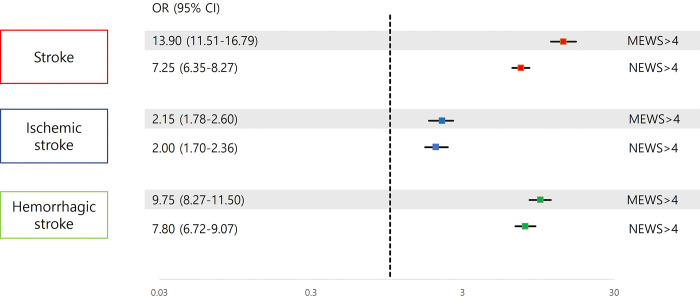
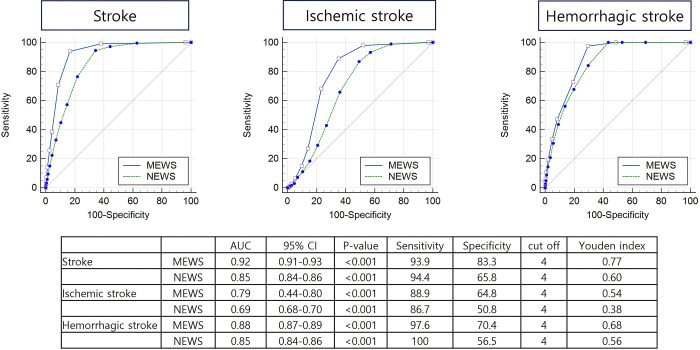
Of the enrolled patients, 33.9% (n = 1853) experienced stroke, comprising 783 cases of ischemic stroke and 1,070 cases of hemorrhagic stroke. Both the MEWS and the NEWS were found to significantly predict overall stroke occurrence with a cutoff value of 4 (MEWS>4; OR [95% CI]: 13.90 [11.51-16.79], p<0.001; NEWS>4; OR [95% CI]: 6.71 [5.75-7.83], p<0.001). Parameters, such as prior malignancy, atrial fibrillation, AVPU response, heart rate, respiratory rate, and oxygen saturation, are also associated with stroke occurrence. The predictive ability of MEWS and NEWS was good for overall stroke occurrence. (AUC of MEWS: 0.92, 95% CI [0.91-0.93], p<0.001; AUC of NEWS: 0.85, 95% CI [0.84-0.86], p<0.001). The predictive ability was considered fair for ischemic stroke but good for hemorrhagic stroke.
MEWS and NEWS demonstrated significant predictive abilities for overall stroke occurrence among hospitalized patients, with MEWS slightly outperforming NEWS.
本研究旨在评估两种广泛使用的早期预警评分系统,即改良早期预警评分(MEWS)和国家早期预警评分(NEWS),对住院患者中风发生的预测能力。
该研究使用智能临床数据仓库(CDW)的数据,纳入了5474名从普通病房转入重症监护病房的患者。在中风发作后4小时内,根据生命体征和临床参数计算MEWS和NEWS。中风发生分为缺血性或出血性。进行逻辑回归和受试者工作特征曲线分析,以评估评分系统的预测能力。
在纳入的患者中,33.9%(n = 1853)发生了中风,其中缺血性中风783例,出血性中风1070例。发现MEWS和NEWS均能显著预测总体中风的发生,临界值为4(MEWS>4;OR [95% CI]:13.90 [11.51 - 16.79],p<0.001;NEWS>4;OR [95% CI]:6.71 [5.75 - 7.83],p<0.001)。既往恶性肿瘤、心房颤动、AVPU反应、心率、呼吸频率和血氧饱和度等参数也与中风发生有关。MEWS和NEWS对总体中风发生的预测能力良好。(MEWS的AUC:0.92,95% CI [0.91 - 0.93],p<0.001;NEWS的AUC:0.85,95% CI [0.84 - 0.86],p<0.001)。对缺血性中风的预测能力一般,但对出血性中风的预测能力良好。
MEWS和NEWS对住院患者总体中风的发生具有显著的预测能力,MEWS略优于NEWS。