Oncology Department, Punan Hospital of Pudong New District, Shanghai, People's Republic of China.
Centre for Cancer Genomics and Computational Biology, Barts Cancer Institute, London, EC1M 6BE, UK.
Clin Interv Aging. 2021 Oct 28;16:1917-1929. doi: 10.2147/CIA.S335315. eCollection 2021.
The incidence and mortality rate of community-acquired pneumonia (CAP) in elderly patients were higher than the younger population. Different scoring systems, including The quick Sequential Organ Function Assessment (qSOFA), Combination of Confusion, Urea, Respiratory Rate, Blood Pressure, and Age ≥65 (CURB-65), Modified Early Warning Score (MEWS) and National Early Warning Score (NEWS), were used widely for predicting mortality and ICU admission of patients with community-acquired pneumonia (CAP). This study aimed to identify the most suitable score system for better hospitalization.
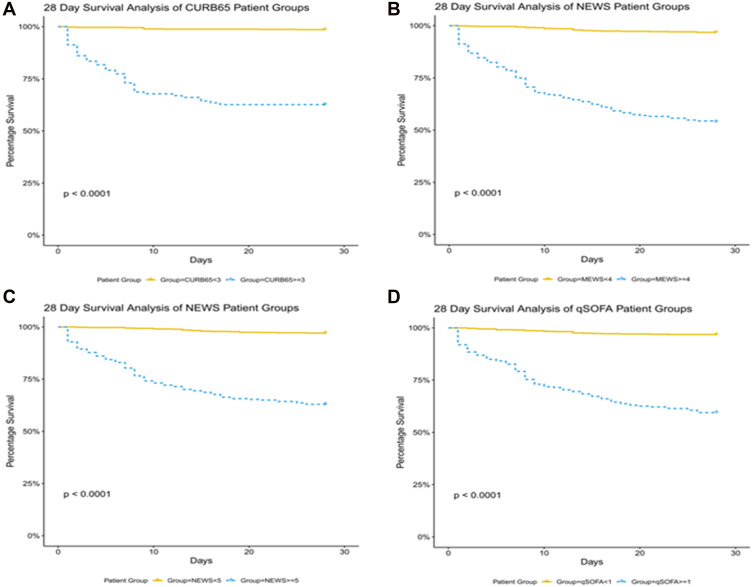
We retrospectively analyzed elderly patients with CAP in Minhang Hospital, Fudan University from 1 January 2018 to 1 January 2020. We recorded information of the patients including age, gender, underlying disease, consciousness state, vital signs, physiological and laboratory variables and further calculated the qSOFA, CURB-65, MEWS, and NEWS scores. Receiver operating characteristic (ROC) curves were used to predict the mortality risk and ICU admission. Kaplan-Meier survival curves were used in survival rate.
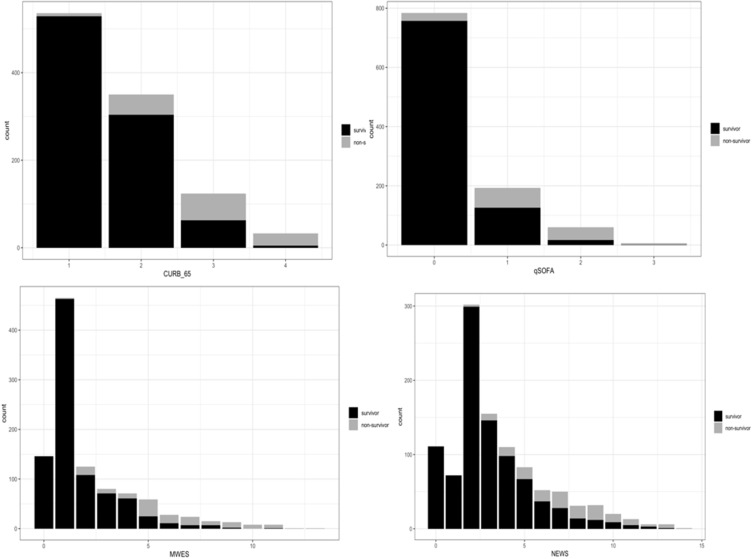
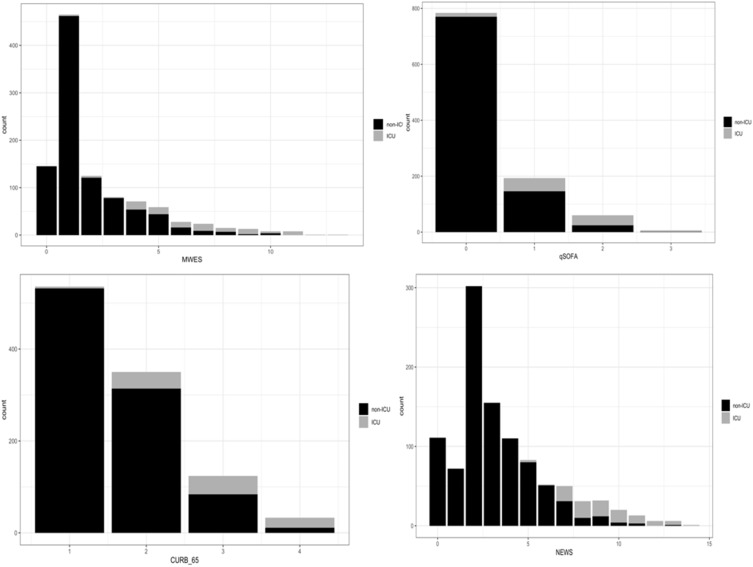
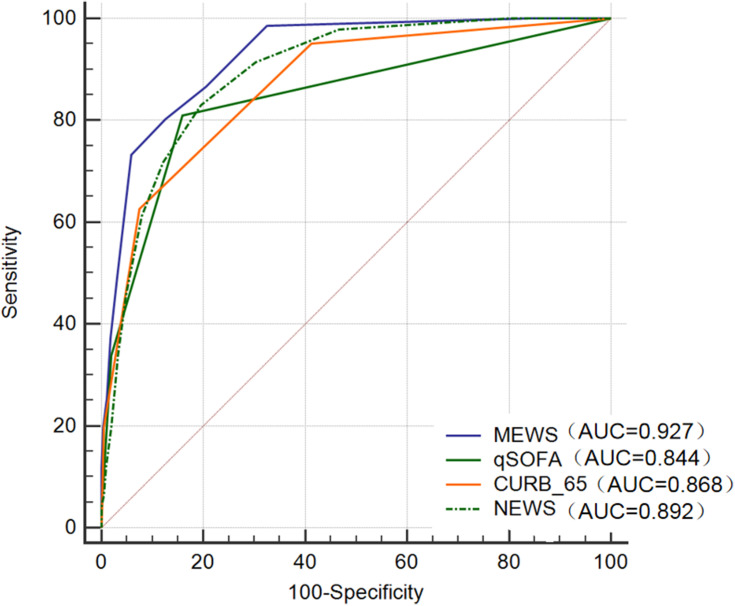
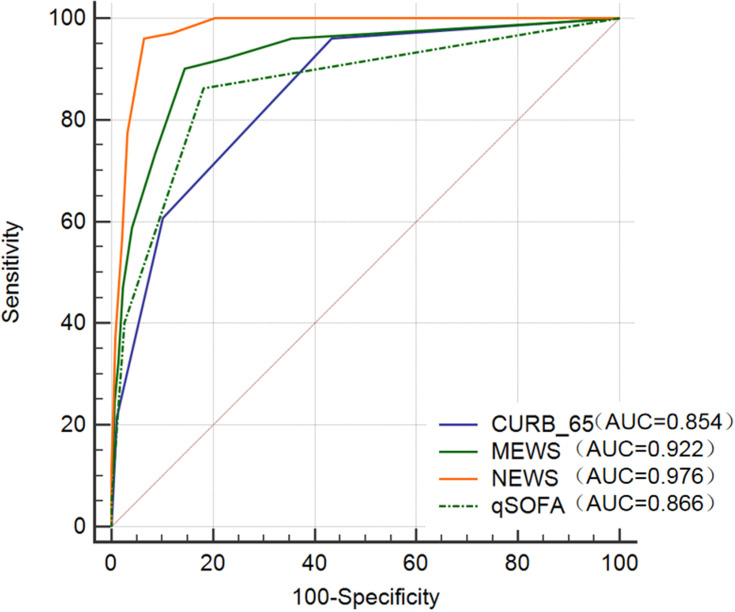
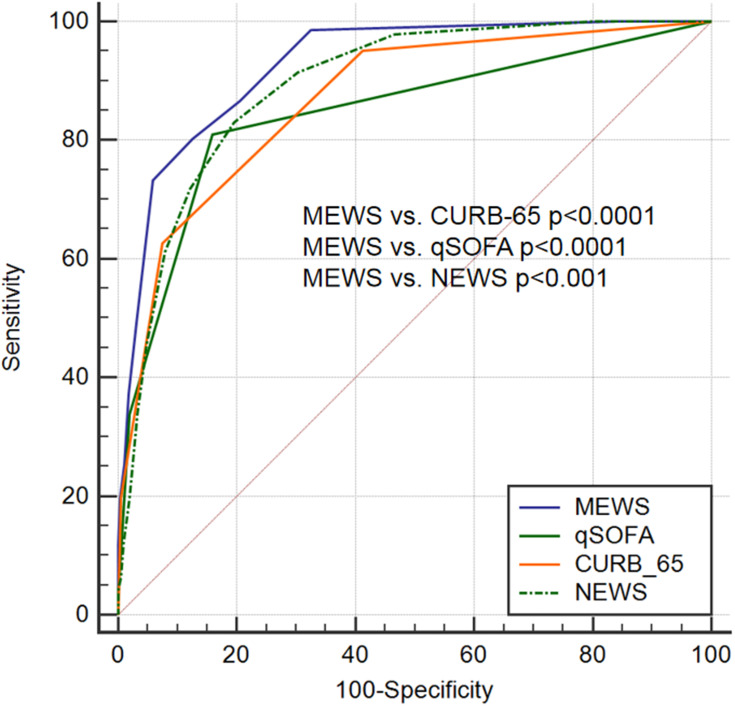
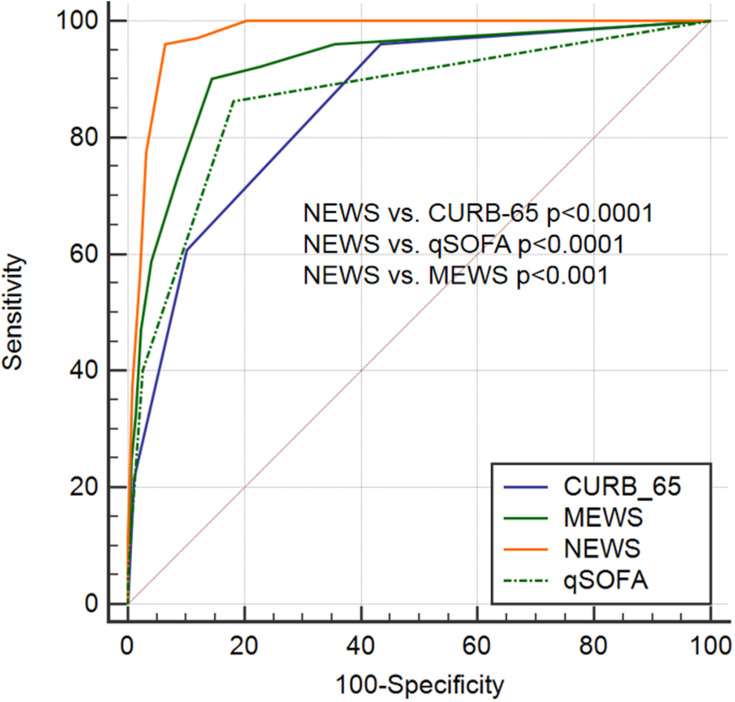
In total, 1044 patients were selected for analysis and divided into two groups, namely survivor groups (902 cases) and non-survivor groups (142 cases). Depending on ICU admission enrolled patients were classified into ICU admission (n = 102) and non-ICU admission (n = 942) groups. Mortality expressed as AUC values were 0.844 (p < 0.001), 0.868 (p < 0.001), 0.927 (p < 0.001) and 0.892 (p < 0.001) for qSOFA, CURB 65, MEWS and NEWS, respectively. There were clear differences in MEWS vs CURB-65 (p < 0.0001), MEWS vs NEWS (p < 0.001), MEWS vs qSOFA (p < 0.0001). For ICU-admission, the AUC values of qSOFA, CURB-65, MEWS and NEWS scores were 0.866 (p < 0.001), 0.854 (p < 0.001), 0.922 (p < 0.001), 0.976 (p < 0.001), respectively. There were significant differences in NEWS vs CURB-65 (p < 0.0001), NEWS vs MEWS (p < 0.001), NEWS vs qSOFA (p < 0.0001).
We explored the outcome prediction values of CURB65, qSOFA, MEWS and NEWS for patients aged 65-years and older with community-acquired pneumonia. We found that MEWS showed superiority over the other severity scores in predicting hospital mortality, and NEWS showed superiority over the other scores in predicting ICU admission.
社区获得性肺炎(CAP)在老年患者中的发病率和死亡率均高于年轻人群。目前有多种评分系统被广泛用于预测社区获得性肺炎(CAP)患者的死亡率和 ICU 入住率,包括快速序贯器官衰竭评估(qSOFA)、意识障碍、尿素、呼吸频率、血压和年龄≥65 岁(CURB-65)、改良早期预警评分(MEWS)和国家早期预警评分(NEWS)。本研究旨在确定最适合的评分系统以更好地进行住院治疗。
我们回顾性分析了 2018 年 1 月 1 日至 2020 年 1 月 1 日期间在复旦大学附属闵行医院就诊的老年 CAP 患者。记录患者的信息,包括年龄、性别、基础疾病、意识状态、生命体征、生理和实验室变量,并进一步计算 qSOFA、CURB-65、MEWS 和 NEWS 评分。使用受试者工作特征(ROC)曲线预测死亡率和 ICU 入住风险。Kaplan-Meier 生存曲线用于评估生存率。
共纳入 1044 例患者,分为存活组(902 例)和非存活组(142 例)。根据 ICU 入住情况,患者被分为 ICU 入住组(n=102)和非 ICU 入住组(n=942)。死亡率的 AUC 值分别为 qSOFA(0.844,p<0.001)、CURB-65(0.868,p<0.001)、MEWS(0.927,p<0.001)和 NEWS(0.892,p<0.001)。MEWS 与 CURB-65(p<0.0001)、MEWS 与 NEWS(p<0.001)、MEWS 与 qSOFA(p<0.0001)之间存在显著差异。对于 ICU 入住,qSOFA、CURB-65、MEWS 和 NEWS 评分的 AUC 值分别为 0.866(p<0.001)、0.854(p<0.001)、0.922(p<0.001)和 0.976(p<0.001)。NEWS 与 CURB-65(p<0.0001)、NEWS 与 MEWS(p<0.001)、NEWS 与 qSOFA(p<0.0001)之间存在显著差异。
本研究探讨了 CURB65、qSOFA、MEWS 和 NEWS 在年龄≥65 岁的社区获得性肺炎患者中的预后预测价值。结果显示,MEWS 在预测住院死亡率方面优于其他严重程度评分,而 NEWS 在预测 ICU 入住方面优于其他评分。