Gamble Laura D, Clare Linda, Opdebeeck Carol, Martyr Anthony, Jones Roy W, Rusted Jennifer M, Pentecost Claire, Thom Jeanette M, Matthews Fiona E
Population Health Sciences Institute, Newcastle University, Newcastle upon Tyne, UK.
Centre for Research in Ageing and Cognitive Health, University of Exeter Medical School, Exeter, UK.
Age Ageing. 2025 Jan 6;54(1). doi: 10.1093/ageing/afae284.
The concept of cognitive reserve may explain inter-individual differences in susceptibility to neuropathological changes. Studies suggest that experiences over a lifetime impact on cognitive reserve, and it is hypothesised that following a dementia diagnosis, greater reserve levels are linked to accelerated disease progression.
To investigate the longitudinal impact of cognitive reserve on cognitive and functional abilities, physical activity and quality of life in people with dementia.
Longitudinal cohort design.
Participants were 1537 people with mild-to-moderate dementia at baseline, 1183 at 12 months follow-up and 851 at 24 months follow-up, from the IDEAL study.
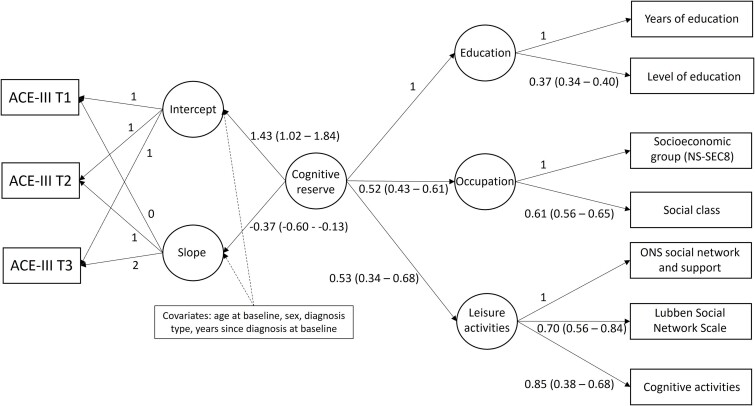
A comprehensive latent measure of cognitive reserve incorporated domains from all stages of life: education, occupational attainment and later-life engagement in leisure activities. The impact of cognitive reserve on cognition, functional abilities, physical activity and quality of life at baseline and over time was investigated using latent growth curve modelling.
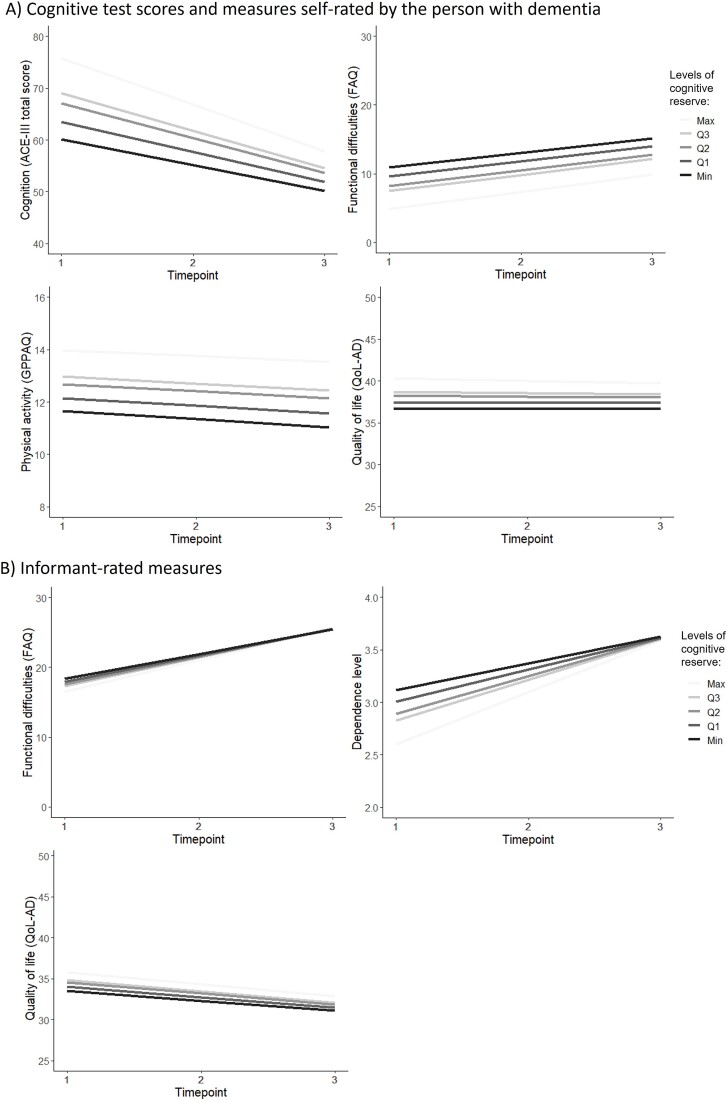
Higher cognitive reserve was associated with better cognition, fewer functional difficulties, more physical activity and better quality of life at baseline but was associated with accelerated cognitive decline and greater dependence over time. After 2 years, those with higher initial reserve were estimated to still have better cognition than those with low reserve.
Cognitive reserve may be important in initially delaying dementia progression but is linked with accelerated deterioration once dementia becomes clinically evident, likely because of the more advanced neuropathological stage of the condition. Engagement in leisure activities is a potentially modifiable domain of cognitive reserve warranting further investigation.
认知储备的概念或许可以解释个体对神经病理变化易感性的差异。研究表明,一生的经历会影响认知储备,并且据推测,在痴呆症被诊断之后,更高的储备水平与疾病进展加速有关。
探讨认知储备对痴呆症患者认知和功能能力、身体活动及生活质量的纵向影响。
纵向队列研究设计。
参与者来自IDEAL研究,基线时为1537名轻度至中度痴呆症患者,12个月随访时为1183名,24个月随访时为851名。
认知储备的综合潜在指标纳入了生命各阶段的领域:教育、职业成就以及晚年参与休闲活动情况。使用潜在增长曲线模型研究认知储备对基线时以及随时间推移的认知、功能能力、身体活动和生活质量的影响。
更高的认知储备在基线时与更好的认知、更少的功能困难、更多的身体活动和更好的生活质量相关,但随时间推移与认知衰退加速和更大程度的依赖相关。2年后,初始储备较高者的认知能力估计仍优于储备较低者。
认知储备在最初延缓痴呆症进展方面可能很重要,但一旦痴呆症在临床上明显出现,就与病情加速恶化有关,这可能是因为病情的神经病理阶段更 advanced。参与休闲活动是认知储备中一个可能可改变的领域,值得进一步研究。 (注:“advanced”此处结合语境推测可能是“进展至更严重阶段”之类意思,但原文表述不太清晰准确)