Sayal Kapil, Wyatt Laura, Partlett Christopher, Ewart Colleen, Bhardwaj Anupam, Dubicka Bernadka, Marshall Tamsin, Gledhill Julia, Lang Alexandra, Sprange Kirsty, Thomson Louise, Moody Sebastian, Holt Grace, Bould Helen, Upton Clare, Keane Matthew, Cox Edward, James Marilyn, Montgomery Alan
Unit of Mental Health & Clinical Neurosciences, School of Medicine, University of Nottingham, Nottingham, UK.
Institute of Mental Health, Nottinghamshire Healthcare NHS Foundation Trust, Nottingham, UK.
J Child Psychol Psychiatry. 2025 Jun;66(6):805-820. doi: 10.1111/jcpp.14090. Epub 2025 Jan 7.
Standardised Diagnostic Assessment tools, such as the Development and Well-Being Assessment (DAWBA), may aid detection and diagnosis of emotional disorders but there is limited real-world evidence of their clinical or cost effectiveness.
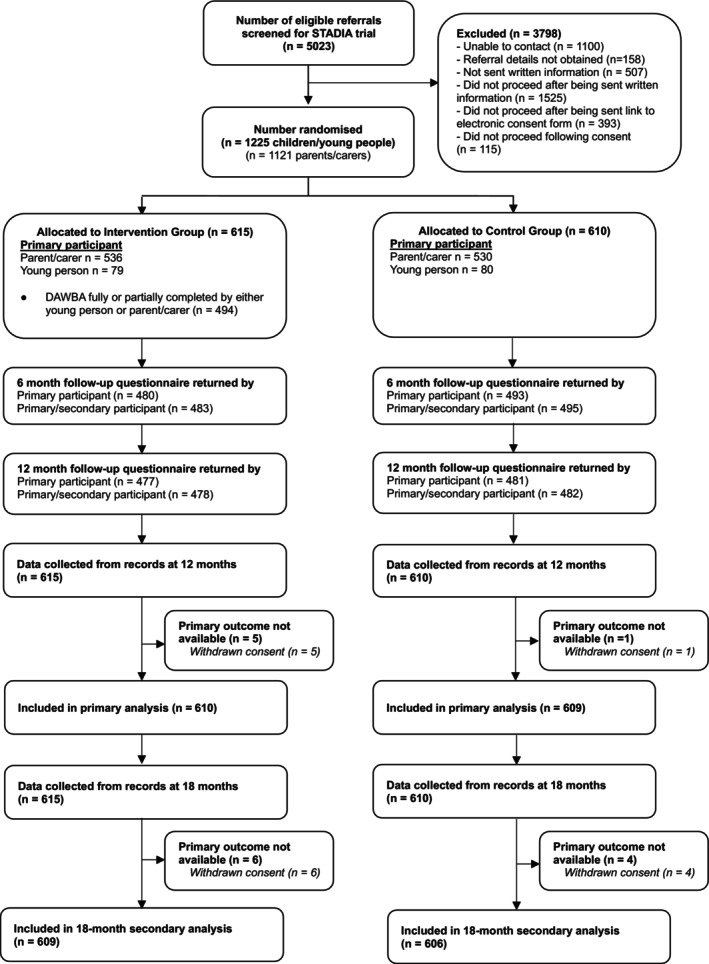
We conducted a multicentre, two-arm parallel group randomised controlled trial in eight large National Health Service Trusts in England providing multidisciplinary specialist Child and Adolescent Mental Health Services (CAMHS). Participants (5-17 year-olds with emotional difficulties referred to CAMHS) were randomly assigned (1:1), following referral receipt, to either receive the DAWBA and assessment-as-usual (intervention group) or assessment-as-usual (control group). Data were self-reported by participants (parents and/or young person, depending on age) at baseline, 6- and 12-month post-randomisation and collected from clinical records up to 18 months post-randomisation. The primary outcome was a clinician-made diagnosis decision about the presence of an emotional disorder within 12 months of randomisation.
ISRCTN15748675.
In total, 1,225 children and young people (58% female sex) were randomised (615 intervention; 610 control). Adherence to the intervention (full/partial completion) was 80% (494/615). At 12 months, 68 (11%) participants in the intervention group received an emotional disorder diagnosis versus 72 (12%) in the control group (adjusted risk ratio (RR) 0.94 [95% CI 0.70, 1.28]). The intervention was not cost effective. There was no evidence of any differences between groups for service-related or participant-reported secondary outcomes, for example, CAMHS acceptance of the index referral (intervention 277 (45%) versus control 262 (43%); RR: 1.06 [95% CI: 0.94, 1.19]) was similar between groups.
As delivered in this pragmatic trial, we found no evidence for the effectiveness or cost effectiveness of using a Standardised Diagnostic Assessment tool in aiding the detection of emotional disorders or clinical outcomes in clinically referred children and young people. Despite regular efforts to encourage clinicians to view the DAWBA report and consider its findings as part of assessment and diagnosis, we did not collect data on usage and therefore cannot confirm the extent to which clinicians did this. As a pragmatic trial that aimed to test the effectiveness of incorporating the DAWBA into usual practice and clinical care, our study found that, in the format as delivered in this trial, there was no impact on diagnosis or clinical outcomes.
标准化诊断评估工具,如发育与幸福评估(DAWBA),可能有助于情感障碍的检测和诊断,但在现实世界中,关于其临床效果或成本效益的证据有限。
我们在英格兰的八个大型国民健康服务信托机构进行了一项多中心、双臂平行组随机对照试验,这些机构提供多学科专科儿童和青少年心理健康服务(CAMHS)。参与者(年龄在5至17岁、有情感问题并被转诊至CAMHS的儿童)在收到转诊后被随机分配(1:1),要么接受DAWBA和常规评估(干预组),要么接受常规评估(对照组)。数据由参与者(父母和/或青少年,取决于年龄)在基线、随机分组后6个月和12个月时自行报告,并从随机分组后长达18个月的临床记录中收集。主要结局是临床医生在随机分组后12个月内对是否存在情感障碍做出的诊断决定。
ISRCTN15748675。
总共1225名儿童和青少年(58%为女性)被随机分组(615名干预组;610名对照组)。干预的依从性(完全/部分完成)为80%(494/615)。在12个月时,干预组有68名(11%)参与者被诊断为情感障碍,而对照组有72名(12%)(调整风险比(RR)0.94[95%CI 0.70, 1.28])。该干预措施不具有成本效益。在与服务相关或参与者报告的次要结局方面,没有证据表明两组之间存在任何差异,例如,CAMHS对索引转诊的接受情况(干预组277例(45%)对对照组262例(43%);RR:1.06[95%CI:0.94, 1.19])在两组之间相似。
在这项务实试验中,我们没有发现证据表明使用标准化诊断评估工具在帮助检测临床转诊的儿童和青少年的情感障碍或临床结局方面有效或具有成本效益。尽管我们经常努力鼓励临床医生查看DAWBA报告并将其结果作为评估和诊断的一部分加以考虑,但我们没有收集关于使用情况的数据,因此无法确认临床医生在多大程度上做到了这一点。作为一项旨在测试将DAWBA纳入常规实践和临床护理有效性的务实试验,我们的研究发现,以本试验所采用的形式,其对诊断或临床结局没有影响。