Nguyen Thi Hoang Ha, Hossin M Zakir, Schmauder Stefanie, Muraca Giulia M, Lisonkova Sarka, Razaz Neda
Clinical Epidemiology Division, Department of Medicine Solna, Karolinska Institutet, Stockholm, Sweden.
School of Population and Public Health, University of British Columbia, Vancouver, British Columbia, Canada.
Paediatr Perinat Epidemiol. 2025 May;39(4):356-369. doi: 10.1111/ppe.13162. Epub 2025 Jan 7.
An evidence gap exists concerning the timing of delivery at 37-42 weeks and the risk of attention-deficit hyperactivity disorder (ADHD) in offspring.
To determine the association between timing of delivery in low-risk pregnancies at term (37-42 weeks) gestations and ADHD in offspring.
This population-based cohort study comprised 1,424,453 singletons in Sweden and 403,765 in British Columbia (BC), Canada, live-born at 37-42 completed weeks to low-risk pregnant women between 2000 and 2018. Children were followed up from age 1 until the date of death, emigration, their first diagnosis, or December 2020 (study's end date). The exposure was time of delivery assessed through gestational age, and the outcome was the diagnosis of ADHD. Cox regression models were used to examine the association between gestational age at delivery and ADHD.
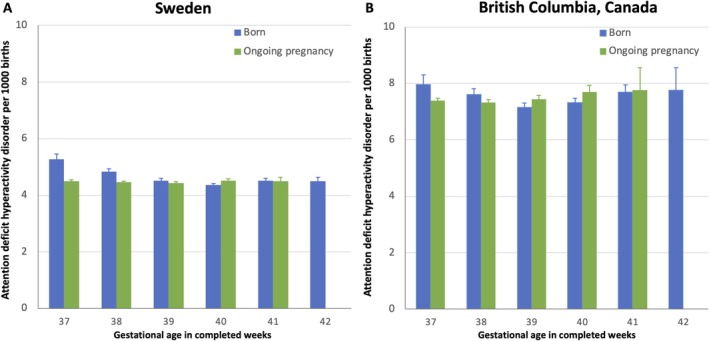
During the follow-up period, 59,989 children in Sweden were diagnosed with ADHD (4.5 per 1000 child-years). Correspondingly, in BC, during the same period, there were 27,445 children diagnosed with ADHD (7.4 per 1000 child-years). In Sweden, the adjusted hazard of ADHD was 10%, 6%, and 3% higher at 37, 38, and 39 weeks gestation compared with those born at ≥ 38, ≥ 39, and ≥ 40 weeks, respectively. In BC, the corresponding hazards were 9%, 6%, and 3%, respectively. Both regions showed no elevated ADHD risks for infants born at 40 weeks compared to those born at ≥ 41 weeks, with slightly lower rates at 40 weeks.
In low-risk pregnancies, births at 37 and 38 weeks were associated with a higher ADHD risk, while births at 40 weeks showed no increased risk compared with those born at later gestations.
关于孕37至42周分娩时机与后代注意力缺陷多动障碍(ADHD)风险之间存在证据空白。
确定足月(37至42周)低风险妊娠的分娩时机与后代ADHD之间的关联。
这项基于人群的队列研究纳入了瑞典的1,424,453名单胎婴儿和加拿大不列颠哥伦比亚省(BC)的403,765名单胎婴儿,这些婴儿于2000年至2018年在孕37至42足周时为低风险孕妇活产。对儿童从1岁开始随访,直至死亡、移民、首次诊断日期或2020年12月(研究结束日期)。暴露因素是通过胎龄评估的分娩时间,结局是ADHD的诊断。采用Cox回归模型来检验分娩时的胎龄与ADHD之间的关联。
在随访期间,瑞典有59,989名儿童被诊断为ADHD(每1000儿童年中有4.5例)。相应地,在BC,同期有27,445名儿童被诊断为ADHD(每1000儿童年中有7.4例)。在瑞典,与分别在孕≥38周、≥39周和≥40周出生的婴儿相比,孕37周、38周和39周出生的婴儿患ADHD的校正风险分别高10%、6%和3%。在BC,相应的风险分别为9%、6%和3%。与孕≥41周出生的婴儿相比,两个地区孕40周出生的婴儿ADHD风险均未升高,且40周时的发病率略低。
在低风险妊娠中,孕37周和38周分娩与较高的ADHD风险相关,而孕40周分娩与孕晚期出生的婴儿相比风险并未增加。