Mangin Camille C, Benzerara Karim, Bergot Marine, Menguy Nicolas, Alonso Béatrice, Fouteau Stéphanie, Méheust Raphaël, Chevrier Daniel M, Godon Christian, Turrini Elsa, Mehta Neha, Duverger Arnaud, Travert Cynthia, Busigny Vincent, Duprat Elodie, Bolzoni Romain, Cruaud Corinne, Viollier Eric, Jézéquel Didier, Vallenet David, Lefèvre Christopher T, Monteil Caroline L
Aix-Marseille Université, CNRS, CEA, BIAM, UMR7265 Institut de Biosciences and Biotechnologies d'Aix-Marseille, Cadarache research centre, F-13115 Saint-Paul-lez-Durance, France.
Sorbonne Université, Muséum National d'Histoire Naturelle, UMR CNRS 7590, Institut de Minéralogie, de Physique des Matériaux et de Cosmochimie (IMPMC), 4 Place Jussieu, 75005 Paris, France.
ISME J. 2025 Jan 2;19(1). doi: 10.1093/ismejo/wrae260.
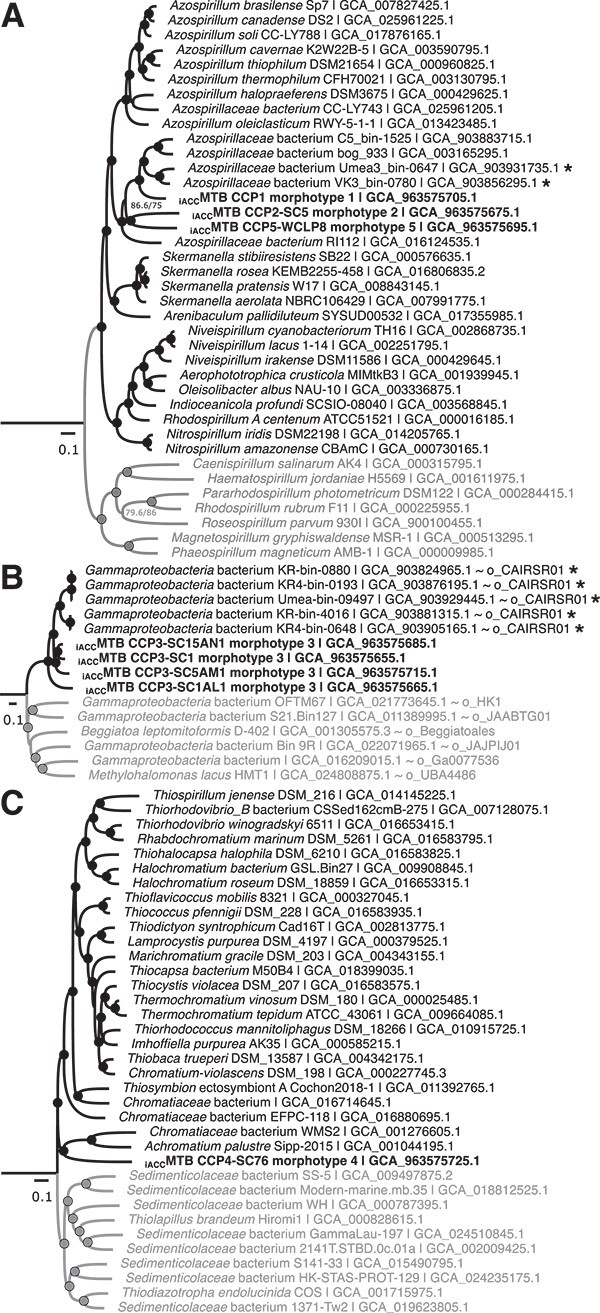
Intracellular calcium carbonate formation has long been associated with a single genus of giant Gammaproteobacteria, Achromatium. However, this biomineralization has recently received increasing attention after being observed in photosynthetic Cyanobacteriota and in two families of magnetotactic bacteria affiliated with the Alphaproteobacteria. In the latter group, bacteria form not only intracellular amorphous calcium carbonates into large inclusions that are refringent under the light microscope, but also intracellular ferrimagnetic crystals into organelles called magnetosomes. Here new observations suggest that magnetotactic bacteria previously identified in the sediments and water column of Lake Pavin (France) were only a small fraction of the diversity of bacteria producing intracellular amorphous calcium carbonates. To explore this diversity further, we conducted a comprehensive investigation of magnetotactic populations with refractive granules using a combination of environmental microbiology, genomic and mineralogy approaches on cells sorted by micromanipulation. Several species belonging to divergent genera of two Pseudomonadota classes were identified and characterized. Scanning transmission electron microscopy coupled with energy-dispersive X-ray spectrometry support that all these species indeed form intracellular amorphous calcium carbonates. Cryo soft X-ray tomography experiments conducted on ice-vitrified cells, enabled 3D investigation of inclusions volume, which was found to occupy 44-68% of the cell volume. Metabolic network modeling highlighted different metabolic abilities of Alpha- and Gammaproteobacteria, including methylotrophy and CO2 fixation via the reverse Krebs cycle or the Calvin-Benson-Bassham cycle. Overall, this study strengthens a convergent evolution scenario for intracellular carbonatogenesis in Bacteria, and further supports that it is promoted by the fixation of CO2 in anoxic environments.
细胞内碳酸钙的形成长期以来一直与一种巨型γ-变形菌属——无色菌属相关联。然而,在光合蓝细菌以及隶属于α-变形菌的两个趋磁细菌家族中观察到这种生物矿化现象后,它最近受到了越来越多的关注。在后一组中,细菌不仅会在细胞内形成无定形碳酸钙,形成在光学显微镜下具有折射性的大内含物,还会在细胞内形成亚铁磁性晶体,进入称为磁小体的细胞器。这里的新观察结果表明,先前在法国帕万湖的沉积物和水柱中鉴定出的趋磁细菌只是产生细胞内无定形碳酸钙的细菌多样性的一小部分。为了进一步探索这种多样性,我们结合环境微生物学、基因组学和矿物学方法,对通过显微操作分选的具有折射颗粒的趋磁群体进行了全面研究。鉴定并表征了属于两个假单胞菌门不同属的几个物种。扫描透射电子显微镜与能量色散X射线光谱联用证实,所有这些物种确实会形成细胞内无定形碳酸钙。对冰玻璃化细胞进行的低温软X射线断层扫描实验,能够对内含物体积进行三维研究,发现其占细胞体积的44%-68%。代谢网络建模突出了α-变形菌和γ-变形菌的不同代谢能力,包括甲基营养以及通过逆向克雷布斯循环或卡尔文-本森-巴斯姆循环进行的二氧化碳固定。总体而言,这项研究强化了细菌细胞内碳酸生成的趋同进化情景,并进一步支持其在缺氧环境中由二氧化碳固定所促进。