Yao Jinfeng, Chen Guo
Department of Oncology, Shuguang Anhui Hospital Affiliated to Shanghai University of Traditional Chinese Medicine (The First Affiliated Hospital West District of Anhui University of Chinese Medicine), Hefei, China.
Front Nutr. 2024 Dec 24;11:1520852. doi: 10.3389/fnut.2024.1520852. eCollection 2024.
The mortality of colorectal cancer (CRC) is increasing year by year and poses a significant global health burden. Many studies have demonstrated that alcohol consumption is an important risk factor for CRC and is closely associated with malignant metastasis in CRC patients, which in turn leads to a poor prognosis.
This study aimed to quantify the global, regional, and national burden of alcohol-related CRC between 1990 and 2021. First, numbers and age-standardized rates of deaths and disability-adjusted life years (DALYs) for alcohol-related CRC in 2021 were analyzed at different levels. Temporal trends in the burden of disease from 1990 to 2021 were analyzed through linear regression models. Finally, both Age-Period-Cohort (APC) models and Bayesian Age-Period-Cohort (BAPC) models were utilized to project the future burden of the disease for 2022-2046.
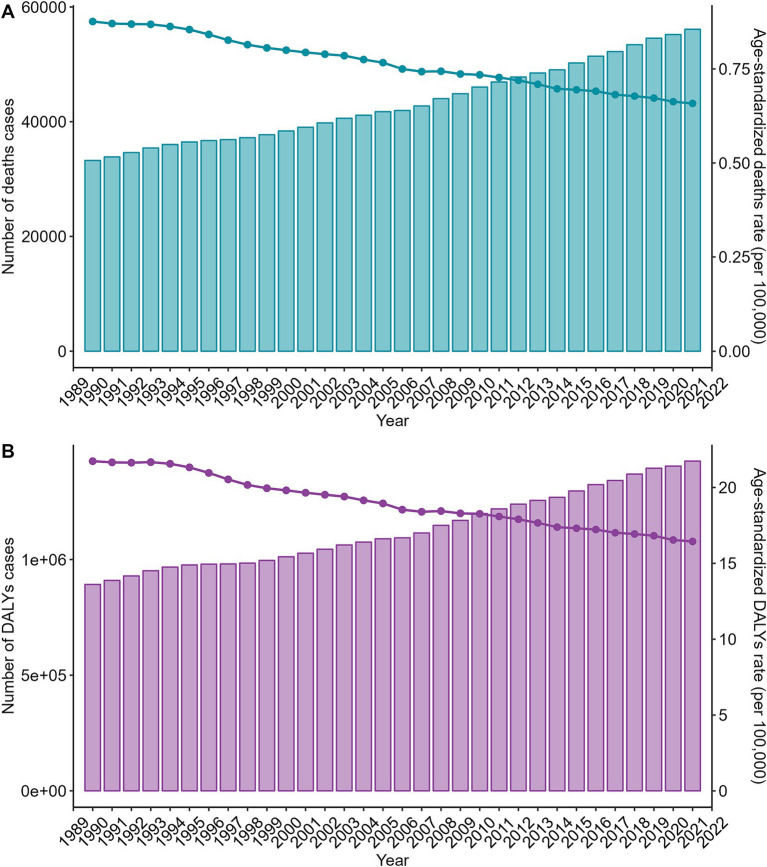
The global burden of disease for alcohol-related CRC is higher in 2021 compared to 1990. Male and older age groups are at high risk. Disease burden varies very much between Sociodemographic Index (SDI) regions, Global Burden of Disease (GBD) regions and countries. From 1990 to 2021, the number of cases increased, but the Age-Standardized Rate (ASR) decreased. The trends in disease burden predicted by the two models for 2022-2046 were not consistent.
This study describes the burden of disease in alcohol-related CRC and emphasizes that alcohol is a non-negligible risk factor for CRC. In order to mitigate harm, we need to strengthen disease surveillance, early prevention, timely detection, and improved treatment measures, with different approaches and responses for different regions.
结直肠癌(CRC)的死亡率逐年上升,给全球带来了重大的健康负担。许多研究表明,饮酒是CRC的一个重要风险因素,并且与CRC患者的恶性转移密切相关,进而导致预后不良。
本研究旨在量化1990年至2021年间全球、区域和国家层面与酒精相关的CRC负担。首先,分析了2021年不同层面与酒精相关的CRC的死亡人数、年龄标准化死亡率以及伤残调整生命年(DALYs)。通过线性回归模型分析了1990年至2021年疾病负担的时间趋势。最后,利用年龄-时期-队列(APC)模型和贝叶斯年龄-时期-队列(BAPC)模型预测了2022年至2046年该疾病的未来负担。
与1990年相比,2021年全球与酒精相关的CRC疾病负担更高。男性和老年人群处于高风险。社会人口学指数(SDI)区域、全球疾病负担(GBD)区域和国家之间的疾病负担差异很大。1990年至2021年,病例数增加,但年龄标准化率(ASR)下降。两种模型预测的2022年至2046年疾病负担趋势不一致。
本研究描述了与酒精相关的CRC的疾病负担,并强调酒精是CRC一个不可忽视的风险因素。为了减轻危害,我们需要加强疾病监测、早期预防、及时检测和改进治疗措施,针对不同区域采取不同的方法和应对措施。