
肝硬化患者深部灰质磁化率的定量评估及其与认知的相关性
Quantitative Assessment of Deep Gray Matter Susceptibility and Correlation With Cognition in Patients With Liver Cirrhosis.
作者信息
Wu Wenjun, Su Yu, Qin Ziji, Kang Jiamin, Xiang Dongqiao, Liu Dingxi, Zheng Chuansheng, Haacke E Mark, Wang Lixia
机构信息
Department of Radiology, Union Hospital, Tongji Medical College, Huazhong University of Science and Technology, Wuhan, China.
Hubei Province Key Laboratory of Molecular Imaging, Wuhan, China.
出版信息
Brain Behav. 2025 Jan;15(1):e70240. doi: 10.1002/brb3.70240.
BACKGROUND AND OBJECTIVES
Accumulation of metals quantified by quantitative susceptibility mapping (QSM) in deep gray matter (DGM) and their impact on cognition have not been studied in patients with liver cirrhosis. This study aims to use QSM to investigate the association between DGM susceptibility and cognition in cirrhotic patients.
METHODS
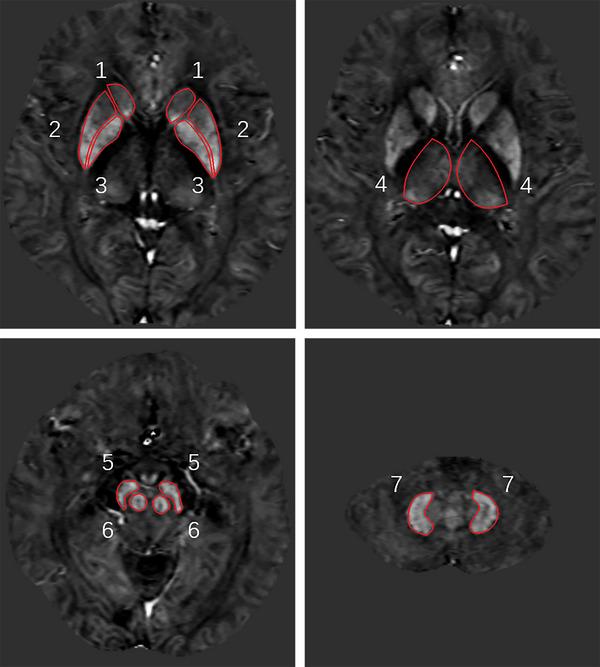
Thirty cirrhotic patients and 30 age-, gender-, and education-matched controls were imaged using a multiecho gradient-echo sequence for QSM analysis in a 3T scanner. The susceptibility values were determined for the caudate nucleus (CN), putamen (PU), globus pallidus (GP), thalamus (TH), red nucleus (RN), substantia nigra (SN), and dentate nucleus (DN). All subjects underwent number connection test A (NCT-A), digit substitution test (DST), and Montreal Cognitive Assessment (MoCA). Comparisons between the two groups and the correlation between the susceptibility values and neuropsychological scores were analyzed.
RESULTS
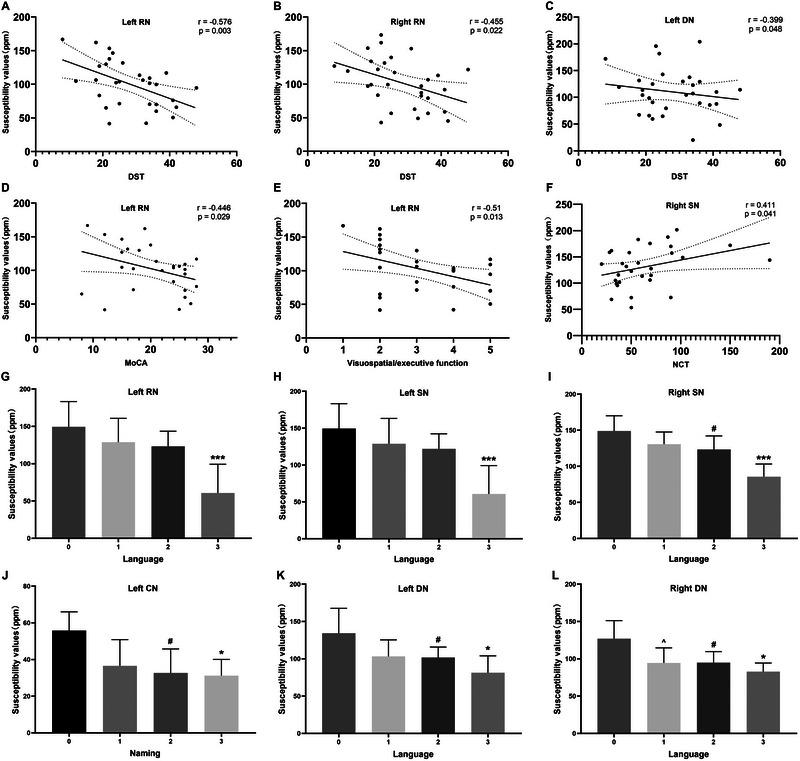
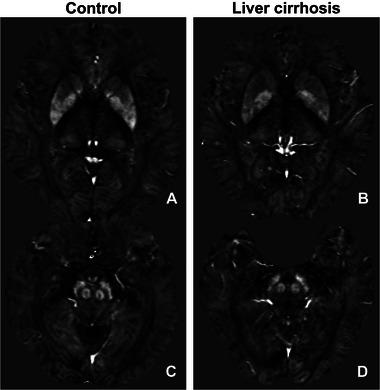
The susceptibility values of bilateral CN, TH, and RN were significantly lower in cirrhotic patients. Cirrhotic patients exhibited significantly prolonged NCT-A time and decreased DST and MoCA scores. The NCT-A, DST, MoCA, and sub-domain scores were correlated with susceptibility values of RN, DN, SN, and CN, respectively. The susceptibility value of the left RN was a predictor variable for the DST, MoCA, and visuospatial-executive scores; those of the right CN and left RN were predictor variables for the naming score, and that of the left SN was an independent predictor variable for the language score.
CONCLUSIONS
Altered susceptibility values of DGM measured by QSM are potential quantitative indicators of cognitive impairment in cirrhotic patients.
背景与目的
尚未在肝硬化患者中研究通过定量磁化率成像(QSM)量化的深部灰质(DGM)中金属的蓄积及其对认知的影响。本研究旨在使用QSM来探究肝硬化患者DGM磁化率与认知之间的关联。
方法
30例肝硬化患者和30例年龄、性别及教育程度相匹配的对照者在3T扫描仪中使用多回波梯度回波序列进行成像以进行QSM分析。测定尾状核(CN)、壳核(PU)、苍白球(GP)、丘脑(TH)、红核(RN)、黑质(SN)和齿状核(DN)的磁化率值。所有受试者均接受数字连接试验A(NCT-A)、数字替代试验(DST)和蒙特利尔认知评估(MoCA)。分析两组之间的比较以及磁化率值与神经心理学评分之间的相关性。
结果
肝硬化患者双侧CN、TH和RN的磁化率值显著降低。肝硬化患者的NCT-A时间显著延长,DST和MoCA评分降低。NCT-A、DST、MoCA及子域评分分别与RN、DN、SN和CN的磁化率值相关。左侧RN的磁化率值是DST、MoCA和视觉空间执行评分的预测变量;右侧CN和左侧RN的磁化率值是命名评分的预测变量,左侧SN的磁化率值是语言评分的独立预测变量。
结论
通过QSM测量的DGM磁化率值改变是肝硬化患者认知障碍的潜在定量指标。
 Zotero 插件