Papier Keren, Bradbury Kathryn E, Balkwill Angela, Barnes Isobel, Smith-Byrne Karl, Gunter Marc J, Berndt Sonja I, Le Marchand Loic, Wu Anna H, Peters Ulrike, Beral Valerie, Key Timothy J, Reeves Gillian K
Cancer Epidemiology Unit, Nuffield Department of Population Health, University of Oxford, Oxford, UK.
Department of Epidemiology and Biostatistics, School of Population Health, Faculty of Medical and Health Sciences, The University of Auckland, Auckland, New Zealand.
Nat Commun. 2025 Jan 8;16(1):375. doi: 10.1038/s41467-024-55219-5.
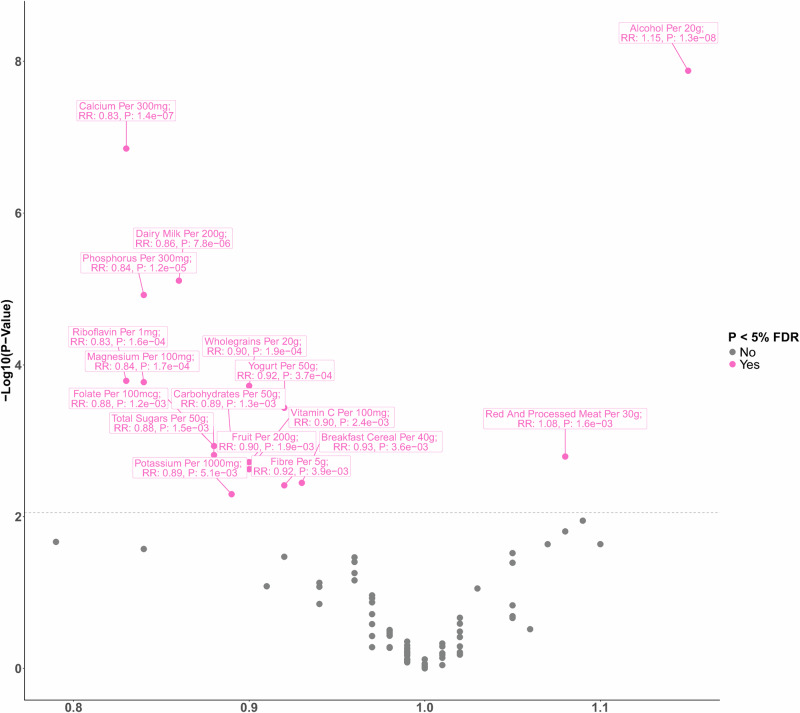
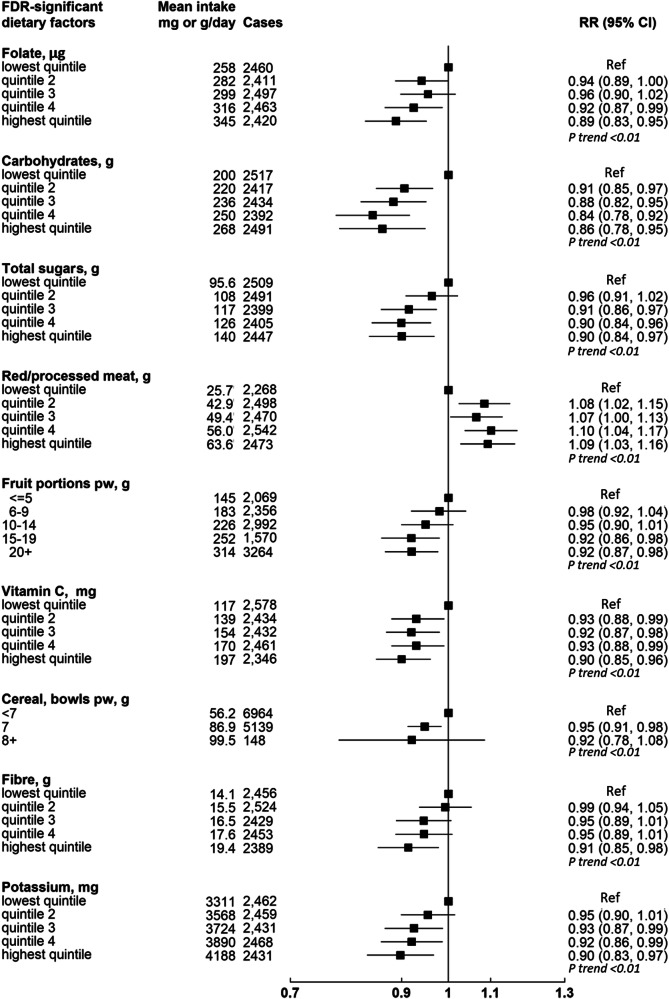
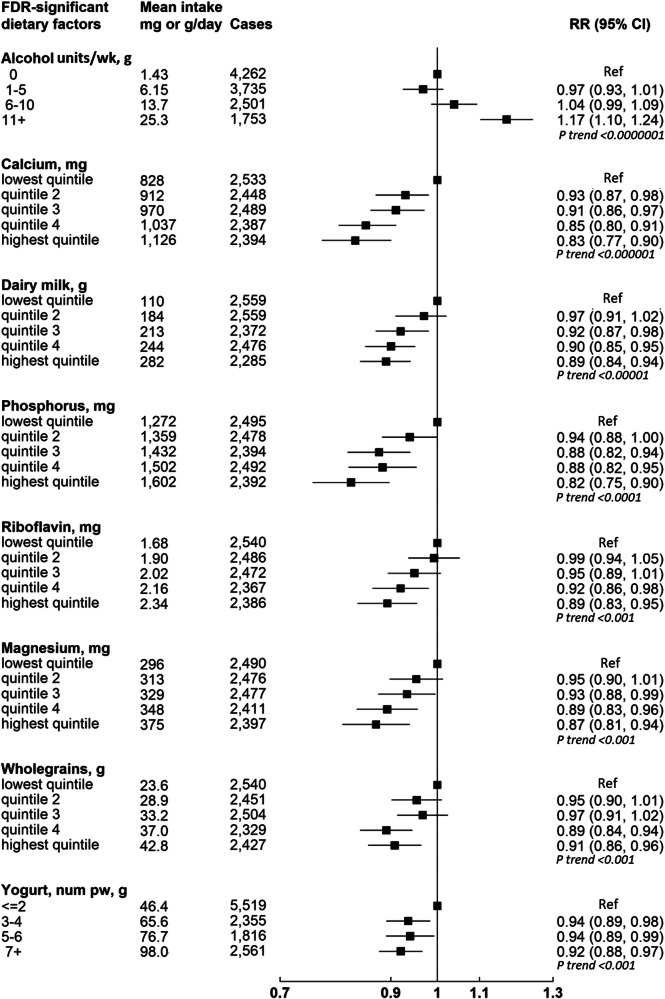
Uncertainty remains regarding the role of diet in colorectal cancer development. We examined associations of 97 dietary factors with colorectal cancer risk in 542,778 Million Women Study participants (12,251 incident cases over 16.6 years), and conducted a targeted genetic analysis in the ColoRectal Transdisciplinary Study, Colon Cancer Family Registry, and Genetics and Epidemiology of Colorectal Cancer Consortium (GECCO). Alcohol (relative risk per 20 g/day=1.15, 95% confidence interval 1.09-1.20) and calcium (per 300 mg/day=0.83, 0.77-0.89) intakes had the strongest associations, followed by six dairy-related factors associated with calcium. We showed a positive association with red and processed meat intake and weaker inverse associations with breakfast cereal, fruit, wholegrains, carbohydrates, fibre, total sugars, folate, and vitamin C. Genetically predicted milk consumption was inversely associated with risk of colorectal, colon, and rectal cancers. We conclude that dairy products help protect against colorectal cancer, and that this is driven largely or wholly by calcium.
饮食在结直肠癌发生过程中的作用仍不明确。我们在542,778名百万女性研究参与者中(16.6年间有12,251例新发病例)研究了97种饮食因素与结直肠癌风险的关联,并在结直肠癌跨学科研究、结肠癌家族登记处以及结直肠癌遗传学与流行病学联盟(GECCO)中进行了靶向基因分析。酒精摄入量(每20克/天的相对风险=1.15,95%置信区间1.09 - 1.20)和钙摄入量(每300毫克/天=0.83,0.77 - 0.89)的关联最为显著,其次是与钙相关的六个乳制品相关因素。我们发现红肉和加工肉的摄入量呈正相关,而早餐谷物、水果、全谷物、碳水化合物、纤维、总糖、叶酸和维生素C的摄入量呈较弱的负相关。基因预测的牛奶消费量与结直肠癌、结肠癌和直肠癌的风险呈负相关。我们得出结论,乳制品有助于预防结直肠癌,而且这在很大程度上或完全是由钙驱动的。