Damtew Solomon Abrha, Atnafu Niguse Tadele, Gidey Mahari Yihdego, Sisay Tesfamichael Awoke, Yohannes Metages
Department of Epidemiology andBiostatistics, School of Public Health, Wolaita Sodo University, Wolaita Sodo, Ethiopia.
School of Nursing and Midwifery, Addis Ababa University, Addis Ababa, Ethiopia.
Sci Rep. 2025 Jan 8;15(1):1297. doi: 10.1038/s41598-025-85421-4.
Current intimate partner violence (IPV) during pregnancy was found to be associated with adverse health outcomes including pregnancy loss, preterm labor, pregnancy complications, hypertension, delivering low birth weight baby, physical injuries and stress. IPV in Ethiopia is considerably high. This study aimed at determining the prevalence of the IPV during the index pregnancy as measured at six weeks postpartum among women in their extended six weeks postpartum period and identify its correlates. Documenting the magnitude of IPV during the index pregnancy as measured six weeks in the postpartum period and identifying factors affecting it could be imperative to generate actionable evidence. Generating such an evidence contributed its share for the Health Minister and other relevant partners in tracking progress towards achievement of the sustainable development goals (SDGs) 5.2.1 by 2030. This study used Performance Monitoring for Action Ethiopian (PMA_ET) merged cohort one baseline and six weeks postpartum data which had enrolled and collected data from currently pregnant women. Frequencies were computed to describe the study participant's characteristics, and chi-square statistics was calculated to assess cell sample size adequacy. Multilevel binary logistics regression statistical modeling was employed to identify correlates of IPV. Results were presented in the form percentages and odds ratio with 95% Confidence Intervals. Candidate variables were selected using p-value of 0.25. Statistical significance was declared at p-value of 0.05. The overall proportion of IPV during the index pregnancy as measured six weeks postpartum was 12.14% (95%CI: 10.66%, 13.79%). A slightly higher percentage of women reported that they have experienced at least one form of sexual IPV 8.09% (95% CI: 6.91%, 9.44%) than experiencing at least one form of physical IPV 6.02% (95% CI: 4.94%, 7.31%). After controlling confounders, the likelihood of experiencing at least one form of physical and/or sexual IPV was 2.14 (95%CI: 1.04, 4.38) times higher among women whose husband had other wives' compared to those who did not have. Women who were residents of Afar region had only 0.14 (95%CI: 0.03, 0.79) odds of experiencing one form of physical and/or sexual IPV. The overall experience of at least one form of physical and/or sexual IPV was found to be 12.14%. A statistically non-significant slightly higher percentage of women reported that they have experienced at least one form of sexual IPV than experiencing at least one form of physical IPV. Activities and efforts which are specific to regions are needed to address the problem of polygamy are hoped to address the problem IPV during pregnancy. Such activities should be tailored along with the maternal and new born care continuum. Further implication of this study is installing violence and contraceptive related preconception care packages in the health system which is imperative in the combat against IPV and any form of gender based violence. In addition, creating institutional capacity in the health system through strengthening and expanding one stop centers to provide medical treatment, care, and psychosocial support along with support for victims and survivors can be considered as imperative. Moreover, the finding gave an insight that installing rapid referral system and linkage to the legal system is key. Similarly, working on early marriage and counseling on childbirth; and spaced pregnancies for those young couples is implied on. Most importantly, determining the prevalence of violence could serve as one of the indicators to monitor the progress towards SDG 5.2.1 and to look for any strategy and policy changes needed in light of the observed progress.
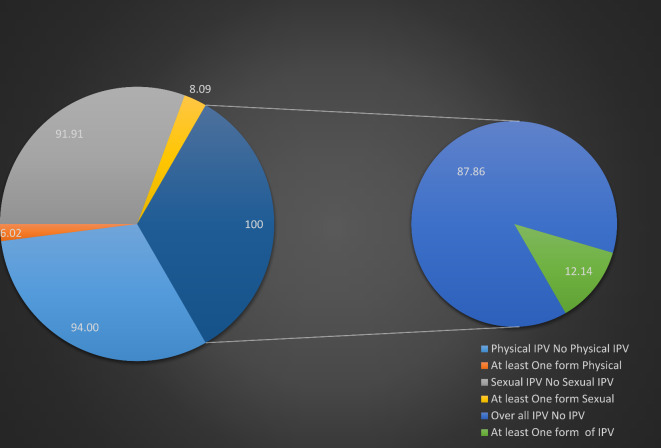
研究发现,孕期遭受的亲密伴侣暴力(IPV)与不良健康后果相关,包括流产、早产、妊娠并发症、高血压、分娩低体重儿、身体损伤和压力。埃塞俄比亚的亲密伴侣暴力发生率相当高。本研究旨在确定产后六周测量的本次妊娠期间亲密伴侣暴力的患病率,并确定其相关因素。记录产后六周测量的本次妊娠期间亲密伴侣暴力的严重程度,并确定影响该暴力行为的因素,对于生成可采取行动的证据可能至关重要。生成此类证据有助于卫生部长和其他相关伙伴在追踪实现2030年可持续发展目标(SDG)5.2.1方面取得的进展。本研究使用了埃塞俄比亚行动绩效监测(PMA_ET)合并队列的基线数据和产后六周数据,这些数据是对目前怀孕的妇女进行登记和收集的。计算频率以描述研究参与者的特征,并计算卡方统计量以评估单元格样本量是否充足。采用多水平二元逻辑回归统计模型来确定亲密伴侣暴力的相关因素。结果以百分比和比值比的形式呈现,并带有95%置信区间。使用0.25的p值选择候选变量。p值为0.05时宣布具有统计学意义。产后六周测量的本次妊娠期间亲密伴侣暴力的总体比例为12.14%(95%CI:10.66%,13.79%)。报告至少经历过一种形式性亲密伴侣暴力的女性比例略高于经历至少一种形式身体亲密伴侣暴力的女性比例,分别为8.09%(95%CI:6.91%,9.44%)和6.02%(95%CI:4.94%,7.31%)。在控制混杂因素后,丈夫有其他妻子的女性经历至少一种形式身体和/或性亲密伴侣暴力的可能性比没有其他妻子的女性高2.14倍(95%CI:1.04,4.38)。阿法尔地区的女性经历一种形式身体和/或性亲密伴侣暴力的几率仅为0.14(95%CI:0.03,0.79)。发现至少经历过一种形式身体和/或性亲密伴侣暴力的总体比例为12.14%。报告至少经历过一种形式性亲密伴侣暴力的女性比例略高于经历至少一种形式身体亲密伴侣暴力的女性比例,但差异无统计学意义。需要开展针对特定地区的活动和努力来解决一夫多妻制问题,有望解决孕期亲密伴侣暴力问题。此类活动应与孕产妇和新生儿连续护理相结合。本研究的进一步意义在于在卫生系统中安装与暴力和避孕相关的孕前护理包,这对于打击亲密伴侣暴力和任何形式的性别暴力至关重要。此外,可以考虑通过加强和扩大一站式中心来提高卫生系统的机构能力,以便提供医疗治疗、护理和心理社会支持,同时为受害者和幸存者提供支持。此外,研究结果表明,建立快速转诊系统并与法律系统建立联系是关键。同样,应致力于早婚和分娩咨询;并建议年轻夫妇间隔怀孕。最重要的是,确定暴力的患病率可以作为监测可持续发展目标5.2.1进展情况的指标之一,并根据观察到的进展情况寻找所需的任何战略和政策变化。
