Kumar Lella Kranthi, Suma K G, Udayaraju Pamula, Gundu Venkateswarlu, Mantena Srihari Varma, Jagadesh B N
School of Computer Science and Engineering, VIT-AP University, Vijayawada, India.
Department of Computer Science and Engineering, School of Engineering and Sciences, SRM University, Amaravati, AP, India.
Sci Rep. 2025 Jan 8;15(1):1270. doi: 10.1038/s41598-025-85561-7.
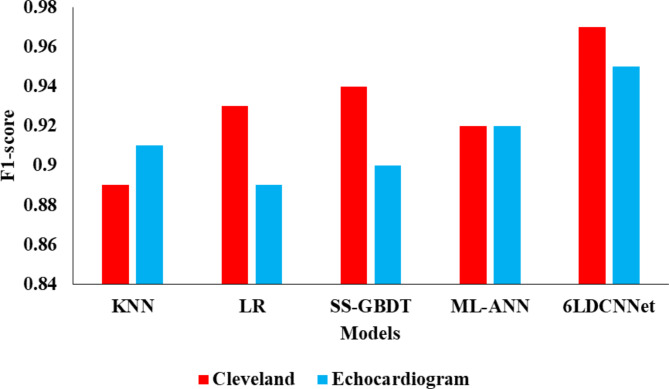
In recent years, the healthcare data system has expanded rapidly, allowing for the identification of important health trends and facilitating targeted preventative care. Heart disease remains a leading cause of death in developed countries, often leading to consequential outcomes such as dementia, which can be mitigated through early detection and treatment of cardiovascular issues. Continued research into preventing strokes and heart attacks is crucial. Utilizing the wealth of healthcare data related to cardiac ailments, a two-stage medical data classification and prediction model is proposed in this study. Initially, Binary Grey Wolf Optimization (BGWO) is used to cluster features, with the grouped information then utilized as input for the prediction model. An innovative 6-layered deep convolutional neural network (6LDCNNet) is designed for the classification of cardiac conditions. Hyper-parameter tuning for 6LDCNNet is achieved through an improved optimization method. The resulting model demonstrates promising performance on both the Cleveland dataset, achieving a convergence of 96% for assessing severity, and the echocardiography imaging dataset, with an impressive 98% convergence. This approach has the potential to aid physicians in diagnosing the severity of cardiac diseases, facilitating early interventions that can significantly reduce mortality associated with cardiovascular conditions.
近年来,医疗数据系统迅速扩展,有助于识别重要的健康趋势并促进有针对性的预防保健。在发达国家,心脏病仍然是主要死因,常常导致诸如痴呆等严重后果,而通过早期发现和治疗心血管问题可以减轻这些后果。持续开展预防中风和心脏病发作的研究至关重要。本研究利用与心脏疾病相关的大量医疗数据,提出了一种两阶段的医疗数据分类和预测模型。首先,使用二进制灰狼优化算法(BGWO)对特征进行聚类,然后将分组后的信息用作预测模型的输入。设计了一种创新的6层深度卷积神经网络(6LDCNNet)用于心脏病分类。通过一种改进的优化方法对6LDCNNet进行超参数调整。所得模型在克利夫兰数据集上评估严重程度的收敛率达到96%,在超声心动图成像数据集上的收敛率高达98%,表现出良好的性能。这种方法有可能帮助医生诊断心脏病的严重程度,促进早期干预,从而显著降低心血管疾病相关的死亡率。