Hsu Meng-Chen, Fu Yu-Hua, Wang Chi-Chuan, Wu Chau-Chung, Lin Fang-Ju
Graduate Institute of Clinical Pharmacy, College of Medicine, National Taiwan University, No. 33, Linsen S. Rd., Zhongzheng Dist., Taipei, 100025, Taiwan.
School of Pharmacy, College of Medicine, National Taiwan University, Taipei, Taiwan.
BMC Geriatr. 2025 Jan 8;25(1):15. doi: 10.1186/s12877-024-05660-4.
To identify cardiovascular (CV) risk factors in Asian elderly aged 75 years and older and subsequently develop and validate a sex-specific five-year CV risk assessment tool for this population.
This study included 12,174 patients aged ≥ 75 years without a prior history of cardiovascular disease at a single hospital in Taiwan. Electronic health records were linked to the National Health Insurance Research Database and the National Death Registry to ensure comprehensive health information. Eligible patients were randomly divided into derivation (80%) and validation (20%) cohorts. A sex-specific CV risk assessment tool was developed to predict major adverse cardiovascular events (MACE) using Cox regression modeling.
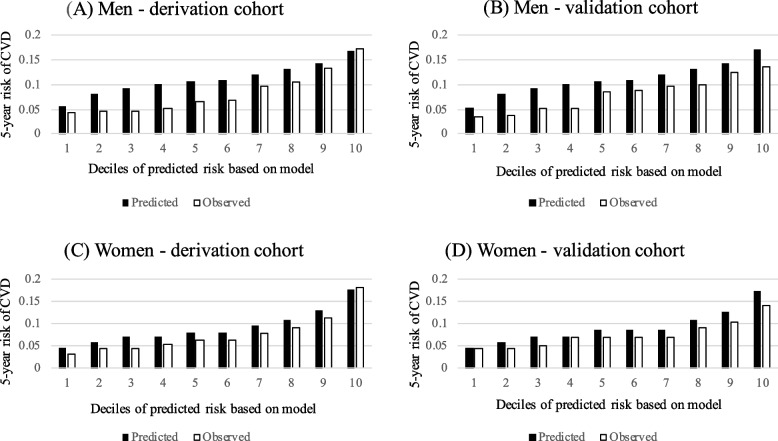
During a median follow-up period of 8.6 years for men and 8.5 years for women in the derivation cohort, MACE occurred in 3.62% of men and 3.02% of women. Predictors for men comprised advanced age, smoking, non-HDL-C levels > 160 mg/dL, metastatic cancer, and aspirin usage. Predictors for women included advanced age, smoking, atrial fibrillation, cancer, dementia, osteoarthritis, systemic lupus erythematosus, use of antihypertensives, and use of oral anticoagulants. In the validation cohort, the sex-specific risk assessment tool demonstrated fair discriminative power (AUC: men, 0.64; women, 0.68). Model calibration demonstrated good performance for women but was less optimal for men.
This sex-specific CV risk assessment tool shows fair discriminative capability in estimating risk of cardiovascular disease among elderly Asians, potentially enabling targeted interventions in this vulnerable population.
识别75岁及以上亚洲老年人的心血管(CV)危险因素,并随后开发和验证针对该人群的性别特异性五年心血管风险评估工具。
本研究纳入了台湾一家医院的12174例年龄≥75岁且无心血管疾病既往史的患者。电子健康记录与国民健康保险研究数据库和国家死亡登记处相链接,以确保全面的健康信息。符合条件的患者被随机分为推导队列(80%)和验证队列(20%)。使用Cox回归模型开发了一种性别特异性心血管风险评估工具,以预测主要不良心血管事件(MACE)。
在推导队列中,男性的中位随访期为8.6年,女性为8.5年,男性中3.62%发生了MACE,女性中3.02%发生了MACE。男性的预测因素包括高龄、吸烟、非高密度脂蛋白胆固醇(non-HDL-C)水平>160mg/dL、转移性癌症和阿司匹林使用情况。女性的预测因素包括高龄、吸烟、心房颤动、癌症、痴呆、骨关节炎、系统性红斑狼疮、使用抗高血压药物和使用口服抗凝剂。在验证队列中,性别特异性风险评估工具显示出中等的判别能力(曲线下面积:男性为0.64;女性为0.68)。模型校准显示女性的表现良好,但男性的表现欠佳。
这种性别特异性心血管风险评估工具在估计亚洲老年人心血管疾病风险方面显示出中等的判别能力,有可能对这一弱势群体进行有针对性的干预。