Budarick Aleksandra R, Hubley-Kozey Cheryl L, Li Linda C, Theou Olga, Stanish William D, Moyer Rebecca F
School of Physiotherapy, Dalhousie University, Halifax, Canada.
Department of Physical Therapy, University of British Columbia, Vancouver, Canada.
Musculoskeletal Care. 2025 Mar;23(1):e70047. doi: 10.1002/msc.70047.
To evaluate the quality and types of care individuals with mild-to-moderate knee osteoarthritis receive in the Canadian Maritime provinces, and determine associations with demographic, social, and patient-reported factors.
Individuals with knee osteoarthritis were invited to complete a healthcare quality survey based on the British Columbia Osteoarthritis (BC OA) survey. The cross-sectional descriptive observational survey assessed four healthcare quality indicators: advice to exercise, advice to lose weight, assessment of ambulatory function, and assessment of non-ambulatory function. Pass-rates were calculated overall and for each quality indicator. Binary logistic regressions determined associations between quality indicators and demographic, social, and patient-reported outcomes. Patient-reported use of exercise and diet as arthritis treatments were added to the quality indicator eligibility criteria as a sensitivity analysis.
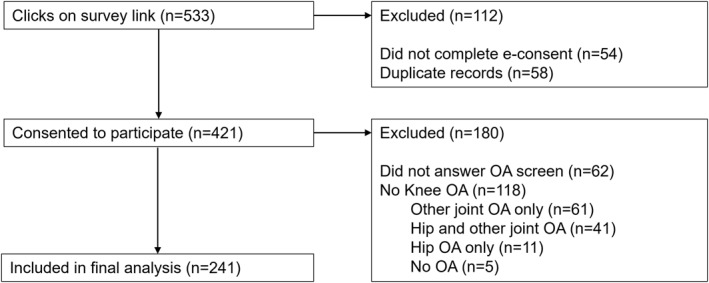
Participants (n = 241) had a mean age of 67 (7) years, body mass index of 30.7 (7.5) kg/m and were 77% female. The overall pass rate was 42.9% using the BC OA criteria, and 49.3% in the sensitivity analysis. Individual quality indicator pass-rates ranged from 4.3% for non-ambulatory function to 85.7% for ambulatory function assessments. The sensitivity analysis increased pass-rates for advice to exercise (61.9%-69.3%) and advice to lose weight (27.9%-35.1%). Pass-rates were not driven by demographic, social, or patient-reported factors.
Over half of individuals with mild-to-moderate knee osteoarthritis did not receive recommended core treatments in the Maritimes, highlighting a need to improve care for this patient group. Quality indicators should be routinely evaluated to determine whether clinical care aligns with best practice guidelines.
评估加拿大滨海诸省中轻度至中度膝骨关节炎患者所接受的护理质量和类型,并确定其与人口统计学、社会因素以及患者报告因素之间的关联。
邀请膝骨关节炎患者基于不列颠哥伦比亚省骨关节炎(BC OA)调查完成一项医疗质量调查。这项横断面描述性观察性调查评估了四项医疗质量指标:运动建议、减重建议、动态功能评估和静态功能评估。计算总体及每项质量指标的通过率。二元逻辑回归确定质量指标与人口统计学、社会因素以及患者报告结果之间的关联。作为敏感性分析,将患者报告的运动和饮食作为关节炎治疗方法的使用情况纳入质量指标合格标准。
参与者(n = 241)的平均年龄为67(7)岁,体重指数为30.7(7.5)kg/m²,女性占77%。按照BC OA标准,总体通过率为42.9%,敏感性分析中的通过率为49.3%。各个质量指标的通过率从静态功能评估的4.3%到动态功能评估的85.7%不等。敏感性分析提高了运动建议(61.9% - 69.3%)和减重建议(27.9% - 35.1%)的通过率。通过率并非由人口统计学、社会因素或患者报告因素所驱动。
在滨海诸省,超过半数的轻度至中度膝骨关节炎患者未接受推荐的核心治疗,这凸显了改善该患者群体护理的必要性。应定期评估质量指标,以确定临床护理是否符合最佳实践指南。