Skau Emma, Wagner Philippe, Leppert Jerzy, Ärnlöv Johan, Hedberg Pär
Centre for Clinical Research, Uppsala University, Västmanland County Hospital, Västerås, Sweden.
Department of Cardiology, Danderyd University Hospital, Stockholm, Sweden.
Ups J Med Sci. 2024 Dec 23;129. doi: 10.48101/ujms.v129.11001. eCollection 2024.
Growth differentiation factor 15 (GDF-15) is a robust prognostic biomarker in patients with cardiovascular (CV) disease, and a better understanding of its clinical determinants is desirable. We aimed to study the associations between GDF-15 levels and in outpatients with peripheral arterial disease (PAD).
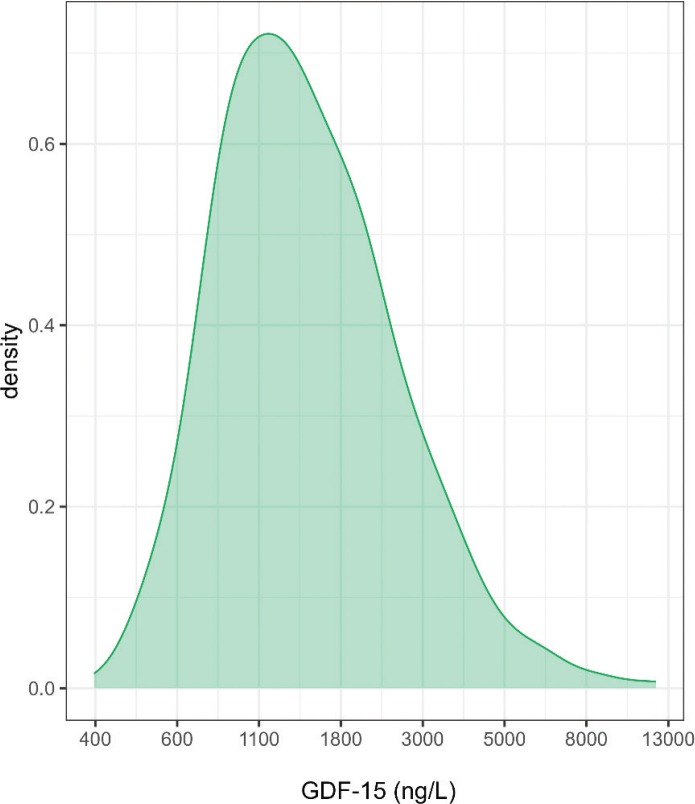
An explorative cross-sectional study (Study of Atherosclerosis in Vastmanland, Västerås, Sweden) included 439 outpatients with carotid or lower extremity PAD. The mean age was 70 years (standard deviation [SD] 7), and 59% of the patients were men. Plasma levels of GDF-15 were obtained along with potential determinants, including medical history, biochemical data, echocardiographic measures of cardiac geometry and function, ankle-brachial index (ABI), and carotid ultrasonographic data on intima-media thickness (IMT) and occurrence of carotid stenosis. The relations between GDF-15 concentrations (transformed with the natural logarithm) and the different determinants were evaluated using uni- and multivariable linear regression models. All pre-specified variables were included in the multivariable models.
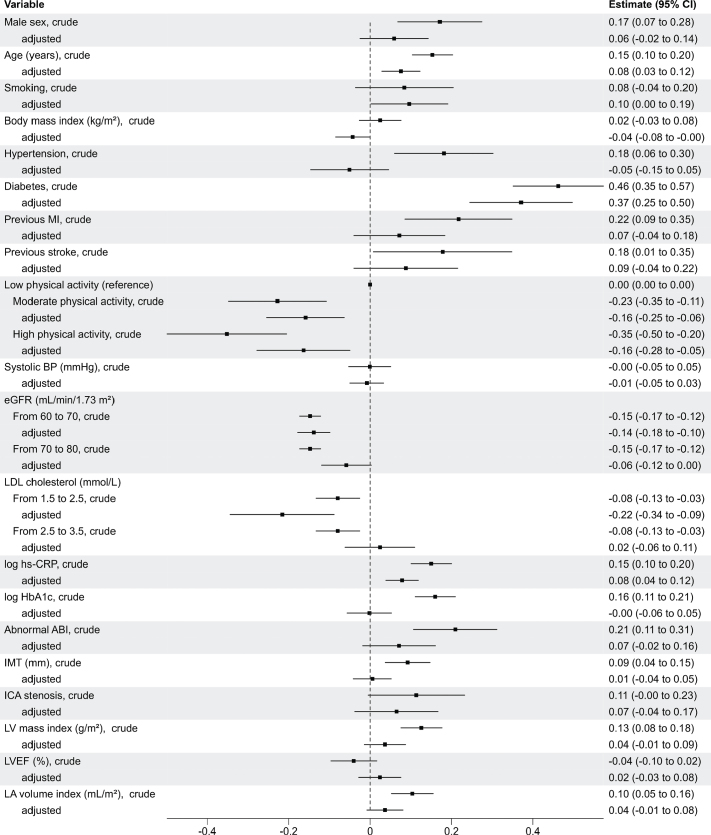
The multivariable analysis identified independent relations of GDF-15 with several of the included variables (adjusted = 0.48). Diabetes (beta coefficient [β] of 0.37, 95% confidence interval [95% CI] 0.25 to 0.50), low-density lipoprotein (LDL) cholesterol (β = -0.22, 95% confidence interval [CI]: -0.34 to -0.09), and physical activity (β = -0.16, 95% CI: -0.25 to -0.06) had the strongest associations. In contrast, no significant independent associations with GDF-15 level were observed for cardiac geometry and function, ABI, IMT, or carotid stenosis.
Circulating GDF-15 is more strongly associated with traditional CV risk factors, especially diabetes, LDL cholesterol, and physical activity than with specific indicators of atherosclerotic burden or cardiac dysfunction. To better understand the pathophysiological role of GDF-15 and its link to clinical outcomes in patients with PAD, future studies should focus on the metabolic processes involved in atherosclerotic disease.
生长分化因子15(GDF - 15)是心血管(CV)疾病患者中一种可靠的预后生物标志物,因此更好地了解其临床决定因素很有必要。我们旨在研究外周动脉疾病(PAD)门诊患者中GDF - 15水平与[此处原文缺失部分内容]之间的关联。
一项探索性横断面研究(瑞典韦斯特罗斯瓦斯曼兰地区动脉粥样硬化研究)纳入了439例患有颈动脉或下肢PAD的门诊患者。平均年龄为70岁(标准差[SD]7岁),59%的患者为男性。获取了GDF - 15的血浆水平以及潜在的决定因素,包括病史、生化数据、心脏几何形状和功能的超声心动图测量、踝臂指数(ABI)以及关于内膜中层厚度(IMT)和颈动脉狭窄发生情况的颈动脉超声数据。使用单变量和多变量线性回归模型评估GDF - 15浓度(用自然对数转换)与不同决定因素之间的关系。所有预先指定的变量都纳入多变量模型。
多变量分析确定了GDF - 15与几个纳入变量之间的独立关系(调整后的[此处原文缺失部分内容]=0.48)。糖尿病(β系数[β]为0.37,95%置信区间[95%CI]为0.25至0.50)、低密度脂蛋白(LDL)胆固醇(β = -0.22,95%置信区间[CI]:-0.34至-0.09)和身体活动(β = -0.16,95%CI:-0.25至-0.06)的关联最强。相比之下,未观察到心脏几何形状和功能、ABI、IMT或颈动脉狭窄与GDF - 15水平有显著的独立关联。
循环中的GDF - 15与传统心血管危险因素,尤其是糖尿病、LDL胆固醇和身体活动的关联比与动脉粥样硬化负担或心脏功能障碍的特定指标更强。为了更好地理解GDF - 15的病理生理作用及其与PAD患者临床结局的联系,未来的研究应关注动脉粥样硬化疾病中涉及的代谢过程。