Chuang Wan-Chi, Chu Chih-Hsun, Yao Cai-Sin, Wei Mei-Chih, Hsieh I-Lun, Liao Chia-Mei
Kaohsiung Veterans General Hospital, Kaohsiung City, Taiwan.
Diabetol Metab Syndr. 2025 Jan 23;17(1):31. doi: 10.1186/s13098-025-01588-w.
Growth differentiation factor 15 (GDF15) is significantly correlated with glycolipid metabolic disorders. Increased GDF15 levels are associated with obesity, insulin resistance, and diabetes as well as a poorer diabetes progression and prognosis. This is a prospective cohort study investigated the association between circulating GDF15 and diabetic peripheral artery disease.
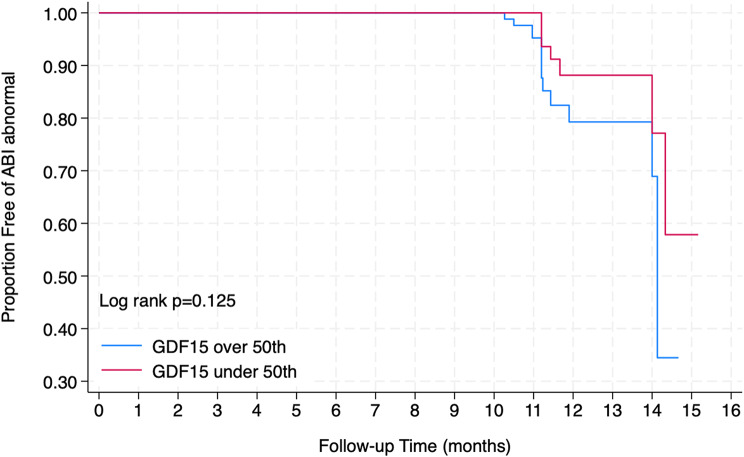
A total of 174 diabetic patients aged 20-80 were enrolled. Plasma GDF15 levels were measured using ELISA. Peripheral Artery Disease (PAD) was evaluated with the Ankle brachial index (ABI) and the Cardio-ankle vascular index (CAVI).
We found that diabetic patients with higher serum GDF15 levels (mean: 2521.5 pg/mL) had a higher incidence of peripheral artery disease. Multivariate logistic regression analysis indicated that patients with high serum GDF15 levels were at an increased risk of developing peripheral artery disease. High GDF15 levels were associated with ABI < 0.9 (right and left mean 19.5% p = 0.80, OR:1.13; 95%CI: [0.44-2.90]). Increased age (p = 0.025 OR:1.02; 95% CI [0.13-0.87]), family history (p = 0.001 OR:1.37; 95%CI: [0.37-5.05]), heart failure (p = 0.002 OR:4.96; 95%CI: [1.76-13.97]), sodium-glucose linked transporter 2 (SGLT 2) inhibitor use (p = 0.026), estimated glomerular filtration rate (eGFR) (p = < 0.001), and uric acid (p = < 0.001) was also positively associated with high GDF15 levels. Urine albumin-to-creatinine ratio (UACR) (p = < 0.010) was associated with higher GDF15 levels after one year of follow up.
Elevated GDF15 was significantly associated with worsening metabolic parameters and an increased risk of peripheral artery disease. Thus, it may be a stronger predictor of these outcomes in people with diabetes.
生长分化因子15(GDF15)与糖脂代谢紊乱显著相关。GDF15水平升高与肥胖、胰岛素抵抗、糖尿病以及较差的糖尿病进展和预后相关。这是一项前瞻性队列研究,旨在调查循环GDF15与糖尿病外周动脉疾病之间的关联。
共纳入174例年龄在20 - 80岁的糖尿病患者。采用酶联免疫吸附测定法(ELISA)测量血浆GDF15水平。使用踝臂指数(ABI)和心踝血管指数(CAVI)评估外周动脉疾病(PAD)。
我们发现血清GDF15水平较高(平均:2521.5 pg/mL)的糖尿病患者外周动脉疾病的发病率较高。多因素逻辑回归分析表明,血清GDF15水平高的患者发生外周动脉疾病的风险增加。高GDF15水平与ABI < 0.9相关(左右平均19.5%,p = 0.80,OR:1.13;95%CI:[0.44 - 2.90])。年龄增加(p = 0.025,OR:1.02;95%CI [0.13 - 0.87])、家族病史(p = 0.001,OR:1.37;95%CI:[0.37 - 5.05])、心力衰竭(p = 0.002,OR:4.96;95%CI:[1.76 - 13.97])、使用钠-葡萄糖协同转运蛋白2(SGLT 2)抑制剂(p = 0.026)、估计肾小球滤过率(eGFR)(p = < 0.001)和尿酸(p = < 0.001)也与高GDF15水平呈正相关。随访一年后,尿白蛋白与肌酐比值(UACR)(p = < 0.010)与较高的GDF15水平相关。
GDF15升高与代谢参数恶化和外周动脉疾病风险增加显著相关。因此,它可能是糖尿病患者这些结局的更强预测指标。