Giangregorio Aidan, Wang Li, Sprague Sheila, Arbus Michelle, Busse Jason W
The Michael G. DeGroote School of Business, McMaster University.
Department of Anesthesia, McMaster University.
Cannabis. 2024 Dec 12;7(3):167-176. doi: 10.26828/cannabis/2024/000259. eCollection 2024.
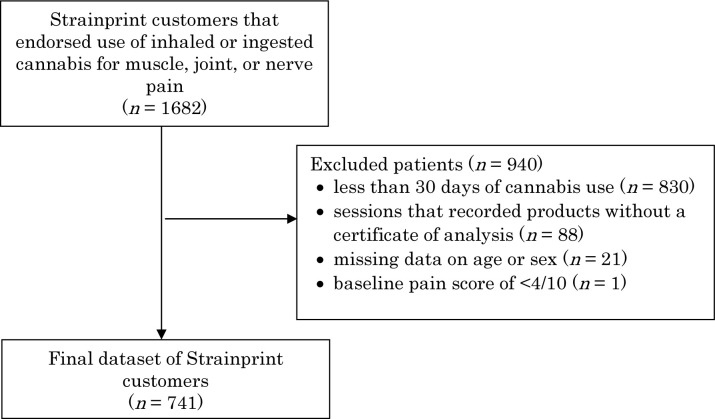
People living with chronic pain increasingly use medical cannabis for symptom relief. We conducted a retrospective cohort study examining cannabis for chronic pain relief using anonymous archival data obtained from the medicinal cannabis tracking app, Strainprint®.
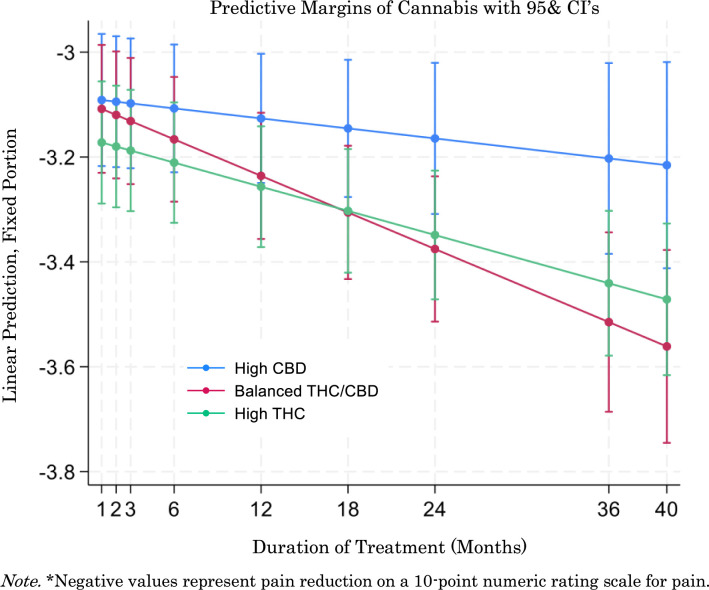
We acquired cannabis utilization data from 741 adults with chronic pain and used multilevel modeling to examine the association of age, sex, type of pain (muscle, joint or nerve pain), cannabis formulation (high CBD, balanced CBD:THC, or high THC), route of administration (inhaled or ingested), cannabis use before vs. during the COVID-19 pandemic, and duration of cannabis use, with pain relief.
Most patients were female ( = 464; 63%), with a mean age of 39 ( = 11), and our cohort had completed a total of 83,622 tracked cannabis sessions through Strainprint. The majority of sessions reported use of inhaled cannabis products (78%), typically with high tetrahydrocannabinol (THC; 64%) versus high cannabidiol (CBD; 15%) or balanced THC:CBD (21%) products. The median change in pain scores across sessions was -3.0 points on a 10-point numeric rating scale (NRS; -4.5 to -2.0). In our adjusted model, greater pain relief was associated with male vs. female sex (-0.69 points on a 10-point NRS; 95%CI -0.46 to -0.91). We found statistically significant, but trivial associations with joint pain (-0.05 points), balanced THC:CBD products in the long term (-0.003 points), and cannabis use during the pandemic (0.18 points).
We found that people living with chronic pain report important pain relief when using cannabis for medical purposes, and that men may achieve greater pain relief than women.
慢性疼痛患者越来越多地使用医用大麻来缓解症状。我们进行了一项回顾性队列研究,使用从医用大麻追踪应用程序Strainprint®获得的匿名档案数据,研究大麻对慢性疼痛的缓解作用。
我们收集了741名慢性疼痛成年人的大麻使用数据,并使用多层模型来研究年龄、性别、疼痛类型(肌肉、关节或神经疼痛)、大麻配方(高CBD、CBD:THC平衡或高THC)、给药途径(吸入或口服)、COVID-19大流行之前与期间的大麻使用情况以及大麻使用持续时间与疼痛缓解之间的关联。
大多数患者为女性(n = 464;63%),平均年龄为39岁(SD = 11),我们的队列通过Strainprint总共完成了83,622次追踪大麻使用记录。大多数记录报告使用吸入式大麻产品(78%),通常使用高四氢大麻酚(THC;64%)产品,而高大麻二酚(CBD;15%)或THC:CBD平衡(21%)产品的使用较少。在10分数字评分量表(NRS)上,各记录期间疼痛评分的中位数变化为-3.0分(IQR -4.5至-2.0)。在我们的校正模型中,男性相比女性有更大程度的疼痛缓解(在10分NRS上为-0.69分;95%CI -0.46至-0.91)。我们发现与关节疼痛(-0.05分)、长期使用THC:CBD平衡产品(-0.003分)以及大流行期间使用大麻(0.18分)存在统计学上显著但微小的关联。
我们发现,慢性疼痛患者报告在将大麻用于医疗目的时疼痛得到了显著缓解,并且男性可能比女性获得更大程度的疼痛缓解。