NICM Health Research Institute, Western Sydney University, Sydney, NSW, Australia.
Bristol Trials Centre, University of Bristol, Bristol, United Kingdom.
PLoS One. 2021 Oct 26;16(10):e0258940. doi: 10.1371/journal.pone.0258940. eCollection 2021.
The use of cannabis for symptoms of endometriosis was investigated utilising retrospective archival data from Strainprint Technologies Ltd., a Canadian data technology company with a mobile phone application that tracks a range of data including dose, mode of administration, chemovar and their effects on various self-reported outcomes, including pelvic pain.
A retrospective, electronic record-based cohort study of StrainprintTM users with self-reported endometriosis was conducted. Self-rated cannabis efficacy, defined as a function of initial and final symptom ratings, was investigated across the included symptom clusters of cramps, pelvic pain, gastrointestinal pain, nausea, depression, and low libido. Cannabis dosage form, dose and cannabinoid ratio information was also recorded.
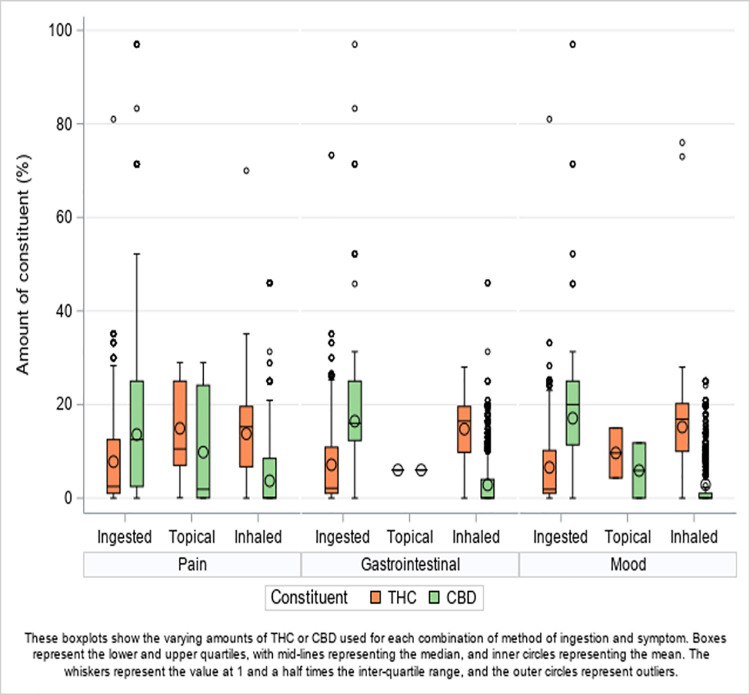
A total number of 252 participants identifying as suffering endometriosis recorded 16193 sessions using cannabis between April 2017 and February 2020. The most common method of ingestion was inhalation (n = 10914, 67.4%), with pain as the most common reported symptom being treated by cannabis (n = 9281, 57.3%). Gastrointestinal symptoms, though a less common reason for cannabis usage (15.2%), had the greatest self-reported improvement after use. Inhaled forms had higher efficacy for pain, while oral forms were superior for mood and gastrointestinal symptoms. Dosage varied across ingestion methods, with a median dose of 9 inhalations (IQR 5 to 11) for inhaled dosage forms and 1 mg/mL (IQR 0.5 to 2) for other ingested dosage forms. The ratio of THC to CBD had a statistically significant, yet clinically small, differential effect on efficacy, depending on method of ingestion.
Cannabis appears to be effective for pelvic pain, gastrointestinal issues and mood, with effectiveness differing based on method of ingestion. The greater propensity for use of an inhaled dosage delivery may be due to the rapid onset of pain-relieving effects versus the slower onset of oral products. Oral forms appeared to be superior compared to inhaled forms in the less commonly reported mood or gastrointestinal categories. Clinical trials investigating the tolerability and effectiveness of cannabis for endometriosis pain and associated symptoms are urgently required.
利用加拿大数据技术公司 Strainprint Technologies Ltd. 的回顾性档案数据,研究了大麻治疗子宫内膜异位症症状的情况。该公司拥有一款手机应用程序,可以跟踪包括剂量、给药方式、化学变种及其对各种自我报告结果(包括盆腔疼痛)的影响在内的一系列数据。
对使用 StrainprintTM 并自我报告患有子宫内膜异位症的用户进行了回顾性、基于电子记录的队列研究。自我评估的大麻疗效,定义为初始和最终症状评分的函数,在包括痉挛、盆腔疼痛、胃肠道疼痛、恶心、抑郁和低性欲在内的纳入症状群中进行了调查。还记录了大麻剂型、剂量和大麻素比例信息。
2017 年 4 月至 2020 年 2 月期间,共有 252 名自我报告患有子宫内膜异位症的参与者使用大麻记录了 16193 次。最常见的摄入方式是吸入(n = 10914,67.4%),大麻治疗的最常见报告症状是疼痛(n = 9281,57.3%)。胃肠道症状虽然是使用大麻的较少见原因(15.2%),但使用后自我报告的改善最大。吸入形式对疼痛的疗效更高,而口服形式对情绪和胃肠道症状的疗效更好。不同摄入方式的剂量不同,吸入剂型的中位数剂量为 9 次吸入(IQR 5 至 11),其他摄入剂型的中位数剂量为 1 mg/mL(IQR 0.5 至 2)。根据摄入方式,THC 与 CBD 的比例对疗效有统计学上显著但临床意义较小的差异。
大麻似乎对盆腔疼痛、胃肠道问题和情绪有效,疗效因摄入方式而异。吸入剂型更受欢迎可能是因为其缓解疼痛的效果更快,而口服产品的效果较慢。与吸入剂型相比,口服剂型在较少报告的情绪或胃肠道类别中似乎更有效。迫切需要进行临床试验,以调查大麻治疗子宫内膜异位症疼痛和相关症状的耐受性和有效性。