• 文献检索
  • 文档翻译
  • 深度研究
  • 学术资讯
  • Suppr Zotero 插件Zotero 插件
  • 邀请有礼
  • 套餐&价格
  • 历史记录
应用&插件
Suppr Zotero 插件Zotero 插件浏览器插件Mac 客户端Windows 客户端微信小程序
定价
高级版会员购买积分包购买API积分包
服务
文献检索文档翻译深度研究API 文档MCP 服务
关于我们
关于 Suppr公司介绍联系我们用户协议隐私条款
关注我们

Suppr 超能文献

核心技术专利:CN118964589B侵权必究
粤ICP备2023148730 号-1Suppr @ 2026

文献检索

告别复杂PubMed语法,用中文像聊天一样搜索,搜遍4000万医学文献。AI智能推荐,让科研检索更轻松。

立即免费搜索

文件翻译

保留排版,准确专业,支持PDF/Word/PPT等文件格式,支持 12+语言互译。

免费翻译文档

深度研究

AI帮你快速写综述,25分钟生成高质量综述,智能提取关键信息,辅助科研写作。

立即免费体验

并非写在脸上:在疼痛门诊会诊与访谈中将慢性疼痛建构为无形

It's Not Written All Over My Face: Constructing Chronic Pain as Invisible in Pain Clinic Consultations and Interviews.

作者信息

Declercq Jana

机构信息

Department of Linguistics, University of Antwerp, Antwerp, Belgium.

出版信息

Clin J Pain. 2025 Mar 1;41(3):e1273. doi: 10.1097/AJP.0000000000001273.

DOI:10.1097/AJP.0000000000001273
PMID:39782005
原文链接:https://pmc.ncbi.nlm.nih.gov/articles/PMC11801457/
Abstract

OBJECTIVES

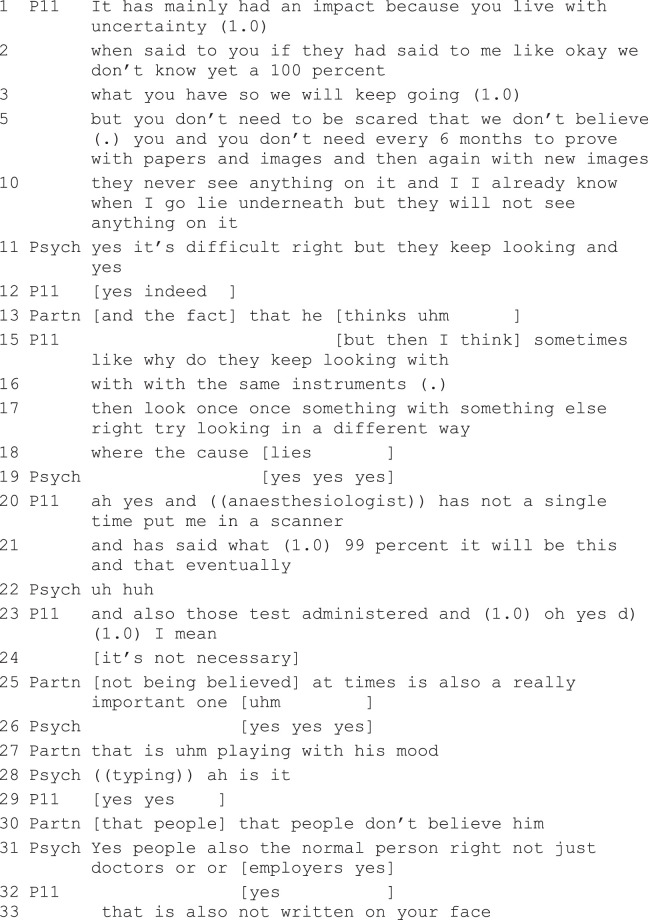
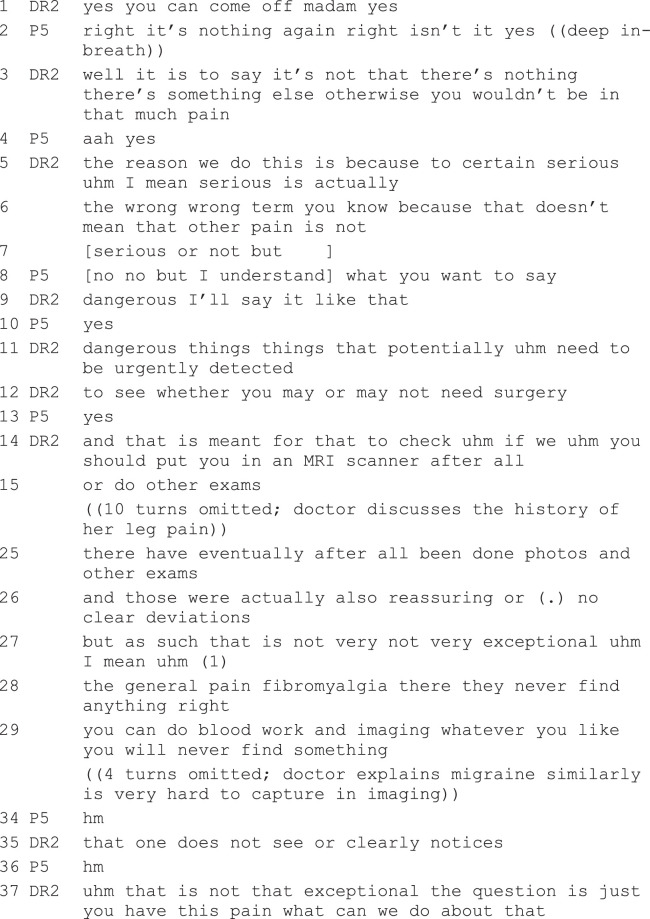
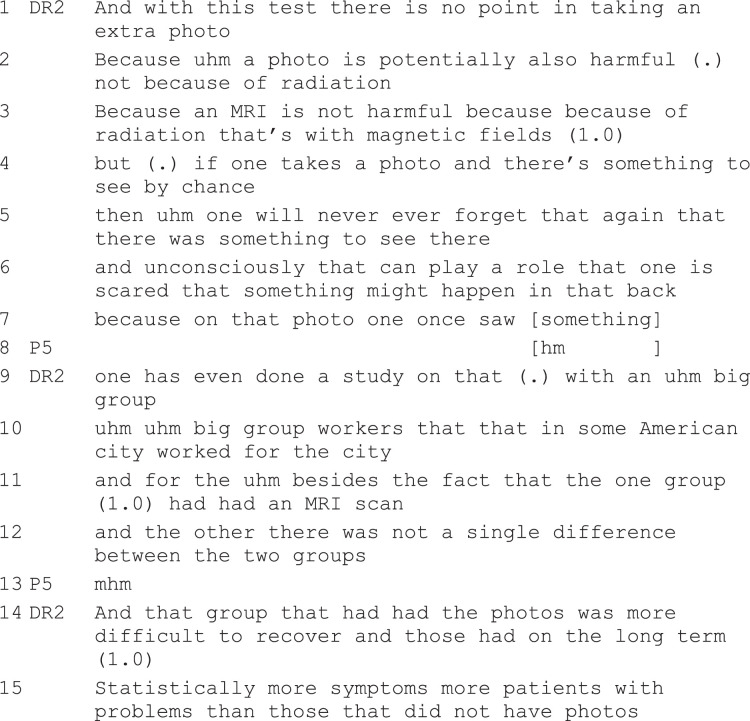
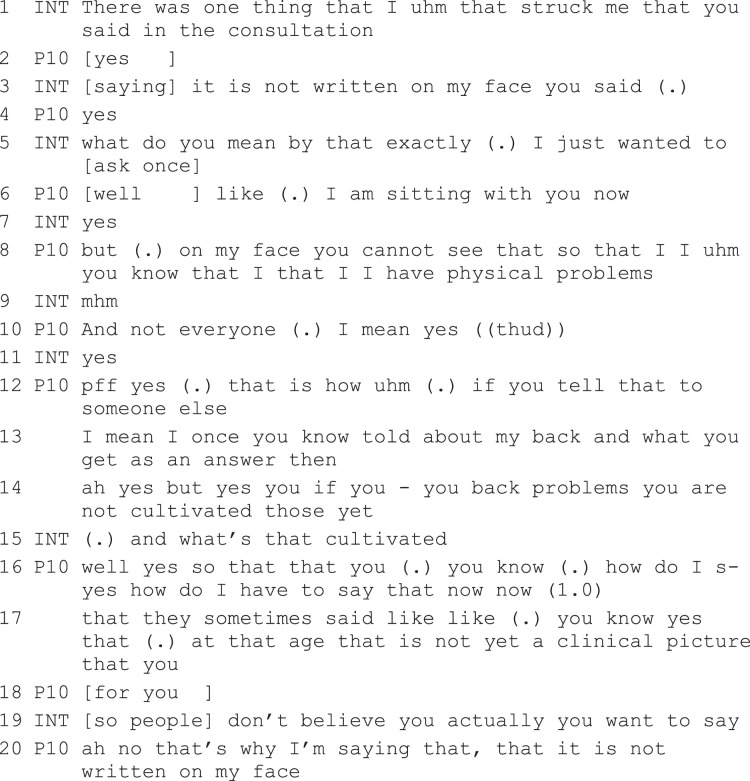
Historically in medicine and beyond, the understanding of and treatment of pain is based on finding tissue injury. The fact that for chronic pain, there often is no (longer) any traceable tissue injury, in combination with the fact that pain essentially is a private experience, poses a challenge for clinical communication. This paper therefore examines how pain is linguistically and interactionally constructed as invisible.

MATERIALS AND METHODS

The qualitative approach of interactional sociolinguistic analysis is used to analyze 37 consultations and 11 semistructured interviews with patients with chronic pain, collected at a Belgian pain clinic. This fine-grained approach to studying communication provides an in-depth empirical understanding of the phenomenon under scrutiny.

RESULTS

The data show that pain is constructed as invisible on several levels: (1) on the biomechanical and clinical level, in terms of its lack of visible or traceable tissue injury, (2) on the level of interaction, as pain needs to be made apparent to other people through pain displays, and (3) on the social level, as chronic pain often is not visible or apparent in society more broadly.

CONCLUSION

The discussion explores how on these 3 levels, notions of the abnormal or deviant body come into play, in which patients and health professionals complexly construct pain both as not normal (i.e., not a neutral or desirable state of being), whereas, at the same time, the lack of traceable tissue injury is constructed as medically normal for chronic pain. This also relates to how patients and health care providers often orient to the stigma around chronic pain.

摘要

目的

在医学及其他领域的历史上,对疼痛的理解和治疗基于发现组织损伤。对于慢性疼痛而言,通常不再存在任何可追溯的组织损伤这一事实,加之疼痛本质上是一种个人体验,给临床交流带来了挑战。因此,本文探讨疼痛如何在语言和互动中被建构为无形的。

材料与方法

采用互动社会语言学分析的定性方法,对在比利时一家疼痛诊所收集的37次会诊以及11次对慢性疼痛患者的半结构化访谈进行分析。这种对交流进行细致研究的方法能对所研究的现象提供深入的实证理解。

结果

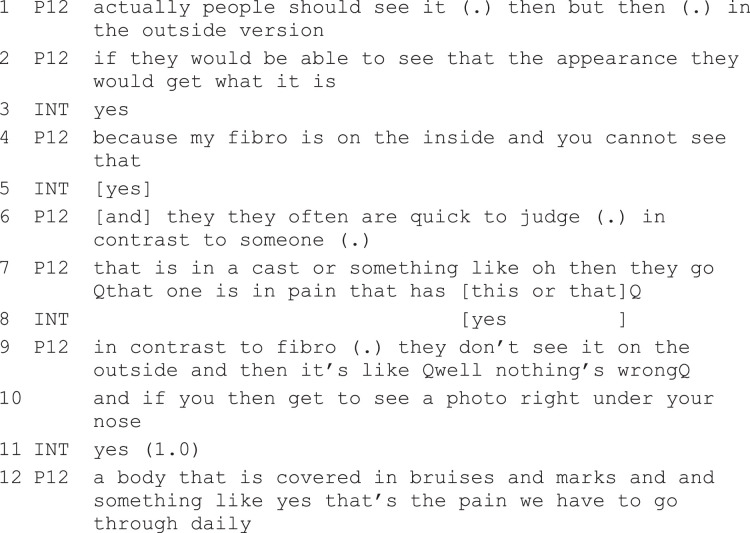
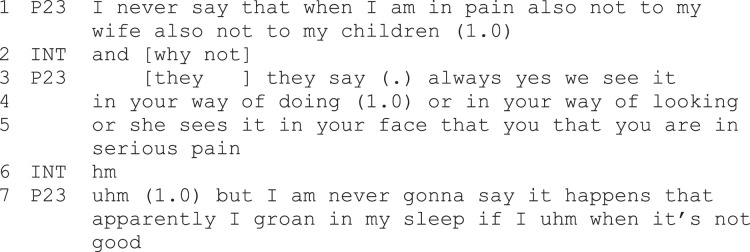
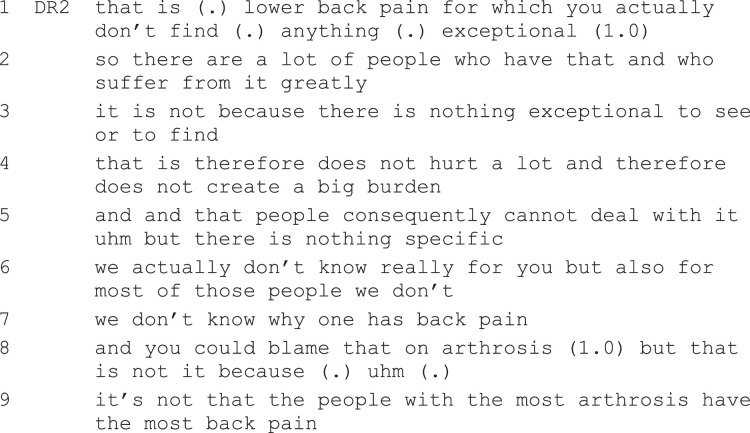
数据表明,疼痛在几个层面上被建构为无形的:(1)在生物力学和临床层面,因其缺乏可见或可追溯的组织损伤;(2)在互动层面,因为疼痛需要通过疼痛表现向他人显现出来;(3)在社会层面,因为慢性疼痛在更广泛的社会中通常不可见或不明显。

结论

讨论探讨了在这三个层面上,异常或偏离正常的身体观念是如何发挥作用的,患者和健康专业人员如何复杂地将疼痛建构为不正常的(即不是一种中性或理想的存在状态),而与此同时,缺乏可追溯的组织损伤对于慢性疼痛而言在医学上却被建构为正常的。这也涉及到患者和医疗服务提供者如何常常面对围绕慢性疼痛的污名化问题。
https://cdn.ncbi.nlm.nih.gov/pmc/blobs/0153/11801457/b2eaa86d49b1/ajp-41-e1273-g008.jpg
https://cdn.ncbi.nlm.nih.gov/pmc/blobs/0153/11801457/e0af348abbb6/ajp-41-e1273-g001.jpg
https://cdn.ncbi.nlm.nih.gov/pmc/blobs/0153/11801457/7657bb9d5abe/ajp-41-e1273-g002.jpg
https://cdn.ncbi.nlm.nih.gov/pmc/blobs/0153/11801457/6f5a474c702a/ajp-41-e1273-g003.jpg
https://cdn.ncbi.nlm.nih.gov/pmc/blobs/0153/11801457/de408fc2c67e/ajp-41-e1273-g004.jpg
https://cdn.ncbi.nlm.nih.gov/pmc/blobs/0153/11801457/9f7acef31ba0/ajp-41-e1273-g005.jpg
https://cdn.ncbi.nlm.nih.gov/pmc/blobs/0153/11801457/e006219025bf/ajp-41-e1273-g006.jpg
https://cdn.ncbi.nlm.nih.gov/pmc/blobs/0153/11801457/f1aae668a4a0/ajp-41-e1273-g007.jpg
https://cdn.ncbi.nlm.nih.gov/pmc/blobs/0153/11801457/b2eaa86d49b1/ajp-41-e1273-g008.jpg
https://cdn.ncbi.nlm.nih.gov/pmc/blobs/0153/11801457/e0af348abbb6/ajp-41-e1273-g001.jpg
https://cdn.ncbi.nlm.nih.gov/pmc/blobs/0153/11801457/7657bb9d5abe/ajp-41-e1273-g002.jpg
https://cdn.ncbi.nlm.nih.gov/pmc/blobs/0153/11801457/6f5a474c702a/ajp-41-e1273-g003.jpg
https://cdn.ncbi.nlm.nih.gov/pmc/blobs/0153/11801457/de408fc2c67e/ajp-41-e1273-g004.jpg
https://cdn.ncbi.nlm.nih.gov/pmc/blobs/0153/11801457/9f7acef31ba0/ajp-41-e1273-g005.jpg
https://cdn.ncbi.nlm.nih.gov/pmc/blobs/0153/11801457/e006219025bf/ajp-41-e1273-g006.jpg
https://cdn.ncbi.nlm.nih.gov/pmc/blobs/0153/11801457/f1aae668a4a0/ajp-41-e1273-g007.jpg
https://cdn.ncbi.nlm.nih.gov/pmc/blobs/0153/11801457/b2eaa86d49b1/ajp-41-e1273-g008.jpg

相似文献

1
It's Not Written All Over My Face: Constructing Chronic Pain as Invisible in Pain Clinic Consultations and Interviews.并非写在脸上:在疼痛门诊会诊与访谈中将慢性疼痛建构为无形
Clin J Pain. 2025 Mar 1;41(3):e1273. doi: 10.1097/AJP.0000000000001273.
2
'Treated as a number, not treated as a person': a qualitative exploration of the perceived barriers to effective pain management of patients with chronic pain.“被当作数字,而非当作人来对待”:对慢性疼痛患者有效疼痛管理中感知到的障碍的质性探索
BMJ Open. 2017 Jun 12;7(6):e016454. doi: 10.1136/bmjopen-2017-016454.
3
A Comparison of Expectations of Physicians and Patients with Chronic Pain for Pain Clinic Visits.慢性疼痛患者与医生对疼痛门诊就诊期望的比较
Pain Pract. 2017 Mar;17(3):305-311. doi: 10.1111/papr.12428. Epub 2016 Mar 15.
4
Duration of opening statement of patients attending a chronic pain clinic consultation.慢性疼痛门诊咨询患者开场陈述的时长。
Ir J Med Sci. 2019 Feb;188(1):273-275. doi: 10.1007/s11845-018-1834-x. Epub 2018 May 19.
5
Communicating about opioids for chronic pain: a qualitative study of patient attributions and the influence of the patient-physician relationship.关于慢性疼痛的阿片类药物沟通:一项关于患者归因及医患关系影响的定性研究
Eur J Pain. 2014 Jul;18(6):835-43. doi: 10.1002/j.1532-2149.2013.00426.x. Epub 2013 Nov 25.
6
'Talk to us like we're people, not an X-ray': the experience of receiving care for chronic pain.“像对待人一样和我们交谈,而不是把我们当成一张X光片”:慢性疼痛患者接受治疗的经历
Aust J Prim Health. 2013;19(2):138-43. doi: 10.1071/PY11154.
7
Improving GP communication in consultations on medically unexplained symptoms: a qualitative interview study with patients in primary care.改善全科医生在对无法解释的医学症状进行咨询时的沟通:一项对初级保健患者的定性访谈研究。
Br J Gen Pract. 2017 Oct;67(663):e716-e723. doi: 10.3399/bjgp17X692537. Epub 2017 Aug 28.
8
Talking about chronic pain: Misalignment in discussions of the body, mind and social aspects in pain clinic consultations.探讨慢性疼痛:疼痛门诊咨询中身体、心理和社会方面讨论的失调。
Health (London). 2023 May;27(3):378-397. doi: 10.1177/13634593211032875. Epub 2021 Jul 22.
9
Uncovering communication strategies used in language-discordant consultations with people who are migrants: Qualitative interviews with healthcare providers.揭示与移民人群进行语言交流障碍咨询时所使用的沟通策略:对医疗保健提供者的定性访谈。
Health Expect. 2024 Feb;27(1):e13949. doi: 10.1111/hex.13949.
10
"I'm Not Gonna Pull the Rug out From Under You": Patient-Provider Communication About Opioid Tapering.“我不会釜底抽薪的”:阿片类药物逐渐减量过程中医患沟通。
J Pain. 2017 Nov;18(11):1365-1373. doi: 10.1016/j.jpain.2017.06.008. Epub 2017 Jul 8.

本文引用的文献

1
Talking about chronic pain in family settings: a glimpse of older persons' everyday realities.在家庭环境中谈论慢性疼痛:老年人日常生活一瞥。
BMC Geriatr. 2022 Apr 23;22(1):358. doi: 10.1186/s12877-022-03058-8.
2
"I would not go to him": Focus groups exploring community responses to a public health campaign aimed at reducing unnecessary diagnostic imaging of low back pain.“我不会去找他”:探讨社区对一项旨在减少低腰背痛不必要诊断性影像学检查的公共卫生运动的反应的焦点小组。
Health Expect. 2021 Apr;24(2):648-658. doi: 10.1111/hex.13211. Epub 2021 Feb 18.
3
How General Practitioners Raise Psychosocial Concerns as a Potential Cause of Medically Unexplained Symptoms: A Conversation Analysis.
全科医生如何提出心理社会问题作为医学无法解释症状的潜在原因:会话分析。
Health Commun. 2022 May;37(6):696-707. doi: 10.1080/10410236.2020.1864888. Epub 2021 Jan 13.
4
Painful metaphors: enactivism and art in qualitative research.痛苦的隐喻:质性研究中的具身认知论与艺术
Med Humanit. 2020 Oct 19. doi: 10.1136/medhum-2020-011874.
5
Clinician and patient beliefs about diagnostic imaging for low back pain: a systematic qualitative evidence synthesis.临床医生和患者对腰痛诊断性影像学检查的看法:一项系统性定性证据综合分析
BMJ Open. 2020 Aug 23;10(8):e037820. doi: 10.1136/bmjopen-2020-037820.
6
The Multimodal Assessment Model of Pain: A Novel Framework for Further Integrating the Subjective Pain Experience Within Research and Practice.多模态疼痛评估模型:进一步将主观疼痛体验整合到研究和实践中的新框架。
Clin J Pain. 2019 Mar;35(3):212-221. doi: 10.1097/AJP.0000000000000670.
7
Defining and Measuring Diagnostic Uncertainty in Medicine: A Systematic Review.医学中诊断不确定性的定义和测量:系统评价。
J Gen Intern Med. 2018 Jan;33(1):103-115. doi: 10.1007/s11606-017-4164-1. Epub 2017 Sep 21.
8
Invisible people with invisible pain: A commentary on "Even my sister says I'm acting like a crazy to get a check": Race, gender, and moral boundary-work in women's claims of disabling chronic pain.隐形的痛苦,隐形的人:评“连我姐姐都说我为了领救济金装疯卖傻”:女性声称患有致残性慢性疼痛时的种族、性别和道德边界工作。
Soc Sci Med. 2017 Sep;189:152-154. doi: 10.1016/j.socscimed.2017.06.009. Epub 2017 Jun 10.
9
Pain, objectivity and history: understanding pain stigma.疼痛、客观性与历史:理解疼痛污名
Med Humanit. 2017 Dec;43(4):238-243. doi: 10.1136/medhum-2016-011133. Epub 2017 Feb 21.
10
Biopsychosocial model of disease: 40 years on. Which way is the pendulum swinging?疾病的生物心理社会模型:40年过去了。钟摆向何方摆动?
Br J Sports Med. 2017 Aug;51(16):1187-1188. doi: 10.1136/bjsports-2016-097362. Epub 2017 Jan 6.